More caribou dying in highway collisions
The number of caribou killed on the highway east of Teslin to Watson Lake this winter is about double the average, says Environment Yukon biologist Al Fontaine.
By Chuck Tobin on March 4, 2013
The number of caribou killed on the highway east of Teslin to Watson Lake this winter is about double the average, says Environment Yukon biologist Al Fontaine.
Fontaine said half of the 21 highway mortalities have occurred in a seven-kilometre stretch just east of Watson Lake in the area of Lucky Lake.
Efforts are ongoing to caution motorists about the possibility of encountering wildlife on Yukon highways, he said.
The regional biologist for the Liard district said in addition to the 21 northern mountain caribou killed on the highway in his district, he knows of two others hit closer to Teslin and three in the Southern Lakes area, for a total of 26 confirmed.
The caribou killed in his district, he said, belong to three herds: the Swan Lake herd ranging from Teslin west to the primary range of the Little Rancheria herd and the Horse Ranch herd, whose range overlaps the Little Rancheria area.
The Swan Lake herd is estimated at 400 caribou, Little Rancheria is estimated at 1,000, and the Horse Ranch herd is estimated at 600.
Fontaine said all three herds spend the summer and early fall in northern B.C, but their winter ranges overlap the Yukon and B.C. border.
"The highway crosses through their winter range.”
He said highway mortality usually begins in November, though the timing of the caribou moving into their winter range is influenced largely by the weather.
The first caribou killed this year in the Liard district was killed last Oct. 29, and those most recent was over the weekend, he said.
Fontaine said he doesn't have any explanation regarding this winter's high rate of mortality from highway collisions.
The Department of Highways and Public Works has not changed anything with its sand and salt mixture, he said.
And while the early winter had an above average snowfall, he added, there's nothing that stands out about this winter that would push them out to the highway.
He is a relative newcomer to the position, Fontaine explained. His technician has chatted with others in the region and other biologists over time.
There's some speculation, though there is no scientific proof, that the caribou have shifted their use of the winter range, which has brought them closer to the highway and closer to a source of salt, he said.
"I know for Lucky Lake, if you were to talk to the biologist 10 or 12 years ago, he would say a lot has changed.”
Fontaine said there is also the public awareness campaign that has been intensified over recent years which may account for an increase in the number of road kills being reported by motorists.
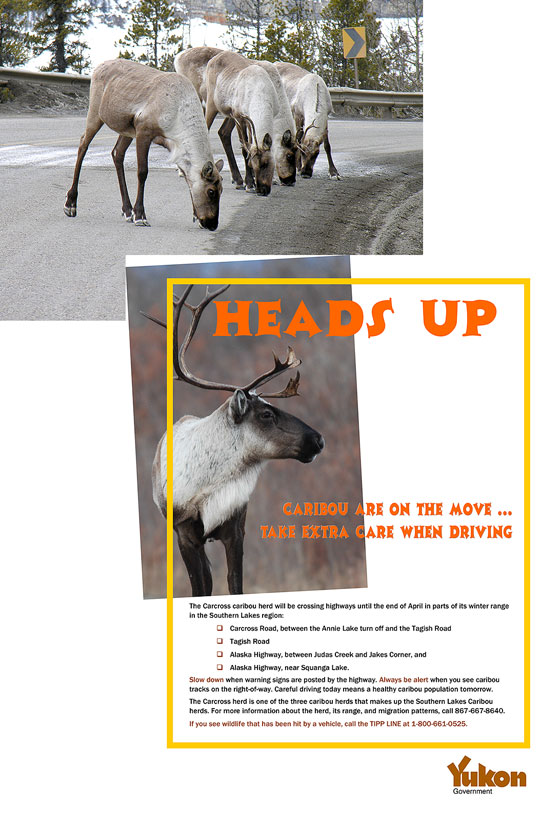
Posters cautioning motorists about caribou on the highway have been posted on both sides of the Lucky Lake area, another leaving Watson Lake on the way to Whitehorse and at the Watson Lake and Whitehorse weigh scales.
They have also been put up in local Watson Lake businesses, he said.
"These posters are to educate the public to slow down, and to always be alert when they see caribou tracks in the snow along the highway right-of-way.”
Fontaine said he's not aware of any motorists reporting injuries related to collisions with caribou.
A large majority of calls they receive are from motorists reporting animals lying by the highway after they've been hit, he said.
He said there is no concrete evidence regarding the type of vehicles that are involved.
Fontaine pointed out, however, conservation officers who recover the carcasses take note of any vehicle debris they find at the scene.
Items like busted headlights would suggest a collision with a smaller passenger vehicle, while no debris suggests a collision with a heavier transport truck, he said.
Fontaine said a lot of the collisions this winter appear to have been with transport vehicles.
Recovered carcasses are distributed for human consumption if the condition of the animal is suitable. Otherwise, the carcasses are given to trappers for use as bait or dog owners for dog food, he explained.
Fontaine said there have been six moose killed by highway collisions in his district since the beginning of October 2012.
The movement of moose, he said, is not influenced by migration patterns between summer and winter ranges like the caribou are.
Be the first to comment