‘Monumental' child welfare agreement signed
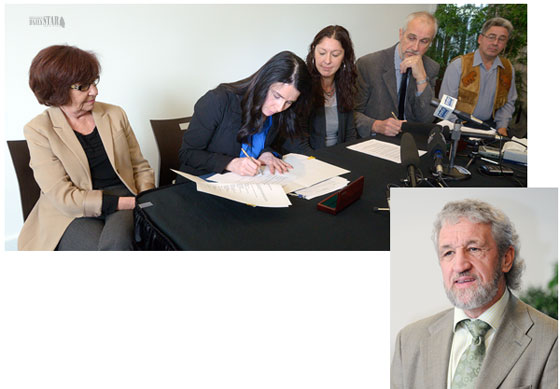
The Kwanlin Dun First Nation and the Yukon government have signed a new child welfare partnership agreement.
By Ainslie Cruickshank on October 5, 2012
The Kwanlin Dun First Nation and the Yukon government have signed a new child welfare partnership agreement.
Thursday afternoon's formal signing came two years after the First Nation banned government social workers from entering its territory.
"The agreement is about setting down procedures for social workers when they come into our community, how they come into our community and basically how Kwanlin Dun is going to be involved with those interactions,” Jeanie Dendys, Kwanlin Dun's director of justice, told a news conference held for the agreement's signing.
Over the course of the agreement's development, which has taken about two years, Dendys said there have been few incidents where social workers have interacted with Kwanlin Dun citizens without the knowledge or presence of the First Nation's child and family services worker or other government representative.
"That's a significant change,” she said.
It's also enabled both governments, through trial and error, to determine the best procedures for dealing with child welfare issues within the First Nation.
"It was a lot of hard work and commitment from both sides to work through some of those difficult issues and come up with an agreement where we provide, together, better services.
"I think at the end of the day, we have an agreement that allows Kwanlin Dun to be fully involved and present in matters involving our children.”
The First Nation will now have decision-making power rather than an advisory role in adoptions of Kwanlin Dun children, for instance.
Dendys highlighted a stronger working relationship with the Department of Health and Social Services as another positive that came out of the two years of hard work on this agreement.
The pact does not provide any increased funding for the extra work involved for the Kwanlin Dun child and family services, though. That's an issue Dendys said will be brought to the community.
Stuart Whitley, the deputy minister of Health and Social Services, said the memory of residential schools makes this partnership exceptionally important.
"For First Nations people, that has an echo that resonates powerfully today so that when children are taken out of their homes, there's more to just that event that's going on in the community.
"Government policy isn't always right,” Whitley said.
"Everything that we do needs thought and careful reflection and scrutiny, and that's what this document is all about.
"At the centre of our activities, whether it's the Department of Health and Social Services or its equivalency in First Nation government, we are about children, looking after the interests of children.
"And I think as part of this exercise, we are required to reflect on that very important priority all the time, not just have it done, ink the agreement ... and forget about it. We are obliged to think about our kids.”
While this is not a takedown of child services, as is possible through the Self-Government Agreement, the partnership does not revoke that option in the future.
Dendys called this a "stepping stone.”
Acting Chief Raymond Sydney called the agreement a "monumental occasion” at the press conference.
He noted the document has come a long way since the two governments began work on it.
Doug Graham, the Minister of Health and Social Services, was also present at the signing event.
"We as a government believe that it's so important that we work together with Kwanlin Dun, especially since (it's) the biggest, single First Nation in the territory. It's essential that we work together.”
In October 2010, the Star reported that Yukon government social workers had been banned from Kwanlin Dun territory.
In a CBC report about the issue, Mike Smith, the chief at the time, said the First Nation felt it had no choice but to implement the ban because the government was failing to notify Kwanlin Dun when government workers were apprehending children.
That was contrary to agreements between the two governments, he said.
Smith also told the CBC of a case where the government had asked for home renovations to occur before it would return a child. Even though the work was completed, Smith said, the child was sent to a home outside of the territory.
The report says the First Nation eventually planned to take control of child welfare.
Comments (1)
Up 0 Down 2
Tim Howell on Oct 5, 2012 at 10:42 am
The First Nations have all the resources to correct this, why is nothing done?