Monsef hosts gathering on electoral reform
More than 100 “democra-geeks” came out to the Coast High Country Inn
By Sidney Cohen on September 1, 2016
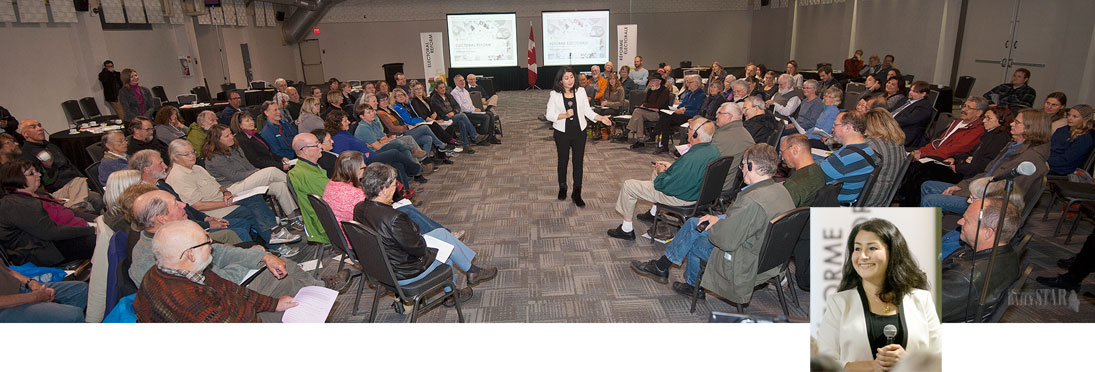
More than 100 “democra-geeks” came out to the Coast High Country Inn Wednesday to talk electoral reform at a gathering hosted by Maryam Monsef, the federal minister of democratic institutions.
“I would really appreciate your help because you seem to be what millennials call ‘geeking out’ about democracy,” said Monsef to the room of engaged citizens.
“You are the ‘democra-geeks’ of your community, I consider you ambassadors.”
Monsef was in Whitehorse as part of a trans-Canada tour during which she’ll host similar public forums in every province and territory.
The goal is to hear views and concerns from a cross-section of Canadians on a variety of questions, from how we vote (should we be able to vote online?) to how votes translate into seats in parliament (should we scrap the first-past-the-post system?) to mandatory voting.
Monsef said she believes the tour will provide “a better understanding of the nuances that different regions across the country feel are most important for their electoral system.”
She hopes to hear a diversity of voices, and from as many people as possible.
The alternative, she said, “would have been for us in a room in Ottawa, (to) draft the legislation and bring it to the House of Commons for consideration and then that would be it.”
Still, some wondered if the group that showed up to the event Wednesday night was indeed an accurate representation of Yukoners.
Anticipating this, Monsef kicked off discussions by asking those present to consider who was absent.
“Inmates,” said one woman; “Children,” said a man; “99 per cent of Yukon,” voiced a third.
People with intellectual disabilities, First Nations representation, rural Yukoners and people under age 30 were also mentioned.
Crowd members had the opportunity to express their views on a range of subjects related to voting, and the democratic process more broadly.
Some expressed concerns about the vulnerability of an online voting system to hacks, and that voter anonymity could be compromised.
Others said online voting would engage young people (“they live in an online world,” said one middle-aged woman), and open up access to “busy voters”, or voters who can’t easily take time off work to stand in line at the polls.
Monsef asked the crowd to consider compulsory voting: What kinds of punishments or incentives should there be?
Some people proposed tax rebates to those who could prove they cast a ballot.
One man suggested, cheekily, jail time.
Others still submitted that voting may go against a person’s cultural or religious beliefs, and that a forced vote may constitute an infringement of Charter rights.
A younger woman in the crowd noted that some indigenous peoples do not feel they are part of Canada and do not wish to vote in a system that is not their own.
After discussions wrapped up, Monsef explained that community gatherings are just one way the government is soliciting views on reforms that could fundamentally alter the democratic process in this country.
“This is one of many channels that people have... to get engaged,” said Monsef.
She noted that Canadians are encouraged to reach out over social media, and make their voices heard at town halls, like the one Yukon MP Larry Bagnell is hosting this evening at the Kwanlin Dün Cultural Centre.
“We’re going to do our best to hear from as many people as we can so that the final outcome is as representative as possible,” she said.
When asked if the government would consider a referendum on electoral reform, Monsef said, as she has before, that she doesn’t want to go down that road.
“(Referendums) tend to be divisive,” she told the Star. “The aftermath requires healing for communities and nations.”
The minister said she is confident that community outreach, as well as a report from an all-party committee on electoral reform, will be sufficient.
Next month, the 12-member Special Committee on Electoral Reform, which includes the
Bloc Quebecois and Elizabeth May of the Green Party, sets off on its own cross-Canada tour.
It is tasked with consulting with Canadians “from all walks of life”, and will submit a report to the House of Commons on Dec. 1.
The special committee will be in Whitehorse Sept. 26.
Legislation will be tabled in the House this spring, said Monsef.
The Liberals campaigned on the promise that 2015 would be the last year a federal election was decided using the first-past-the-post (FPTP) system.
But what if it’s determined that Canadians don’t want a change?
A number of Yukoners at the event Wednesday said they considered FPTP to be a “strong” system.
Monsef did not reject the possibility of keeping the electoral system as is.
“If at the end of the committee’s work, in hearing from experts and academics and Canadians as well, if the letters and the social media conversations say that Canadians want
System X, we’re going to deliver System X,” she said.
“Because ultimately, this is for them, this is their electoral system.
Comments (8)
Up 0 Down 0
Radical vs centrist on Sep 7, 2016 at 7:18 pm
The system is indeed mostly working, but is it because FPTP mostly works, or are we getting lucky?
What if there are 2 or 3 centrist/non radical parties and one 'radical' party; and the majority centrist population splits their vote? In this case the so-called radical or 'fringe' party has the best chance of winning with FPTP versus the alternatives.
Arguing that FPTP helps prevent small or fringe populations from having 'more than their fair share of influence' is simply wrong. For example, in the most recent UK elections (which was FPTP), the Scottish National Party had only 4.7% of the popular vote but ended up with 8.6% of the seats, effectively doubling the power of a fringe group. Meanwhile, the Liberal Democrat party had 7.9% of the popular vote but only got 1.2% of the seats. This is directly a consequence of the FPTP system, and while we in Canada have managed to avoid such upsets, we are certainly not immune to them.
This can be mitigated in a number of ways, such as with ranked-ballot voting for example. A centrist may prefer their own party but may not mind similar parties so they rank them in order of preference. As the votes get tabulated, the lowest ranked party gets dropped from the running, and then their voters' second choice is used, and so on. This goes on until a party gets over 50% of the vote, or there is one contender left.
I'm wary about statements like "FPTP isn't broken but it could use some tweaks." If you 'tweak' FPTP, say by ranking candidates instead of picking a single one as in the example above, then it is no longer FPTP, it is what's called Alternative Vote. If someone comes out and says "Let's switch to Alternative Vote" it will likely scare most people away if they've been conditioned that "FPTP isn't broken, let's just tweak it." Saying that it isn't broken but could use some tweaks (and therefore become a new system) is a subtle acknowledgement that it is indeed broken, so let's not be afraid to openly admit its shortcomings and let's talk about alternatives.
Other voting systems do have flaws, certainly. But this is definitely not an argument that supports the status quo, but rather should encourage discussion on what criteria we want to evaluate our voting system with. If, for example, you look at the 'Voting System' Wikipedia page (hardly a robust source of information, I know, but for the illustration), there is a list of criteria and a table that evaluates 14 different voting systems. FPTP is tied for the absolute worst (and one of the voting systems is literally "Let's just take one ballot at random and go with that!"). FPTP is what we came up with when we didn't know any better (a long time ago); many alternative voting systems are created precisely to address specific shortcomings with FPTP while still maintaining similarity. It should then come as no surprise that they may still share some of the deficiencies, but on the other hand practically all are at least slightly better (again, depending on the criteria).
Indeed, no one is forced to vote strategically. However, in practice, the fact is that many do because FPTP strongly encourages it (when there are more than 2 parties). If there are only two parties it is easy - you vote for the one you dislike least. However, if we continue with the example from above where you have, say, 3 centrist parties and one radical party, not voting strategically (if you happen to be a centrist) increases the likelihood that the radical party will be over-represented. Strategic voting is the 'solution' to vote splitting with FPTP, which is the sad fact of the system. This is why during the last election there were websites dedicated to telling voters in each individual riding how to vote for the best chance of preventing the incumbent party from winning.
Changing the system doesn't necessarily mean that the North has to give up it's MPs. If this is something that's important to you I'd strongly recommend sending a note to the Electoral Reform Committee saying so.
I agree that elected senators would be a fabulous idea! Although I might timidly propose something other than FPTP...
Up 6 Down 0
Let's start with the election of senators on Sep 6, 2016 at 5:58 pm
Election of senators has been talked about for years and - in my opinion only - would make a major improvement to Canadian government.
Up 6 Down 1
It's good to have the discussion on Sep 6, 2016 at 5:11 pm
I still have a hard time understanding how different voting processes would be 'better' than the current one (and yes, I've done my homework). Each of the ones proposed or discussed has flaws as does First-past-the-post. As for voting so-called strategically, well no one is forced to do that ... it's a choice. And as for the comment about wanting to vote a particular party but not liking its leader? It's a bundle ... each party selects its leader. If there was a change, I have to think it would mean that small populations like the Yukon, NWT and Nunavut would no longer each have an MP - as nice as that is for us, talk about "disproportional representation".
Up 9 Down 1
ProScience Greenie on Sep 5, 2016 at 4:46 pm
FPTP works if you roll up your sleeves and get to work at the grassroots level within a political party. One can have lots of influence that way including having a vote on the candidate. Takes effort but if you care it is worth it.
Most people in Canada are centrists leaning a bit right on this issue and a bit left on that issue. We have a system that mostly works. If you look at those who are the most vocal about electoral reform they are from the fringe wings of the political spectrum. They want more than their fair share of influence. Squeaky wheel gets the grease types. In a way FPTP protects us from that.
That all said, it is good that we are looking at this. There are a few versions of PR that might work. A few that would be dysfunctional nightmares. We just have to ensure that we do not switch to a system that gives the ideological fringe too much influence.
Bottom line, FPTP isn't broken but it could use some tweaks. If your political party of choice can't seem to win maybe look in the mirror and make some changes rather than trying to rig the system to get your way. Hint - move to the center where most people sit politically.
Up 3 Down 6
Yukon and only one MP on Sep 3, 2016 at 10:34 pm
Micheal B:
Yukon does indeed only have one MP, but it is of course part of a much larger system. One of the funny things of our current FPTP system is that voting for a local representative directly decides who gets to be Prime Minister; but what do you do if you want the local representative from party X, but you want the Prime Minister from party Y? Alternatively if you want a certain Prime Minister, that decides how you must vote in your local election, regardless of the strengths and weaknesses of the local candidates.
Even though we contribute only one MP, the process still has a fair chance of contributing to the global inequality and proportional misrepresentation of the whole federal government. If there are 4 parties and party X gets the most votes in each jurisdiction (which only requires 26% of the vote!), then in the worst case you can still end up with 100% of the MPs from party X, but only 26% of the population wanted them! Should 26% of the population have full control of the country? What about for the most important decisions, like going to war?
But, to more directly answer your question, practically any other voting system would be better. If we look at Alternative Vote, it still has some of the drawbacks of FPTP, but at least you can vote with your conscience and not have to vote strategically; this helps prevent results like 74% of the population voting for similar parties but splitting the vote between 3 parties, so that a radical party can win with only %26 of the vote.
More broadly, we don't even necessarily have to remain married to the current single-MP system. We could potentially allow more than one MP from each jurisdiction (for STV or MMP voting, for example). There are so many other possibilities we can consider if we can keep open minds and can rationally argue the merits and drawbacks of all the systems. Some will not work for us, some will; big change is scary but as long as we can remain honest and committed to trying to make the best decisions using the wealth of information we have access to, I think most would agree that the likelihood of ending up with positive progress is too substantial to give up on.
Up 3 Down 0
Michael B on Sep 2, 2016 at 10:50 am
Since Yukon only has one MP right now, which voting system would you recommend for Canada. How would Yukon fit into this model? Sincerely, non-Yukoner.
Up 6 Down 6
CGPFan on Sep 1, 2016 at 6:20 pm
I'm surprised and disheartened that a number of people think FPTP is a strong system. I'd be interested in hearing what their particular thoughts are on the well known deficiencies of the system, including issues with strategic voting, gerrymandering, minority rule, vote splitting and so on. There are lots of other options, and virtually all of them result in a more proportionally appropriate result.
Perhaps issues with voter turnout can be addressed with a system where people can vote with their conscience and be reasonably satisfied with the results, instead of the potential majority of people feeling disenfranchised after the election. My wife was in tears after voting last fall because she felt she had to vote strategically instead of according to her conscience. No wonder a third of people just don't bother.
I hope that the decision is not put to a referendum because I feel it is just too important for it to potentially be skewed. There are so many different voting systems and variations that I'm afraid the average person doesn't have the time, motivation, or capacity to be able to gather all the available data, analyze it, and make an informed judgment. Nowadays, with facebook feeds, blogs from nobodies, and shoddy reporting, public opinion is trivially swayed from extreme to extreme by irrational and emotional arguments.
If people are motivated to learn about voting systems I'd highly recommend the following Youtube videos by CGPGrey. There are lots of other videos as well, (for example by Fair Vote Canada), but a lot of these are boring and dry. I'd also recommend suitably motivated people to look at the voting systems of other countries and see what's working and what's not.
The Problems with First Past The Post: https://www.youtube.com/watch?v=s7tWHJfhiyo
Alternative Vote: https://www.youtube.com/watch?v=3Y3jE3B8HsE
Single Transferable Vote: https://www.youtube.com/watch?v=l8XOZJkozfI
Mixed Member Proportional Representation: https://www.youtube.com/watch?v=QT0I-sdoSXU
Up 10 Down 14
Wilf on Sep 1, 2016 at 3:51 pm
Welcome Minister Monsef. This is a little different for us where a Government is going to consult and actually listen to the public. With our two most senior levels of Government we get the consultation but they do what they originally had in mind anyways and the public meetings are just window dressing. This happens time and time again especially at the Territorial level of administration.