Photo by Whitehorse Star
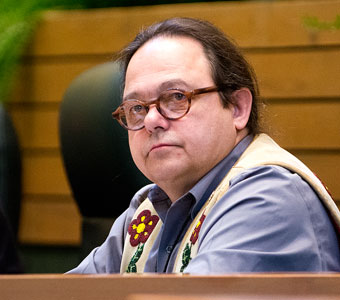
NDP MLA Kevin Barr
Photo by Whitehorse Star
NDP MLA Kevin Barr
Yukon MLAs unanimously supported a motion Wednesday urging the government to make all necessary efforts to release information requested by the Truth and Reconciliation Commission (TRC).
Yukon MLAs unanimously supported a motion Wednesday urging the government to make all necessary efforts to release information requested by the Truth and Reconciliation Commission (TRC).
The data regard the deaths, illnesses, and disappearances of children at residential schools in the territory.
The motion was brought forward by NDP MLA Kevin Barr, who opened debate with an emotional appeal.
"First Nations across Canada, Yukon First Nations with us in the gallery today and across the territory have lost so much,” he told a hushed legislature.
"However, they have never lost the will to rise above the obstacles continually put before them,” he said.
"They have never lost the will to maintain their dignity and achieve their respected place on the land, in communities and nations and globally as a people.
"First Nations are resilient and adaptable,” Barr said.
"First Nations know about all of our interconnectedness in all of creation,” he continued.
The MLA for Mount Lorne-Southern Lakes noted the mandate of the commission is to inform Canadians about the 150-year history of residential schools and to "guide and inspire” reconciliation and the development of renewed, respectful relationships.
"Knowing what happened in the Indian residential schools involves gathering information and seeking truth,” said Barr, who has worked with victims of abuse.
"To that end, the commission has asked jurisdictions across the country to provide information for their review.
"The guiding principal in the Truth and Reconciliation Commission is that the truth of our common experiences will help set our spirits free and pave the way to reconciliation.
The motion before us today is focused on truth gathering. How this government participates in this process sets the stage for reconciliation,” he said.
Kimberly Murray, the executive director of the TRC, explained today that the commission inherited the missing children project from the missing children working group, which was comprised of representatives from the churches, the Assembly of First Nations and the federal government.
Through its work, the TRC is seeking answers to three questions: Who died in the schools? How did they die? And, where are they buried?
The commission reached out a few years back to chief coroners in all provinces and territories for information regarding children who died in residential schools. The next step was to broaden the search to each province and territory's death registration system.
So far, B.C. has provided more than 4,900 electronic death records of aboriginal children.
The commission is in the process of cross-referencing those names with its own data to determine whether they were students at a residential school.
Alberta has also provided records to the commission, close to 10,000 aboriginal death records on microfilm that the commission will comb through, searching for records of children.
The Yukon government is "very supportive of the project and wants to help in anyway they can,” Murray said.
But the territory also has strict legislation that prevents it from releasing a person's cause of death until 100 years afterward, unlike B.C., whose privacy legislation only extends 10 years on death records.
Still, the government has committed to provide any information it can without breeching its privacy legislation.
Murray noted the Yukon's first residential school opened in 1891, and the schools closed in 1985. Any pre-1914 records are public, but those subsequent to 1914 are subject to the territory's privacy legislation.
Pat Living, the director of communications for the Department of Health and Social Services, said this morning the government cannot provide the cause of death for records within the past 100 years.
However, it will provide the names of children who died, the date and place of death, and the place of burial.
It will also compile a report for the commission outlining the percentage of children who died in a certain way.
For instance, the report could say 20 per cent of children died from tuberculosis.
In that way, the commission will be able to determine how many former residential school students died from various causes without being able to link a specific cause of death to a specific student.
Back in the legislative assembly Wednesday, Barr concluded his opening comments, noting that "the majority of Canadians and their elected representatives still do not understand the impacts of (residential schools) history....
"That is why the work of the Truth and Reconciliation Commission is so important and that is also why we hope that this motion, as written, will receive the unanimous consent of this House.
"Let us all demonstrate our commitment to the truth, to healing and to reconciliation.
"If Canadians do not know this history and do not understand the impacts on generations of First Nations, it means that Canadians cannot fully understand and appreciate the resilience of First Nations,” he said.
Nine other members of the legislative assembly also spoke to Barr's motion Wednesday, including NDP Leader Liz Hanson, NDP MLAs Kate White, Jim Tredger, and Lois Moorcroft, ministers Mike Nixon, Elaine Taylor, Scott Kent, and Brad Cathers, and Sandy Silver, the leader of the Liberal party.
Justice Minister Nixon rose first to speak for the government, thanking Barr for bringing forward the motion and thanking those who gathered in the public gallery for attending.
The minister went on to offer a brief history of residential schools before quoting from Prime Minister Stephen Harper's official apology for the residential schools system, which he delivered on behalf of the Government of Canada in June 2008.
"We now recognize that it was wrong to separate children from rich and vibrant cultures and traditions, that it created a void in many lives and communities, and we apologize for having done this,” said Nixon, reading from Harper's landmark apology.
"We now recognize that in separating children from their families, we undermined the ability of many to adequately parent their own children and sowed the seeds for generations to follow, and we apologize for having done this.
"We now recognize that far too often these institutions gave rise to abuse or neglect, and were inadequately controlled, and we apologize for failing to protect you.
"Not only did you suffer these abuses as children, but as you became parents, you were powerless to protect your own children from suffering the same experience, and for this we are sorry.”
In order to encourage thoughtful and responsible discussion, website comments will not be visible until a moderator approves them. Please add comments judiciously and refrain from maligning any individual or institution. Read about our user comment and privacy policies.
Your name and email address are required before your comment is posted. Otherwise, your comment will not be posted.
Comments (8)
Up 8 Down 5
Sad, sad world we live in on Apr 9, 2014 at 2:41 am
The actual story is a good news story, not sure how many posters and dislikers actually read the story or understand residential school and the damage it did?
This was the "right thing" to do by all MLAs, it is too bad that they can't agree on more issues and do the "right thing". Far too often the governing Yukon Party panders to big business and big mining/oil. The Yukon Government should be looking out for all interests of Yukoners!
Up 6 Down 22
Asif on Apr 7, 2014 at 1:22 am
Residential school was an act of genocide - torture, rape, starvation and enslavement. Children stolen and made to work to feed the communities, made to do laundry for the communities, abused on all levels while others benefited from their hard work, not being fed properly and little education. Parents who grieved when the children where taken, knowing that they were to be used and abused yet not able to do anything to keep them at home. Others to never see their children again and not being told what happened to them. Questions need to be answered.
Up 7 Down 18
hmm on Apr 4, 2014 at 10:01 am
June if your child died in government care you I'd hope as a mother would want to know how, where and why they died. Where in the article did it say that releasing information was going to mean more monetary funds for the people who went through this horrible time in their lives?
Up 12 Down 21
Sandy Helland on Apr 4, 2014 at 7:44 am
The whole purpose of residential school was to "kill the Indian, but save the person."
FN native tongue was forbidden in the controlled atmosphere of residential schools.
English language and culture was forced on the young by immersion.
Up 30 Down 10
June Jackson on Apr 4, 2014 at 7:34 am
The Canadian government already put a price on FN death. The settlement money did not go to some healing fund or a monument to history to ensure it never can happen again, it went directly to individuals.
That tragedy has become an excuse for others, "I deserve compensation because my Mother couldn't be a good mother due to residential school", "I deserve compensation because my grandmother couldn't be a good mother to my mother and my mother couldn't be a good mother to me" etc. "I don't deserve to go to jail because my father's father went to residential school". What started out to be an investigation, to discover the truth, to provide closure has evolved into something else. And don't presume that I have 'lucky stars' hmmmm you know nothing about me.
As usual, I speak only for myself.
Up 14 Down 23
asif on Apr 4, 2014 at 2:53 am
only June can start with a monetory comment on the Canadian Government's acts of genocide.
Up 14 Down 21
hmmm on Apr 4, 2014 at 1:23 am
June I did not know there was a price put on the life/death of a child especially if they are your child, sibling, nephew or niece. Just thank your lucky stars you did not have a child stolen from you and forced into a school then die.
Up 23 Down 15
June Jackson on Apr 3, 2014 at 7:31 am
A LOT of money in this huh?