Photo by Whitehorse Star
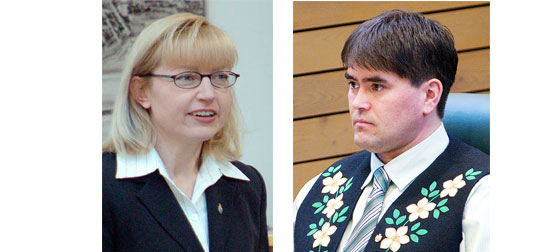
Pictured above: Elaine Taylor and Darius Elias
Photo by Whitehorse Star
Pictured above: Elaine Taylor and Darius Elias
Yukon MLA Darius Elias, the Liberals' Environment critic, says the territorial government is failing Yukoners in the need to express international concern over the plight of salmon stocks.
Yukon MLA Darius Elias, the Liberals' Environment critic, says the territorial government is failing Yukoners in the need to express international concern over the plight of salmon stocks.
Elias is accusing Environment Minister Elaine Taylor of doing nothing to emphasize the seriousness of the situation at home or with counterparts in Alaska.
"I am not going to condone her silence for a second," the Vuntut Gwitchin MLA said in an interview Monday after issuing a press release calling on Taylor to do something.
"Silence is accepting what is going on, and I, for one, do not accept that."
Elias also suggested federal Fisheries Minister Loyola Hearn was more interested in a Conservative party fundraiser during his recent trip to the Yukon than he was with this year's below-average return of salmon.
Neither Hearn's office nor the Yukon Party government notified the media in advance of the minister's trip to the territory.
The stock of Yukon River chinook is being hurt by overfishing in Alaska, by huge numbers of fish caught as a bycatch in the state's lucrative pollock industry and by a destructive parasite, Elias said.
But Taylor, he charged, hasn't said a word about the perilous situation facing the Yukon River chinook.
"All these questions need to be championed by our Environment minister; they need to be brought to the forefront by our Environment minister."
Elias said he was hoping the relatively new minister to the portfolio doesn't follow in the footsteps of the former minister, Premier Dennis Fentie who handed off the Department of Environment in a cabinet shuffle early last month.
Fentie, said Elias, was also invisible when it came to concerns over the health of the territory's salmon.
Taylor, on the other hand, said Monday the matter of this year's low return of salmon into the Yukon was indeed raised with Hearn during his visit to the Yukon.
During the meeting with the federal minister, she emphasized the importance of the salmon stocks to first nations and to the commercial and recreational fisheries, she said.
"At that time, I encouraged the minister to engage with first nations to hear their concerns first hand, and I encouraged the minister to engage with the Yukon River Panel to ensure the Yukon Pacific Salmon Treaty was being adhered to."
She pointed out the federal government has jurisdiction over salmon, and the Yukon River Panel is the joint Canada-U.S. authority for establishing management priorities, such as spawning escapement goals and harvest considerations.
It's important to accept the river panel as the recognized mechanism for dealing with concerns on the Yukon River salmon stocks, Taylor suggested.
She said her government provides input to the river panel and supports its work.
It also takes whatever opportunity arises to raise the issue with federal ministers and officials in Alaska, she said.
Taylor said she plans to follow up this week with a letter to Hearn to reiterate the Yukon government's concern over the state of the stocks, and to get an indication of how Ottawa plans to respond to the issue.
As for Elias' suggestion that the Yukon Party is more interested in fundraising events rather than the issues when federal ministers visit, Taylor said that is absolutely false.
The Yukon Party, she said, has not hosted any fundraisers with federal ministers.
Elias, however, doesn't see it that way.
He said when federal minister Rona Ambrose was in town during the spring, and when Hearn was here a couple of weeks ago, they were more
interested in staging barbecues for Conservatives than dealing with the issues.
Enough is enough, insisted Elias.
This past weekend in Old Crow, for instance, the community was forced to fly in sockeye for the annual general assembly of the Vuntut Gwitchin
First Nation, because there are virtually no chinook in the Porcupine River, he said.
Just seven chinook, he said, have been caught so far by seasoned Old Crow fishermen.
Elias said the federal minister needs to understand the seriousness of the below-average salmon returns.
It's time for a delegation of Yukon, federal and first nations leaders to travel to Juneau to emphasize the impact being felt in the territory, he said.
"Worry about fundraising later," says the press release issued by the Vuntut Gwitchin MLA. "Worry about Yukoners now."
This year has brought concerns from up and down the west coast about the state of salmon stocks.
The Department of Fisheries and Oceans has closed the Yukon River's commercial, domestic and recreational chinook fishery, and has asked first nations along the watershed to cut their normal annual harvest in half, or to about 4,000 chinook.
A dismal return of sockeye and chinook on the Tatshenshini and Klukshu rivers has forced even the closure of the aboriginal food fishery there.
In order to encourage thoughtful and responsible discussion, website comments will not be visible until a moderator approves them. Please add comments judiciously and refrain from maligning any individual or institution. Read about our user comment and privacy policies.
Your name and email address are required before your comment is posted. Otherwise, your comment will not be posted.
Be the first to comment