Minister declines to address scientists survey
Canada's Environment minister would not comment Monday on the results of a survey commissioned to determine the extent to which government scientists are censored.
By Ainslie Cruickshank on October 22, 2013
Canada's Environment minister would not comment Monday on the results of a survey commissioned to determine the extent to which government scientists are censored.
The online survey was commissioned by the Professional Institute of the Public Service of Canada (PIPSC) and hosted by Environics Research.
Of the 15,398 PIPSC members, including scientists, researchers and engineers, invited to participate in the survey, 4,069 responded between June 5 and 19.
According to a release by the professional institute, the survey is considered accurate to plus or minus 1.6 per cent, 19 times out of 20.
Ninety per cent of respondents said they don't feel they can speak freely to media about their work.
Eighty-six per cent said they could not share concerns with the media nor public if they felt a department decision could harm the public health, safety, or environment without facing retaliation.
Thirty-seven per cent of respondents said they had been prevented from responding to questions from the public and media by public relations staff or management over the past five years.
On the same trend, 24 per cent reported they'd been asked to exclude or alter information for non-scientific reasons; and 74 per cent said they believe the government has become too restrictive regarding the scientific information shared with the public.
Half of the respondents said they were aware of specific cases in which the health and safety of Canadians or the environment has been compromised because of political interference in scientific work.
Furthermore, 71 per cent said they believe Canada's ability to develop policy has been compromised by political interference.
Specific to climate change, 62 per cent of Environment Canada and Department of Fisheries and Oceans respondents said they don't feel their departments incorporate the best climate science in their policies.
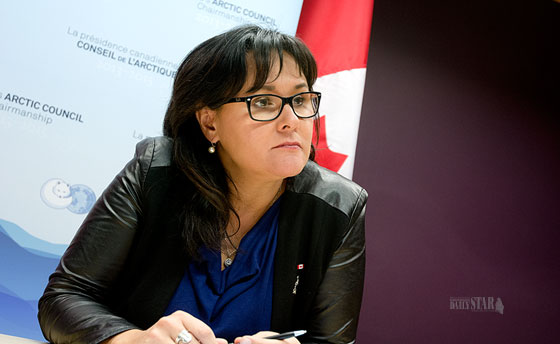
During an interview at the Minister's Regional Office in Whitehorse on Monday afternoon, minister Leona Aglukkaq said she could not comment on the results of the survey.
"I can just speak to what I'm doing for the Arctic Council and my own record,” she told the Star.
"I can say within Environment Canada, I have to work within a group of scientists on decisions that we have to make. That's important, and I will do that.
"The other point I will say is the funding for Environment Canada scientists has increased to about $4 billion since our government has taken over, investing in scientists,” she noted.
Aglukkaq defended her record with scientists as Canada's former Health minister, citing a research project she supported into the Chronic Cerebro-Spinal Venous Insufficiency or CCSVI treatment for multiple sclerosis.
"There was a lot of political push from the oppositions to apply the CCSVI procedure without any science,” Aglukkaq said.
"And my position as Health minister at the time was I cannot force Canadians to go on the surgery bed without any science,” she said.
"This year, the reports came back that there's no basis for the CCSVI treatment. It's important to use science to make good decisions, and that's an example of my record on working with scientists.”
Aglukkaq also highlighted the importance of creating partnerships between scientists and Canada's aboriginal people, who, as she said, have thousands of years of traditional knowledge.
The federal government has supported the development of those partnerships through the creation of Canada's High Arctic Research Station, Aglukkaq noted.
Using scientific and traditional knowledge in combination is also a key priority during Canada's chairmanship of the Arctic Council, the minister said.
Aglukkaq was in Whitehorse to open the first meeting of senior Arctic Council officials under Canada's chairmanship Monday morning.
Aside from meeting with those officials, Aglukkaq met with the council's working group chairs, and permanent indigenous participants.
She also met with Premier Darrell Pasloski, Yukon College students, industry representatives, the Yukon and Whitehorse Chambers of Commerce and the Reindeer Herders Association.
Be the first to comment