Photo by Vince Fedoroff
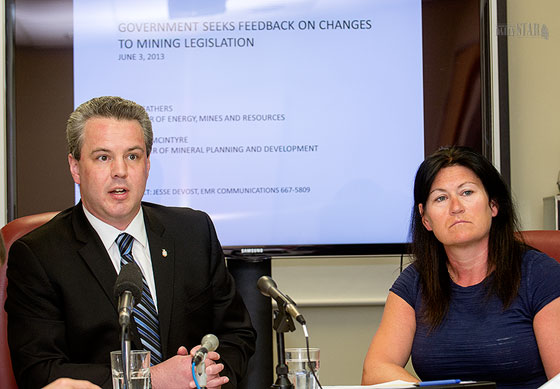
REFORMS COMING – Energy, Mines and Resources Minister Brad Cathers and Bryony McIntyre, the territory's manager of mineral planning and development, discuss the alterations to mining regulations Monday afternoon.
Photo by Vince Fedoroff
REFORMS COMING – Energy, Mines and Resources Minister Brad Cathers and Bryony McIntyre, the territory's manager of mineral planning and development, discuss the alterations to mining regulations Monday afternoon.
Energy, Mines and Resources Minister Brad Cathers says proposed changes to mining regulations are required to comply with last December's ruling by the Yukon Court of Appeal.
Energy, Mines and Resources Minister Brad Cathers says proposed changes to mining regulations are required to comply with last December's ruling by the Yukon Court of Appeal.
The Dec. 27, 2012 decision by the territory's highest court said the government must consult with the Ross River Dena Council before any work can be carried out on a mining claim inside the First Nation's traditional territory.
Legal authorities have suggested it can be argued the ruling essentially applies to the entire Yukon, and perhaps beyond.
Cathers explained in a press briefing Monday afternoon the government accepts the finding, and now needs to accommodate the appeal court's decision.
To that end, the minister said, the government is planning to amend the process for allowing the lowest class of exploration activity, which currently does not require any notification provided to either mining inspectors or First Nations.
Cathers said the government is looking at a period of 25 days to provide for the required consultation with First Nations for class one exploration, with the ability to extend the period beyond 25 days.
Class one activity, for instance, allows for the use of heavy equipment, underground exploration, trenching, clearing trees, the use of explosives, and the construction of camps without telling anyone.
Cathers said his department is counting on feedback from the public, industry and First Nations by July 31 so it can proceed with the preparation of legislative amendments to be presented during the fall sitting of the legislature.
"What we are doing here today is taking the next step forward along the path of improving our mining legislation,” he said.
Cathers said amendments will apply to both the Quartz Mining Act and the Placer Mining Act, even though the court case dealt only with the Quartz Mining Act.
The consultation process will also be applied equally across the Yukon, in the traditional territories of the 11 First Nations with aboriginal land claim settlements and in the territories of the three First Nations without settlements, including Ross River, he said.
The Ross River Dena Council filed a lawsuit in 2011. It argued the government had a duty to consult the First Nation even before it recorded mineral claims.
Supreme Court Justice Ron Veale agreed with the duty to consult, but said the mining recorder could fulfill the obligation by notifying Ross River after a mineral claim was recorded.
The Court of Appeal overturned Veale's finding in its ruling handed down last Dec. 27. It said the duty to consult exists before a claim is recorded, and before any work can begin.
The court suspended its decision for one year, to give the government time to bring its legislation into compliance by this coming Dec. 27.
The government has accepted the court's finding that a duty to consult exists before any work can be carried out, such as using explosives or constructing travel corridors through the bush.
But it has asked the Supreme Court of Canada to hear an appeal of the finding that the duty to consult exists prior to recording a mineral claim.
Both the government and the Yukon Chamber of Mines have argued that requiring consultation prior to recording a claim would unravel a century-old system of free entry staking, which depends on secrecy prior to claims being recorded.
Canada's high court has not yet decided whether it will hear the appeal.
Cathers declined to explain what, if anything, the government is doing to prepare should the Supreme Court of Canada decide not to hear the appeal regarding the duty to consult prior to recording a mineral claim.
The minister would only say the government is confident it will win its appeal.
The steps being taken now by the department to amend the quartz and placer mining legislation will help support a positive relationship with the Yukon's First Nations, Cathers said.
Class one exploration, said the minister, has the lowest impact on the environment.
It's the only class of the four exploration categories which does not require a review under by the Yukon Environmental and Socio-economic Assessment Board (YESAB).
The minister said the YESAB process does provide for the required period of consultation for Class two, three and four exploration activities.
Bryony McIntyre, the manager of mineral planning and development, pointed out the department uploaded the discussion paper regarding the amendments on its website yesterday.
Officials will be meeting with First Nations directly, along with the different industry associations, the outfitters and the local renewable resource councils, she said.
McIntyre said the government is also looking at the ability to include mechanisms for managing sensitive areas, or areas which are critical at different times for calving and lambing, for example.
In order to encourage thoughtful and responsible discussion, website comments will not be visible until a moderator approves them. Please add comments judiciously and refrain from maligning any individual or institution. Read about our user comment and privacy policies.
Your name and email address are required before your comment is posted. Otherwise, your comment will not be posted.
Be the first to comment