Photo by Vince Fedoroff
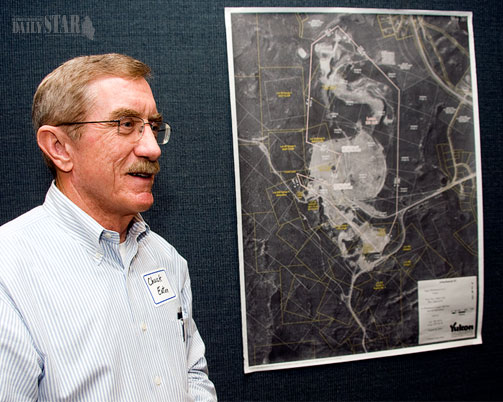
PROJECT PROPOSED – Chuck Eaton, president of Eagle Industrial Minerals Corp., discusses plans for the former Whitehorse Copper mine site during a public consultation held Wednesday evening at the Westmark Whitehorse hotel.
Photo by Vince Fedoroff
PROJECT PROPOSED – Chuck Eaton, president of Eagle Industrial Minerals Corp., discusses plans for the former Whitehorse Copper mine site during a public consultation held Wednesday evening at the Westmark Whitehorse hotel.
The American mining company which has leased a former mine site in Whitehorse says its planned operation could offer the community both economic growth and even some environmental benefit.
The American mining company which has leased a former mine site in Whitehorse says its planned operation could offer the community both economic growth and even some environmental benefit.
The company, Eagle Industrial Minerals Corp., is based in California and has operations in Vancouver Island, Alaska and Nevada.
It has leased the former site of Whitehorse Copper from the Yukon government and plans to extract the mineral magnetite from the tailings left behind by Whitehorse Copper.
It believes it has found treasure among Whitehorse Copper's trash.
Whitehorse Copper was in operation between 1967 and 1982, just off the Mt. Sima road, west of the Alaska Highway.
While in operation, the company produced tailings which include high levels of magnetite, an iron oxide used as a source of iron for the production of steel.
At the time, it was not economically viable to process and ship the mineral, so the mineral sat, unprocessed, among the tailings left behind.
Company president Chuck Eaton, an investment banker, said Wednesday he heard about the neglected mineral reserves "through the old boy network,” and made the move to lease the land in 2010.
"There is basically no copper left in the tailings,” said Eaton. "Whitehorse Copper did a good job back in the day.”
What there is among the 10 million tons of tailings left at the Whitehorse Copper site, is magnetite, about two million tonnes of it, he said.
And it's not difficult to recover.
Getting the remaining magnetite out of the tailings is a fairly simple process, said Eaton.
First, water is poured over the tailings to create slurry. Then, because magnetite is so susceptible to magnetic fields, the mixture is poured over magnetic drums, separating the mineral from the rest of the tailing.
If approved by the Yukon Environmental Socioeconomic Assessment Board (YESAB) the company would operate seasonally for eight to nine months of the year.
It plans to be in full operation by 2013, trucking the mineral to Skagway and shipping it to a steel mill Outside, probably in East Asia.
Another benefit would be to local employment.
The company say the operation will employ 35 to 40 locals residents, with about $1.5 million spent on annual payroll. Goods and services could net $2.5 million and $5.5 million could be spent on trucking.
The company says it would utilize "as many local suppliers as possible.”
The proposed operation could even be environmentally beneficial, the company say.
Eagle Industrial is currently going through the YESAB approval process and has been deemed "adequate,” for consideration by the board.
One benefit it believes it could provide is a reduction in levels of airborne dust in the area.
The former Whitehorse Copper site has been the subject of complaints over the years from neighbouring residents. They complain about dust blowing into residential areas from the site while the copper mine operated. Eagle Industrial would cap the area with gravel, which would eliminate the problem, it says.
After the operation is complete, the company would also backfill the "dangerous” pits and crevices left behind by Whitehorse Copper on the southwest side of the property.
When the whole process is complete, Eagle Industrial said it would just leave the site to nature.
"We are going to let it get green by itself,” said Eaton. "That should improve the area as a habitat for flora and fauna.”
Other options for the site include stacking the tailings or creating engineered fill for possible development.
"If enough benefits are determined by the city or YTG, the land could just be reclaimed and developed. Hopefully there is a budget for something like that.”
There are some concerns with the proposed operation as well.
"There are some issues, but there are no show stoppers,” said Lewis Rifkind, mining co-ordinator with the Yukon Conservation Society.
"Noise is a concern because the company would be operating at night. The company say they can mitigate the noise at night, perhaps by doing things like not crushing at night and replacing the back-up noises on their trucks with strobe lights, things like that.”
Other potential concerns the company has identified include a fear of increased traffic on the Mount Sima road and the Alaska Highway, as well as light pollution in the area, which the company said it will work to reduce.
The greatest concern is to the area's groundwater.
"Water is the obvious concern,” said Rifkind. "They will be using recycled water from the site, which has elevated levels of some substances, including uranium, but the company are unlikely to be adding any more to the water. Some treatment will probably be necessary to treat the wastewater.”
It's a concern shared by the public as well, the company say.
Part of the YESAB process involves public consultation and a primary concern that the company has identified so far has been the use and possible contamination of the area's groundwater.
The operation will use about 200 to 220 cubic metres of water per day.
The company plans to use as much recycled water as it can from a pit lake, left over from the Whitehorse Copper operation
Should that run out, it said, existing water reserves in the flooded shafts from Whitehorse Copper's former underground operations should provide much of the remaining water needed for the operation.
"We are making sure we are not leaching out any bad actors for water run-off,” said Eaton.
"All tests have shown that any exceedences from the operation will not show up in any of the local wells.”
The water drawn on by residential wells is separated from the operation site by layers of ground rock, said Eaton. The company also plans to treat the water in the pit lake.
"It's really a belt and suspenders kind of thing,” he said, adding that "water use, contamination and treatment issues are certainly something we would like to keep talking about.”
Eagle Industrial will make its application for a water permit after it is approved by the YESAB. The next phase would be the construction of a processing plant at the site.
The operation is currently up for public review, as per YESAB requirements, and so far, opposition to the project has been minimal.
In fact, having an operation so close to home may even offer some unintended benefits.
"When you rework old mine tailings, it's pretty benign, because the environmental damage has already been done,” said Rifkind.
"It also presents an opportunity for people in Whitehorse to see how mining happens and become informed about the process.”
The public comment period for the project began Dec. 1 and will continue until Jan. 5.
Members of the community are urged to submit their comments to the YESAB during the remaining weeks.
In order to encourage thoughtful and responsible discussion, website comments will not be visible until a moderator approves them. Please add comments judiciously and refrain from maligning any individual or institution. Read about our user comment and privacy policies.
Your name and email address are required before your comment is posted. Otherwise, your comment will not be posted.
Be the first to comment