Photo by Vince Fedorof
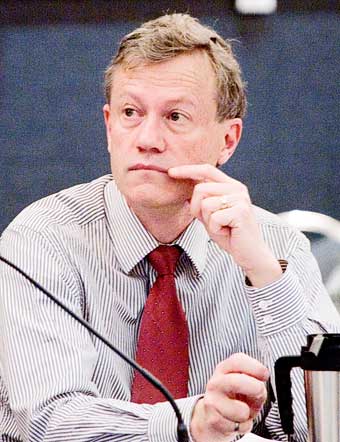
SECURITY BOLSTERED – Bob Holmes, director of mineral resources for the Yukon government, says the Minto Mine has been asked to more than double its reclamation security.
Photo by Vince Fedorof
SECURITY BOLSTERED – Bob Holmes, director of mineral resources for the Yukon government, says the Minto Mine has been asked to more than double its reclamation security.
The Minto Mine has been instructed to double its reclamation security deposit to $8.33 million, the Yukon Territory Water Board heard Monday.
The Minto Mine has been instructed to double its reclamation security deposit to $8.33 million, the Yukon Territory Water Board heard Monday.
The matter was raised by local environmental consultant Bill Slater. He has been retained as a expert witness to testify on behalf of the Little Salmon-Carmacks First Nation during the hearing into a water licence application for the proposed Carmacks copper mine.
Bob Holmes, the Yukon government's director of mineral resources, explained Monday afternoon that Capstone Mining was asked in a Feb. 15 letter from Energy, Mines and Resources Minister Patrick Rouble to provide the increase in security in the next 60 days.
There is currently $3.8 million being held by the government through a letter of credit issued by Capstone, Holmes explained.
Under the government's new reclamation guidelines, the amount of security must keep pace with the estimated cost of closing down the mine at any given time and completing the reclamation work.
Holmes said under the Minto Mine's operating licence, the company must provide an updated assessment of the mine site every two years.
It submitted a report last October, and, after a review of the material and discussions between government and company representatives, it was decided security in the amount of $8.33 million is appropriate at this time, Holmes explained.
The new reclamation policy was developed to coincide with the Yukon government taking the responsibility for regulating mining in the territory on April 1, 2003. On that date federal authority for managing lands and resources in the Yukon was transferred to the territory.
The new reclamation policy is meant to avoid leaving taxpayers in the lurch for mining developments that go bust without enough money to clean up, such as the cases with the Faro and Mount Nansen mines.
The mines were permitted under Ottawa's watch, so now it's the federal taxpayer who must pay for the cleanup – $500 million or more in the case of Faro alone.
Any mine approved now by the territorial government will ultimately be the responsibility of Yukon taxpayers if things go wrong.
The technical expert for the first nation referred to the Faro and Mount Nansen mines as examples of how the public can be left on the hook for hugely expensive cleanups without adequate closure plans being in place with sufficient financial security.
The Faro and Mount Nansen mines, Slater emphasized, both used tried and true mining methods, without any questions surrounding the technology employed.
In both cases, things still went horribly wrong and the public's paying the price, he told the board.
Slater and several others have argued Western Copper's proposal to use sulphuric acid to process ore from the Carmacks copper deposit is unproved technology.
With unproved technology, he insisted, there's no way to paint a true picture of what the future holds for the Carmacks Copper project.
Slater said if there's no way to determine with any certainty what will be required for reclamation, there's no way to gauge what level of financial security would be appropriate.
"In the case of unproven technology, you do not understand what the risks are,” said the environmental consultant.
The hearings were scheduled to wrap up this afternoon with closing submissions from Western Copper, the Little Salmon-Carmacks First Nation and a several other parties that have intervened in the company's application for a water licence.
Originally scheduled for five days, the hearings began Feb. 15 and went for the week, but Monday and today were needed to wrap up matters.
It's been seven days of submissions and cross-examinations by lawyers and technical experts retained by the different parties.
The Little Salmon-Carmacks First Nation and other parties have argued because the technology is unproved, there should be no licence issued.
In its response this morning to the submissions from interveners, Western Copper spokesman Jonathan Clegg assured the board the Carmacks copper proposal is viable and sound.
The company, he insisted, has shown plans for adequate contingency measures to ensure the environment is protected.
Approval for the proposal from the Yukon Environmental Socio-economic Assessment Board was received in July 2008.
The process by the quasi-judicial water board, however, is a different matter, and the board is under no obligation to issue a licence, Little Salmon-Carmacks lawyer Arthur Pape reminded the board this morning.
In order to encourage thoughtful and responsible discussion, website comments will not be visible until a moderator approves them. Please add comments judiciously and refrain from maligning any individual or institution. Read about our user comment and privacy policies.
Your name and email address are required before your comment is posted. Otherwise, your comment will not be posted.
Comments (1)
Up 0 Down 0
francias pillman on Mar 2, 2010 at 9:19 am
Good. With the spike in the price of Copper over the weekend due to the CHILE earthquake, there shouldn't be no problem paying this. And this is also a concern to me. Something tells me that they know this mine will fail eventually and trying to cover someones butt right now.