Mayor, chief commit to helping vulnerable people
Whitehorse Mayor Dan Curtis and Kwanlin Dun First Nation Chief Doris Bill have declared Friday’s Vulnerable People At Risk Forum a success,
By Rhiannon Russell on April 27, 2015
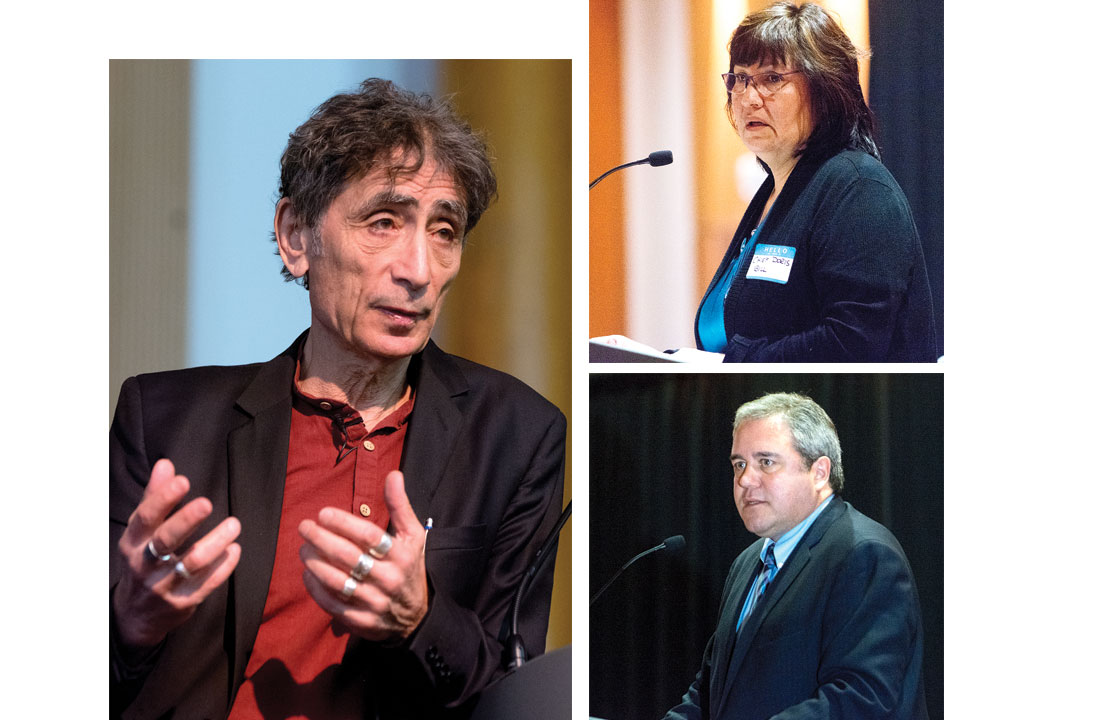
Whitehorse Mayor Dan Curtis and Kwanlin Dun First Nation Chief Doris Bill have declared Friday’s Vulnerable People At Risk Forum a success, and pledge to work together to better assist those in need in the community.
About 300 people turned up to the all-day event to participate in focus groups and interactive exercises and listen to both a panel of local speakers and keynote Dr. Gabor Maté.
“It has been a remarkable day,” said Curtis Friday afternoon.
“Mark it on your calendars because I’m not going to forget it, Chief Bill’s not going to forget it, and I hope none of you forget it, because this really is an epic day and it’s the beginning of a long, strong partnership for our community.”
Standing at the podium alongside Curtis, Bill said collaboration is necessary to identify gaps in existing services, in order to determine what further resources are needed by vulnerable people.
“It’s about working smarter, not harder,” she said. “There are dozens of agencies and organizations working on these files and currently no perceived alignment or collaboration.”
Both she and Curtis agreed a resource handbook must be compiled, with copies available in public locations, that lists all supports and services in Whitehorse.
Until now, organizations and governments have been working in silos, Bill said. It’s time to change that.
“We have so many resources in this community. It’s fantastic. But we’re kind of scattered all over the place.”
In the late morning, “circles of sharing” discussed several issues: What locations in the city attract vulnerable people? How can we improve safety for them and other citizens? What municipal, territorial and First Nation government programs are in place to help people? What new ideas can be implemented to improve the lives of vulnerable people?
At the end of the session, large sheets of paper affixed to the walls were covered with pink, orange and yellow Post-it notes – all ideas and suggestions from participants.
At day’s end, Bill summarized them: the “glaring” need for long-term and emergency housing, after-hours services including a 24-hour medical drop-in centre and mental health supports, employment support and life skills, and a downtown sobering centre.
“It was really important to hear from the community, to hear what the problems are,” Bill told reporters after the event.
“From our perspective, we know some of the issues, but we don’t know it all. We know there are people sleeping, for instance, by the cultural centre here ... under a tarp. We don’t know what the extent of the problem is. We do know that we have a problem, and what I am hearing from people is that problem is getting worse.”
She and Curtis said they both strove to make Friday’s event apolitical.
“We didn’t want to invite a whole bunch of ministers to give speeches,” Curtis said.
“Chief Bill and I were just hosts of our community. So I do firmly believe that, of the 300-plus people that were there, everyone walked out very adamant in their mind they’re going to make a difference in the community.”
From now on, when he walks along the waterfront, he’ll look people in the eye, ask them how they’re doing and give them a hug, he said.
He also suggested that when bylaw officers finish their parking patrols along Main Street, they walk along the river – not for enforcement, but to ensure people are safe and that no one needs assistance.
In Kwanlin Dun, Bill said staff are surveying homeless people to find out what their needs are, whether they couch-surf, stay with friends or live on the street and what resources they access.
This will help identify gaps in aid.
She said the First Nation is raising money for a crisis fund, to be used for people living in the community from other Yukon First Nations in case of emergency – such as the death of 17-year-old Brandy Vittrekwa in December.
Kwanlin Dun raised money for her family so her body could be transported home to Fort Macpherson, N.W.T., for a funeral. Because Vittrekwa wasn’t a Kwanlin Dun citizen, the money the First Nation has earmarked for its own couldn’t be used.
“It’s the only thing I can do that’s immediate and that can help in a pinch,” Bill said of the fund.
A former foster child, Bill is also working on opening up a group home and transition home in the community.
“These kids are turned on to the street (once they turn 19), with not a dime in their pocket and no place to go,” she said. “It’s unacceptable.”
In the past several years, five Kwanlin Dun members transitioned out of foster care and are living on the street, Bill said.
Maté, a renowned addictions and mental health expert, spoke in the afternoon, and was rewarded with a standing ovation.
“Vulnerability,” he said, traces back to a Latin term that means humans’ capacity to be wounded.
“Obviously, as human beings, we are all vulnerable, from conception to death,” he said. “But who is more vulnerable than others?”
It’s not an individual question, he said, but rather a social and cultural one.
Maté said anything can be analyzed on its own. Diabetes can be considered solely a health problem, rheumatoid arthritis can be examined as a joint problem, and addictions as “people making dumb choices.
“We can isolate everything but do we understand anything if we isolate things?”
Maté pointed to statistics that show various health problems, including asthma and diabetes, are much higher among aboriginal people.
“That means there is vulnerability there,” he said. “They are more likely to be hurt.”
He spoke about the effects of residential schooling in Canada. An adverse upbringing – one that involves abuse, the death of a parent, divorce, violence, parental addictions or mental illness – leads to a higher risk of various ailments, addictions and mental illness, he said.
“We’re all connected,” Maté said. “Everything is connected to everything else.”
See related coverage.
Comments (10)
Up 7 Down 0
Nice thing this mayor will be gone in October on May 3, 2015 at 10:13 am
Nice thing this mayor will be gone in October
Up 3 Down 1
Making something illegal does not stop the supply. on Apr 30, 2015 at 6:23 pm
Most of the homeless and addiction problems are caused by drugs being illegal.
Making something illegal does not stop the supply. It only guarantees that drug lords and their lapdog politicians will get rich from obscenely high prices for otherwise cheap drugs. The 'war-on-drugs' is a lucrative cash cow that supports a huge 'justice business' and 'social services' that live off addicts.
Making drugs legal, cheap, and controlled would get most addicts out of the crime cycle. Sure, some would OD earlier than they would have otherwise, however many others could get their lives back on track if they weren't hobbled by a life of crime to pay for an expensive addiction.
Of course we can't expect any change. It's far easier to distract people with endless discussions of the symptoms instead of addressing the causes. Homeless addicts are acceptable 'collateral damage' when so many get rich off other people's misery and addiction issues.
Up 47 Down 5
Again the Mayor does get it on homelessness on Apr 30, 2015 at 1:29 pm
Homelessness is not the problem. It is social, economic and addiction problems.
People with addiction having kids will create mind defects, so people cannot function in life properly.
Where there is addiction it means no money for food or the basics in life that would create a start in life for children which end up in these situations.
Question is how do we help to change this situation from occurring? And we need more programs such as analysis of all the individuals in this situation and then develop a program for each which includes medical, continuing care, housing and support and after care.
Homelessness is not the problem but health and environmental situations of social economic development. Existing housing is available.
Mayor Curtis you just don't get it again. Consult and find out the facts before speaking on any subject.
I have worked on this subject for years including in the Yukon.
You create more problems than you solve!
Take a break and rethink your approach because it is not helping any of these situations.
If I were mayor, I would develop a try party program for this problem that would include:
1 Data analysis of all the people who have problems which would include a medical team. So then you know how many that have problems, who they are, what condition these people are in and what the treatment is that they need. That is the existing people.
2 Next we need some type of program where kids and adults can go to get help if they are in a challenging situation - addiction, socially, economical, mentally and I think all this exist now.
3 The big problem is, how do identify and help people in this situation because they will not want to ask for help, are too scared, or some other reason.
4 Does society put in place in an intervention program?
Up 4 Down 3
Josey Wales on Apr 30, 2015 at 9:16 am
Hey Virgil...ya know as abrasive as I can/am at times I'd say...."Arbeit Mecht Frei"
was completely tasteless.
Freely expressed I'll give you that, but tossed in this conversation ..tasteless.
I even agree with your points, just not your tasteless abstract.
Later Virgil...OJW
Up 11 Down 2
June Jackson on Apr 29, 2015 at 8:57 am
When I first wrote the following it hadn't occurred to me that perhaps this forum was not really interested in helping anyone..but more interested perhaps in hiding the eyesores?
Who are "vulnerable people at risk" in Whitehorse? Is "vulnerable people at risk' addicts? alcoholics? mentally ill? at risk for what?
Why not call it what it is? I don't want ANYONE to be homeless.. but I think "poor thing you are vulnerable at risk" gives a different message than "you are an addict, own it, and get help for it".
Why wasn't Salvation Army represented here? How many folks here have actually spent a Friday night or an SA Wednesday volunteering at Sally Ann?
A big expensive forum to discuss what everyone already knows.. and they also know what has to be done.. make a safe temporary roof available, make nutritious food available, make help available, make support available and then leave folks alone. Your going to 'reach out"? What does that mean?
Everyone should get to decide how they want to live their life the way they want to. Because YOU don't want to live that way doesn't make someone else wrong.
No one talked about education or providing work opportunities or helping people help themselves. Even "vulnerable people at risk" can have pride.
I am all about freedom, and that means everyone gets a choice. I would have been more impressed to see even one "vulnerable people at risk' on that stage talking about what he/she wants and how he/she wants it delivered.
Up 16 Down 6
Virgil on Apr 28, 2015 at 1:35 pm
The City is supposed to be involved in roads, garbage, infrastructure, and taxing.
Please define "vulnerable people."
Then do a thorough investigation as to how those people got there. Then investigate which social programs they are currently under. You'll find out this has everything to do with the territorial government and nothing with the City.
Thank you for yet again taking us down a path where you literally aren't allowed to do anything.
The only viable and effective (proven effective) option is...!!!
Rehabilitation clinics with mandatory 90 day or longer stays. Basically jails... with people that are supporting the victims versus our current jails which have been caught smuggling drugs/liquor in for inmates. Otherwise you're offering this...
"go out, get drunk, get arrested or feel sick, go to safe place, wake up, lather rinse, repeat."
You're creating a set of conditions that are mirrored across Canada. Our current system is in a state of disrepair. In order to change it there needs to be a new offering.
Then we get the cliche's/liberal comment "everything is connected to everything else." Work smarter not harder
That is exactly how people work the system... "I can get free money and not work, work is hard, welfare is easy..."
Also, if residential schools are still being brought up. What about the successful first nations that are dealing with the pain and are still providing for their family and own their own companies? In the year 2015... it has to be a persons choice to use drugs/alcohol; else they've given up free will.
Arbeit Mecht Frei
Up 20 Down 12
Michael McCann on Apr 28, 2015 at 11:20 am
Congratulations to all involved. Great to see KDFN and the City taking this on.
Up 22 Down 12
Well written piece of reporting on Apr 28, 2015 at 9:44 am
Well written piece of reporting.
Up 11 Down 24
Josey Wales on Apr 27, 2015 at 6:21 pm
By-Law are care givers now? So they run around fining folks for daring to participate in our false economy....then go to ensure piss tanks are OK, got mix, may need a snack?
So not the role of THE city, but their forte now is social engineering and not so much on fiscal "responsibility"
I say for every dollar of cost for this "experiment" or pander effort towards this "feel good initiative" dollar for dollar SHOULD be NOT I repeat NOT paid out to other elitist special interests.
Example...By-Law molly coddling time, snack runs say in a month are $2000?
Then $2000 comes outta the regular wealth re-distribution avenues like SIMA, X-country and bike snobs, soccer stadium plans etc..see the point?
Of course I wish folks get well, those that want too...but some folks you just can't reach.
...and you get what we have here today.
CoW are socialist engineers now? Fantastic...what could possibly happen?
Soon to hire a addictions "specialist" complete with full team of "crack commano" hardworking (too funny I know) bureaucrats?
Up 20 Down 12
John Glynn-Morris on Apr 27, 2015 at 4:05 pm
It was a great day; hats off to the City and KDFN for showing some leadership.
Look what Medicine Hat is doing to combat homelessness:
http://thetyee.ca/News/2015/04/25/mIn-Medicine-Hat-Homelessness-Is-Almost-Over/?utm_source=mondayheadlines&utm_medium=email&utm_campaign=270415