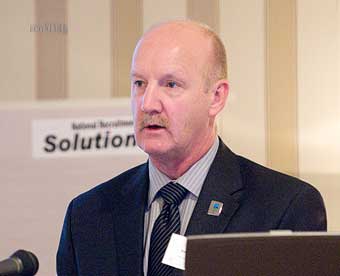
Photo by Whitehorse Star
Kerry Jothen
Photo by Whitehorse Star
Kerry Jothen
When Kerry Jothen, Human Capital Strategies' chief executive officer, appeared at a labour market symposium hosted by the Yukon government earlier this week, he asked whether delegates wanted his pre-October 2008 slide show or post-October 2008 show.
When Kerry Jothen, Human Capital Strategies' chief executive officer, appeared at a labour market symposium hosted by the Yukon government earlier this week, he asked whether delegates wanted his pre-October 2008 slide show or post-October 2008 show.
Indeed, there are still many unknowns about just what impact the market crisis will have, he said as he moved into the post-October slide show. The production displayed numerous quotes and headlines about the recent market meltdown.
Jothen was the guest speaker at the one-day conference held at the Westmark Whitehorse Hotel.
His Human Capital Strategies has been in operation for seven years, focusing on human resources research, strategic planning and policy, with his entire career having spanned more than 30 years in human resources.
He noted most of his comments come out of his experience in the B.C. economy.
Jothen told the 100 or so delegates at the forum that though there are still unknown factors that will emerge from the current financial market situation, recent trends are already evident. Examples are the swift plummet of the Canadian dollar, delays or cancellation of some major projects, a downturn in construction and a decline in commodity prices.
Meanwhile, a number of baby boomers are delaying their retirement by a few years or retiring at a lower income than they had originally planned, he noted.
That said, it's important to ensure the country has the workers it needs now and into the future, Jothen stressed.
"Workforce stability is key in a weak economy," he said, noting a number of questions are being asked in looking at the financial situation.
They include how important major projects are, what the low Canadian dollar could mean for the manufacturing industry, if workers are changing their retirement plans, and whether there may be more closures and layoffs.
Other queries are whether employers may end up going back to old habits in hiring after having to become employers of choice when the economy was thriving, and whether Generation X and Y job seekers, who have had options to be choosy in selecting where they work, will change their behaviour.
Even before the market turmoil, a "perfect storm" was happening in B.C., with the convergence of economic growth, a declining workforce in the 15- to 24-year-old age groups, and competition with other markets.
In B.C., the biggest increase in labour has come from the immigrant population, while the second increase came from newcomers to the province from within the country. Meanwhile, there's been a decline in the number of workers available from inside the province, Jothen said.
Even in the current economic situation, it's expected that immigration will be the largest labour source in the province, with efforts now being made to encourage immigrants to locate outside of the Vancouver centre into smaller communities that are experiencing the labour shortage.
While immigrants may continue to help fill jobs as the largest labour source, Jothen told delegates, efforts may have to be stepped up in bringing more newcomers to Canada for work.
Efforts are being made in many countries overseas to keep their workers there, he said, stressing that it won't be as easy to compete for foreign staff in the future.
Regardless of the economic crisis, demographics aren't changing, and it's expected the country will still need people from outside Canada to fill gaps.
Additionally, it's expected 75 per cent of new jobs will require some form of post-secondary education whether that be through an apprenticeship or university degree.
"You've got to compete," he said, also stressing the importance of finding employees from those populations that are currently under-represented in the workforce such as aboriginals, women and those with disabilities.
In many cases, employers are surprised to find out it costs less than they expected to accommodate staff who have disabilities.
Looking at Yukon statistics which showed a positive economic outlook for the next decade, Jothen said that while there may be some decline, given the global market place, things will likely continue to go well for the territory.
TheYukon's unemployment is currently 5.1 per cent, which follows the trend for other western provinces, he said.
"I think it still bodes well for you," he told the room full of many employers from around the Yukon.
In order to encourage thoughtful and responsible discussion, website comments will not be visible until a moderator approves them. Please add comments judiciously and refrain from maligning any individual or institution. Read about our user comment and privacy policies.
Your name and email address are required before your comment is posted. Otherwise, your comment will not be posted.
Be the first to comment