Man pursuing eight-year trip around the world
Sitting in the Gold Rush Inn’s bar Wednesday afternoon,
By Stephanie Waddell on March 13, 2015
Sitting in the Gold Rush Inn’s bar Wednesday afternoon, Angelo Wilkie-Pages admits it’s hard to think about getting back on his bicycle Thursday morning to continue on his journey to Fairbanks after getting to sleep in a bed in the hotel for a couple of nights.
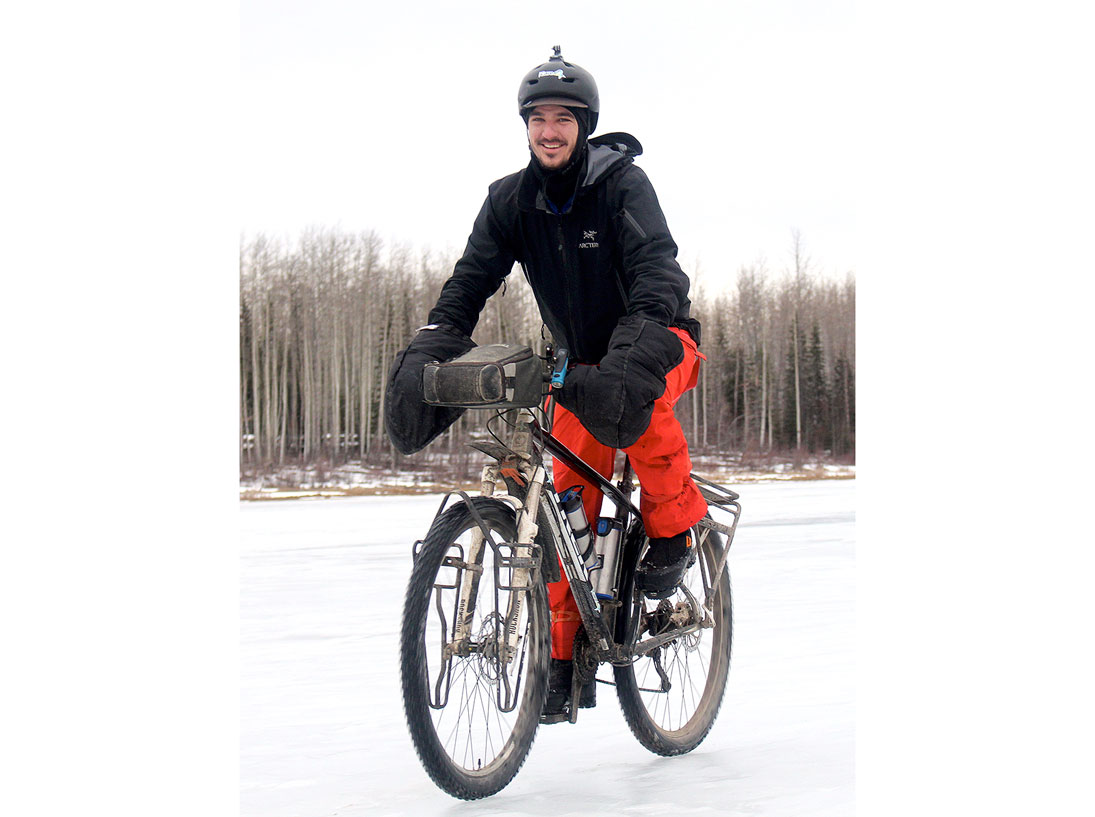
By the time he arrives in the Alaska city, Wilkie-Pages will have propelled himself more than 6,000 kilometres on two wheels after departing Los Angeles on Nov. 20, 2014.
By then, it will be time to do something different – say, kayaking along the coast over to Russia.
It’s all part of Wilkie-Pages’ dream of becoming the first person to circumnavigate the globe using entirely his own energy, cycling, kayaking and sailing his way around the earth.
The 30-year-old from South Africa predicts the endeavour will take eight years to accomplish.
The idea for the journey came about out of Wilkie-Pages’ love for endurance activities – he’s competed in a number of Ironman triathlons over the years – and his interest in circumnavigation.
“I’ve always had this fascination with circumnavigation,” he told the Star.
He combined the two into Expedition 720, “the ultimate test of human endurance and will-power,” and set out from Los Angeles to begin the journey that will take him from east to west and, eventually, pole to pole.
He attributes his corporate background to helping him get the numerous sponsorships needed to fund the journey.
That includes one that’s working on a documentary about it, with filmmakers meeting him in various major points on the track to follow him for portions of it.
So far along the way, Wilkie-Pages has encountered numerous challenges.
They have grown as he’s gotten further north and the temperatures have dropped (though he acknowledges he’s been fortunate northern B.C. and the Yukon have had a fairly mild winter).
Just outside Fort St. John, B.C., he made the mistake of wearing the wrong boots, and that cost him about 2 1/2 weeks’ time recovering from the fallout.
Ensuring he was wearing the proper footwear, Wilkie-Pages set out as soon as he could for the climb toward the Yukon.
Of course, there’s a long list of highlights along the way.
Those include the incredible landscape of California, cycling through the Canadian rockies, an amazing display of the northern lights at the Liard Hot Springs and riding alongside the many bison frequenting the Alaska Highway in southern Yukon and northern B.C.
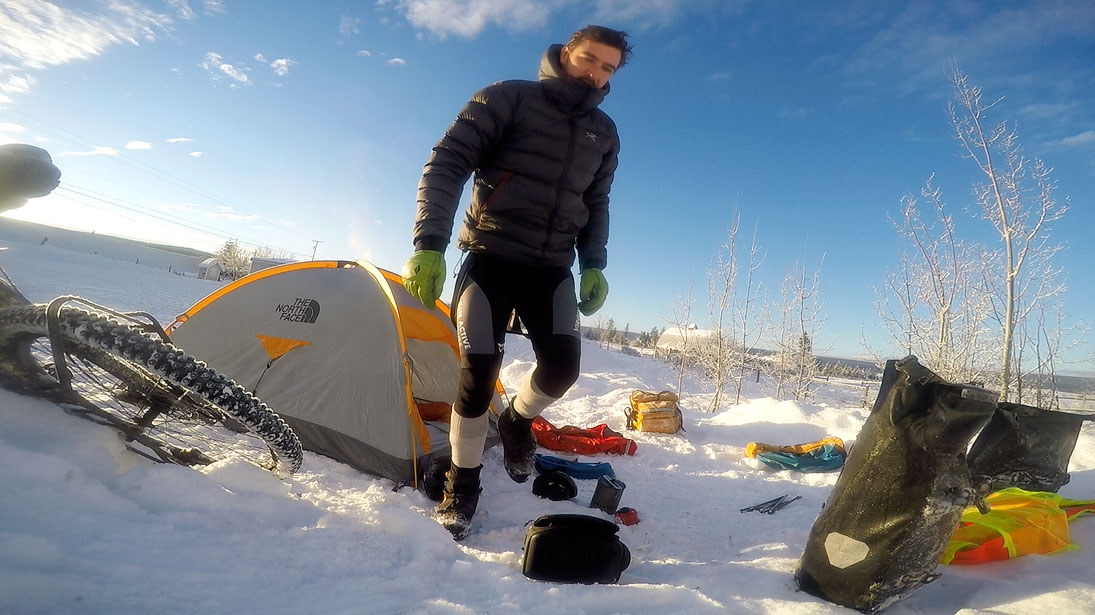
Most nights on the road, Wilkie-Pages camps, which means chores like setting up his tent, melting snow to make water, and cooking.
So when he arrives in a larger community like Whitehorse, he likes to take a couple of days for a break and enjoy such creature-comforts as slumbering in a hotel bed.
As for how he trained for such a journey – which currently has him on his bike for 80 to 100 kilometres in a given day – he said with laugh: “I don’t think there’s any way you can train.”
His past experience competing in endurance events along with a two-week stint in Nepal on his bike have helped, he added.
Emphasizing that he is, by no means, a professional athlete, Wilkie-Pages explained one of the goals of his journey is to show the options for human-powered transportation, and that “anyone could do it.”
A journey of this magnitude also means a lot of time on his own. As he pointed out, however, there’s also a lot to think about around meals, where and when to stop and looking at the day ahead.
The experience has taught the traveller to plan ahead, but not too far into the future, so he usually considers his next two or three days as he continues his journey.
Wilkie-Pages would like to say he’s determined to eat a healthy diet to fuel his daily calorie burn of about 7,000 calories.
However, he hasn’t been that focused, and is mainly concerned with just consuming enough calories.
When he’s on the road, he said, he eats a lot of freeze-dried food, which has a certain convenience factor.
As Wilkie-Pages continues to show the world just how people can power their own transportation means, he is also working on another goal to raise at least $1 million for Heifer International South Africa, an organization Wilkie-Pages has seen do tremendous work in his own country.
As he was planning the expedition, he said he wanted to find a way to give back and make positive changes in his own community.
So he looked for an organization for which to raise awareness and money. He quickly discovered the work of Heifer in helping those living in poverty become more self-sufficient through farming programs and the like.
Wilkie-Pages was able to visit a number of communities in South Africa that have benefited from the work of Heifer, which has taught residents how to farm as well as provide livestock and crops to get them started.
As it’s stated on Heifer’s website: “We believe in equipping our people with the tools, education and livestock to bring about positive transformation. Together, through every small step forward, we’re transforming the world for the better.”
Donations can be made through Heifer’s website at www.heifer.org.za
If Wilkie-Pages is successful in raising the $1 million he aims to, he said it could help up to 2,500 families in South Africa.
Wilkie-Pages’ progress will continue to be tracked on his website at http:/expedition720degrees.com/
Comments (1)
Up 9 Down 0
Thomas Brewer on Mar 13, 2015 at 4:20 pm
" the first person to circumnavigate the globe using entirely his own energy, cycling, kayaking and sailing his way around the earth." this might be semantics, but this has already been done, unless he's counting the method of self propelled transportation (which seems kind of silly to me...)
"Colin Angus is a Canadian author and adventurer who is the first person to make a self-propelled global circumnavigation." From the wiki page at:
https://en.wikipedia.org/wiki/Colin_Angus_(explorer)