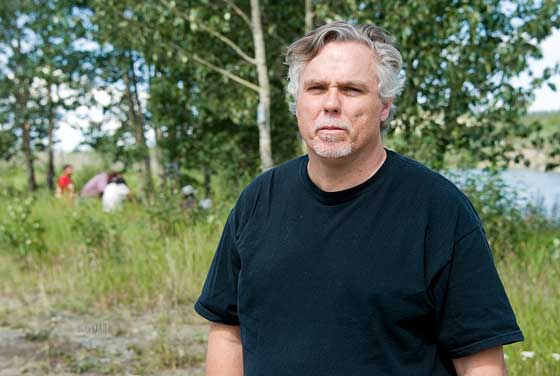
Photo by Vince Fedoroff
SOBERING RESEARCH SUBJECT – Mark Horvath tells homeless stories on invisiblepeople.tv. He was in Whitehorse late last week to find stories of people here.
Photo by Vince Fedoroff
SOBERING RESEARCH SUBJECT – Mark Horvath tells homeless stories on invisiblepeople.tv. He was in Whitehorse late last week to find stories of people here.
In the shadow of construction and development, five people sit on tarps at the edge of the Yukon River in Whitehorse.
In the shadow of construction and development, five people sit on tarps at the edge of the Yukon River in Whitehorse.
They are homeless, struggling to make ends meet by collecting empty bottles and relying on aid from the local Salvation Army.
On Friday afternoon, the group is approached by a man with a backpack and a video camera.
His name is Mark Horvath, and he is interested in hearing what they have to say.
An American videographer on tour across Canada, Horvath was in Whitehorse last Thursday and Friday to gather firsthand accounts of what it means to be homeless. He then posts the unedited videos on his website, invisiblepeople.tv.
No one's interested in appearing on camera, but Rose, the apparent leader of the group, wants to make it clear that they are not looking for charity.
"We do our best, we're not going around with our hands out saying, ‘Spare change',” she said. "We want to work.”
Rose, who asked that her last name not be used, tells Horvath that she is often skipped over for jobs because she can't leave potential employers an address or phone number.
"The shelter can't give us messages all the time so we don't hear about things,” she said. Rose has been living by the river "since the snow melted.”
She has worked as a prep cook and a housekeeper and is "willing to do whatever or learn new skills” if it means having a job and a home.
"We're not lazy,” she said.
Born and raised in the Yukon, Rose also speaks passionately about what she believes is discrimination against First Nations people like her.
"I see a lot of white people getting jobs ahead of us,” she said. "I am just as willing to work but I am looked over.”
The government should use empty buildings such as the former Canadian Tire store at Fourth Avenue and Ogilvie Street to help house some of the city's most vulnerable, Rose said.
"They put up nice buildings and it turns out to be office space,” she said. "Those are vacant for so long and they could be used for something else.”
Homelessness and the lack of affordable housing in the city have been hot issues for some time, particularly since campers began protesting on the lawn of the legislature.
Horvath, who was once homeless himself, has visited the tent city, but said he's looking for stories outside of the politically charged environment.
"I am not the news media. I am not looking for an angle, I am looking to tell our story,” he tells the group.
After one more try to get their stories on camera, Horvath thanks the group and leaves.
Even after 37 days on the road, he's still amazed by the stories he hears.
"Sometimes the best stories are the ones that don't get on camera,” he said. "That doesn't mean they don't need to be heard.”
Walking away from his conversation with Rose, Horvath takes out his cell phone and sends out a quick tweet.
"Rose, a wonderful aboriginal woman, wants to work, and wants to be inside. But work goes to 'white people' & there is no affordable housing.”
And just like that Rose's message has reached Horvath's 12,000 twitter followers around the globe.
To Horvath, that's the power of social media. Giving a voice to the homeless, letting people hear their stories unfiltered and breaking the stereotypes that sometimes come with living on the street.
"Rose wants to work, you can see it when you talk to her, but not having a phone number is really getting in her way.”
After two days in Whitehorse, Horvath has heard a lot of stories about homelessness, particularly among the territory's First Nations.
He doesn't pretend to have all the answers.
"I really love all the different cultures,” he said. "I think when it comes to coming up with a solution for aboriginal homelessness you have to take the culture into consideration.
"You can't just throw people into housing without considering the community that needs to be there as well.”
Walking through the city, Horvath and his camera begin attracting the attention of the people around him.
Leaning up against the wall of the downtown Staples Business Depot, Horvath meets a young man just released from jail.
He has a place to sleep for one night, he said, but after that, he is not sure.
He's wearing jeans and a T-shirt he picked up from the nearby Salvation Army and keeps all his possessions in a tiny black duffel bag guarded carefully at his feet.
On top of his few personal items is an envelope full of résumés.
"I want to have them ready in case anyone wants them,” he said.
As the afternoon winds down, Horvath has yet to convince anyone to appear on camera. He plans to come back in the evening and try again.
"These stories are worth telling,” he said. "We witness a lot of people who are walking wounded. There is a lot of hurt and there is a lot of pain .... these are people who are trying to get their lives together.”
Horvath is currently visiting Yellowknife. His tour continues until November.
In order to encourage thoughtful and responsible discussion, website comments will not be visible until a moderator approves them. Please add comments judiciously and refrain from maligning any individual or institution. Read about our user comment and privacy policies.
Your name and email address are required before your comment is posted. Otherwise, your comment will not be posted.
Comments (4)
Up 0 Down 0
Stop calling names on Jul 29, 2011 at 8:56 am
Please stop using the term 'White People", We are all different, just because I have pale skin does not mean I am White. The term you are using is like someone using the word Indian, or nigger, please note that those of us who do not have dark skin all come from different places and races, Stop calling us White People!
Up 0 Down 0
jessie on Jul 29, 2011 at 7:10 am
I agree that there is a big racial problem, but its not just in the Yukon that racism happens. We have multi-cultural people working everywhere, from first nations, to germans, to philipino's, everyone has there own opinion, employers however, are not suppose to look at the skin. But take in recognition, how is it that you make yourself appear applying for a job. Someone wearing a suit is more likely to get a job the somebody in ripped clothes and head bands. The salvation army has excellent clothes that are appropriate for work, show the initiative and go out of your comfort zone, don't blame your race on why you're not getting work. I know MANY MANY first nations people youth to adults who are working, from little jobs to big jobs because they tried, Don't blame your race for why you can't work. Its all about how you approach getting a job and how you dress, and act, and how you apply yourself, and talk to the future employers. I know many first nations people that have dealt with addictions and quit them because they realized that they need to be working that life is'nt going to be given to them, if you make a STRONG effort to find work, appearance wise, and attitude wise likely you will find one, even if its just a small job.
Up 0 Down 0
JC on Jul 25, 2011 at 10:28 am
"Work goes to white people". Come on, give me a break. Check the Tim Hortons, Cdn. Tire store and many others and see how many white people are working there. Its quite apparent that this Horvath dude (who isn't from here) is being taken for a ride. If he wants some answers, I suggest he talk to us who contribute to society. But then, that wouldn't make much of a story in the leftist media would it?
Up 0 Down 0
anonymous on Jul 25, 2011 at 9:02 am
"a wonderful aboriginal woman, wants to work, and wants to be inside. But work goes to ‘white people' & there is no affordable housing.”
If all the work goes to the "white" people then why are the staff I work with everything other than white!?!
I think you should spend a day in the Superstore parking lot or walking back and forth downtown to see how these "homeless people" REALLY act.
They are homeless because they are lazy and they want to drink and do drugs. PERIOD.