Photo by Whitehorse Star
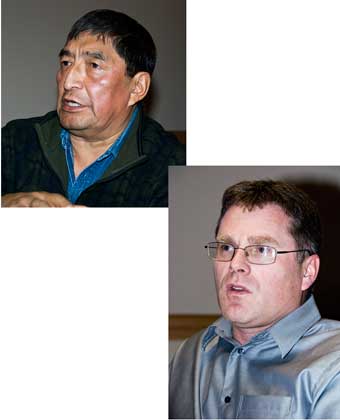
Richard Sidney and Allan Koprowsky
Photo by Whitehorse Star
Richard Sidney and Allan Koprowsky
The Yukon Wolf Conservation and Management Plan is under review, for the first time since it was drafted in 1992.
The Yukon Wolf Conservation and Management Plan is under review, for the first time since it was drafted in 1992.
Among its primary functions is to establish what conditions must exist prior to implementing an aerial wolf-kill or other methods of reducing the wolf population to assist troubled moose and caribou populations.
The review is being conducted by a six-member committee established through a partnership agreement between the Yukon government and the Yukon Fish and Wildlife Management Board.
Richard Sidney, co-chair of the management board, told a news conference Monday afternoon that local renewable resource councils have asked for the review of the document.
Some concern has been expressed by a couple of councils regarding caribou and moose populations in different parts of the territory, Sidney acknowledged.
Updating the document, he added, will also ensure the board and local renewable resource councils keep current with their responsibilities laid out in the Yukon land claim agreements.
Sidney said the intention is to have any recommendations arising out of the review ready by next July.
"What we are looking at over the next couple of months is a series of meetings with communities, councils and First Nations to get some input in the plan,” Allan Koprowsky, assistant deputy minister with Environment Yukon, told reporters.
He pointed out that when the plan was drafted 18 years ago, there were no local renewable resource councils in place, but that's all changed.
Having the councils established now enhances the opportunity to gather local input, Koprowsky suggested.
While the councils were not up and running in 1992, they were contemplated as the parties moved towards finalizing the Umbrella Final Agreement, the blueprint for negotiating individual First Nation agreements which was signed off in 1993.
The management plan, in fact, calls for the agreement of the local renewable resource councils before any wolf-kill programs are implemented.
A budget of $148,000 has been indentified to complete the review.
Karen Clyde, one of three Environment Yukon representatives on the review committee, said the committee will be holding its first meeting next week.
It plans to provide the public with access to background material and a copy of the 1992 plan sometime in January, Clyde said.
She said the committee wants the material out in advance of the community meetings scheduled to begin in February and run through to the end of April.
In addition to setting out conditions required before implementing a wolf-kill program, the plan sets down principles to ensure the long-term survival of wolves across the Yukon.
It also calls upon the government to undertake education efforts to enhance awareness and understanding about wolves, and management decisions affecting the animals.
Eighteen years ago, however, the management plan was viewed by some as a compromise to assure critics of the aerial wolf-kill that there is more to managing wolves in the Yukon than shooting them from helicopters.
The government adopted the policy in December 1993, and the Aishihik wolf-kill began shortly afterwards.
Management of wolves in the Yukon reaches back into the history of the Yukon's aboriginal people, and how they would remove cubs from their dens as a means of controlling the local population to reduce pressure on caribou and moose.
Non-aboriginal programs were common throughout the 20th century, with the use of a bounty program to the use of poison by the Yukon government.
In addition to the aerial wolf-kill, the Aishihik wolf control program included a sterilization program involving the capture of wolves and their release after they were operated on.
In order to encourage thoughtful and responsible discussion, website comments will not be visible until a moderator approves them. Please add comments judiciously and refrain from maligning any individual or institution. Read about our user comment and privacy policies.
Your name and email address are required before your comment is posted. Otherwise, your comment will not be posted.
Comments (7)
Up 0 Down 0
Arn Anderson on Dec 1, 2010 at 4:17 am
As stated before, send the wolves an invoice and summons from the powerful courts to scare them to comply. Or better yet, send them a fine of a $1000 and 30 days Den arrest, they will never do this sort of thing again and deter other wolves of committing the same crimes. HA
Up 0 Down 0
Andre Roothman on Nov 30, 2010 at 10:27 am
Rather manage the humans, they are in need of it. Even better, send them to observe the wolves so that they can learn from them. Most people may pick up some very useful skills, amongst others caring taking care of your children. The problem is with the modern day "sports" of hunting. The hunting for food and clothes are limited to a few people and it has no significant impact on the balance in nature. What a pity that the animals can not shoot back, so we can have some "sports"!
Canus Lupis Africanis
Up 0 Down 0
Francis pillman on Nov 26, 2010 at 10:56 am
Manage predators? Here's an idea, LEAVE THEM ALONE. we have no business determining how many animals should be in a given area. Humans can't even manage themselves, so why give them the right to play God? Oh right, it's called a career. My bad. Everything on this planet has been destroyed because of meddling humans.
Up 0 Down 0
scott mac lean on Nov 26, 2010 at 6:24 am
Thank`s for most rational comment I have ever seen on this subject Terry. Some people seem to think everything is like a Disney movie where all the animals get along. One of the reason we are seeing so much predation is the decline in fur prices thanks to the anti-fur movements. Hunting and trapping has been a part of this country`s history for a long time and thanks to Yukon outfitters assn and local renewable resource councils are helping to make harvesting wolves easier on the pocket book. I also find it funny that Mike Grieco wont let a dog pull a sled but is ok with them getting eaten alive
Up 0 Down 0
Terry Wilkinson on Nov 25, 2010 at 4:10 pm
We have roughly 50 to 60 thousand moose in the Yukon so there are roughly 30,000 cows. We know that they almost all get bred in the fall and can average 110 calves per 100 cows born in May/June, This means at least 30,000 calves are born each May but the moose populations are seemingly in slow to serious decline. We then look at moose calf counts in the following winter and see in most cases less than 30 calves per 100 cows with some places less than 10 calves. Something is killing those calves. Neither sport nor first nation hunters are to blame. We know from studies done that bear, both black and grizzly are the biggest killers of the newborn calves and then wolves take over as the biggest predator.
We need to manage all predators, not just the humans. Stopping the 1 to 6% human harvest, most of which are bulls will not change the downward trend.
It is hunters, first nation and sport who have called in the decline because they are out there on the land.
Up 0 Down 0
Mike Grieco on Nov 25, 2010 at 10:05 am
Alert! Alert! : Major review of human behaviour toward wolves desperately needed!
Up 0 Down 0
bedrock billy on Nov 23, 2010 at 2:19 pm
Whatever happened to the old Animal Rights group's idea of slicing off the male wolves you know whats?