Photo by Whitehorse Star
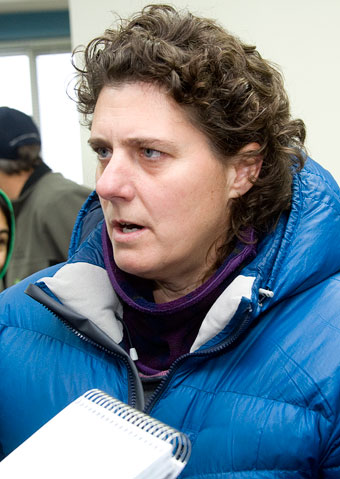
Patricia Bacon
Photo by Whitehorse Star
Patricia Bacon
The withdrawal of the drug OxyContin in Canada this week has sparked renewed local interest in the abuse of prescription medication and the best method to curtail its spread in the Yukon.
The withdrawal of the drug OxyContin in Canada this week has sparked renewed local interest in the abuse of prescription medication and the best method to curtail its spread in the Yukon.
Purdue Pharma, producer of the drug OxyContin, announced that it will no longer be manufacturing the drug in Canada.
Since its release in the mid-1990s, the synthetic-opiate pain killer, sometimes called "hillbilly heroin,”or "oxy,” has been the subject of major controversy, surrounding abuse and ease of addiction.
When snorted or injected, OxyContin causes euphoric effects that mimic those of opiates such as heroin or morphine.
As of tomorrow, the drug will no longer appear on pharmacy shelves Canada-wide.
"The company decided to discontinue the production of long acting oxycodone, OxyContin, in Canada, in favour of a new product and the Yukon will be no exception,” said Diane Tate, manager of extended benefits and pharmaceuticals for the Yukon government.
Part of her job is to provide input into the list of prescription drugs available to seniors and people with chronic illnesses in the Yukon.
"The drug will be replaced in Canada with a drug called OxyNEO, made from the same active ingredient, the drug oxycodone, but more difficult to break down or liquify,” said Tate.
Despite the national attention, the loss of OxyContin isn't likely to make much of a difference in the Yukon.
Abuse of OxyContin is not common on the street here.
"OxyContin, isn't really the drug of choice for abuse in the Yukon,” Patricia Bacon, executive director of the Blood Ties Four Directions Centre, told the Star yesterday.
In terms of opiate abuse, she said, the drug hydromorphone, often sold under the brand name Dilaudid, is more of a concern in Whitehorse.
Other non-prescription drugs, such as crack cocaine, are also more commonly abused than OxyContin.
That's not to say, prescription drug abuse is not a serious issue for the Yukon.
One key concern is the lack of protection against things like prescription forgery, the multiple filings of prescriptions, or "doctor shopping.”
To manage the issue, the government is considering the development of an ehealth system, which would centralize prescription information, from doctors and pharmacists, in a central data-base, which could be referenced by health care providers.
"As it stands, pharmacies currently have their own systems, but none of them talk to each other and no one can go in to check what has been filled by another pharmacy, said Brian Pierson, ehealth information director with the Department of Health and Social Services.
"It's really important from a number of standpoints, to track abuse and from a patient safety standpoint, to reduce averse drug interactions.”
The proposed system would be based on similar databases, already used in provinces such as British Columbia, Alberta, Saskatchewan and parts of the Maritimes.
"We are in the planning and assessment phase to realize what such a system would be for the territory,” said Pierson.
"We've pulled together an advisory group with representatives from community pharmacies, doctors, government pharmacists and representatives of the hospital corporation.”
There are no firm numbers yet as to how much such a system would cost, but it's safe to say it would be an expensive undertaking.
"It would certainly be over $1 million, with additional costs for maintenance,” said Pierson, noting that funding would likely be provided by both the Yukon and federal governments.
For organizers, the benefits outweigh the cost.
"One thing that is important to consider is that this would help address the very valid issue of abuse of prescription drugs,” said Pierson. "But it would have other benefits as well, including reduction of adverse events, increased medical compliance, productivity benefits from enhanced communication between doctors and pharmacy workers and better care.”
According to critics, however, such a database may interfere with a patient's right to privacy and, with still relatively low levels of prescription drug abuse, could actually bring more harm than good.
The ehealth program is being developed alongside a health information system, a separate program which would centralize patient medical histories securely online.
"With the programs, we are running into some problems with human rights issues,” Doug Graham, minister of Health and Social Services, told the Star this morning. "For instance, what kind of information should be made available in order to cut down on abuse of the system, so that doctors can be better prepared, and what should not be included. But who should have access to the system? Should your social worker have this information, for instance? These are the issues we are dealing with.”
Despite the concerns, Graham believes privacy and access issues will be ironed out and the systems will be in place soon.
"Not next year, but hopefully by 2014,” he said.
The notion has been greeted with trepidation by addictions treatment workers.
"There are major privacy concerns at play when it comes to electronic databases,” said Bacon. "We deal with clients who may have HIV and may share their information with doctors and pharmacists that they trust, but they may not necessarily be comfortable sharing that with the doctor that they play squash with.”
She also points out that when it comes to curtailing prescription drug abuse, there may be more urgent issues than pulling drugs off the market or offering better monitoring and regulation.
"The problem is that we do not have enough systems in place for treatment and the standard 28-day abstinence program, is not effective for all people, especially within our aboriginal population,” she said.
"Purdue Pharma changed their formula because their very effective product was too addictive. Their decisions were made for their own reasons, but they did their part. Now it is time for our leaders to do theirs.”
The answer, she said, is less about monitoring abuses of the system, and more about funding programs which offer realistic solutions to curtailing drug abuse.
"For the Yukon, we need to look at investment territorially and federally into our methadone program,” she said.
"We need to be ready to service an increase in clients and it needs to be barrier free. We also need policy support and funding commitments for drug treatment and other types of options for aboriginal people, including back to the land methods here in the territory.”
As of tomorrow, OxyContin will no longer be produced in Canada. Hydromorphone and other opiate-based pain killers will continue to be prescribed to thousands of Canadians annually.
In order to encourage thoughtful and responsible discussion, website comments will not be visible until a moderator approves them. Please add comments judiciously and refrain from maligning any individual or institution. Read about our user comment and privacy policies.
Your name and email address are required before your comment is posted. Otherwise, your comment will not be posted.
Be the first to comment