Maiden French debate made political history
Although the Yukon's first-ever French-language debate started off with a bit of a hiccup Tuesday evening, it proved the francophone community has a great deal of concerns going into next week's territorial election.
By Nadine Sander-Green on October 5, 2011
Although the Yukon's first-ever French-language debate started off with a bit of a hiccup Tuesday evening, it proved the francophone community has a great deal of concerns going into next week's territorial election.
The forum began with an audience member asking Elaine Taylor, the deputy premier and Whitehorse West MLA, why her Yukon Party hasn't said whether it will support the final recommendations for the Peel watershed. It seemed like a reasonable plan to her, the audience member said.
But Taylor answered the question, in English, by talking about the Yukon Party's obligation to follow its obligations around the Yukon Supreme Courts' order this past summer that a new French high school be built within two years.
The forum's host, Julie Carpentier from Radio-Canada Vancouver, asked the question to be repeated in English.
She would give Taylor another chance at answering it.
And so the debating began.
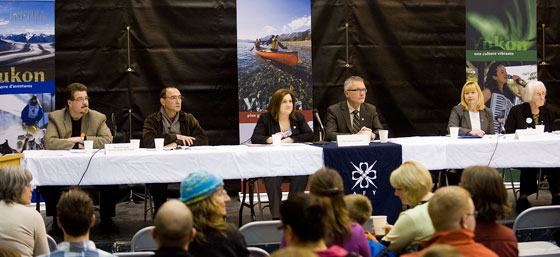
The forum, which took place at École Émilie-Tremblay, covered topics from the court ruling to child care spending to supporting French health care professionals.
The Association franco-yukonnaise (AFY) and the Yukon Francophone School Board (CSFY) put together the debate, asking each party specifically to present their Whitehorse West candidate and at least one other person who could speak French.
Taylor represented the Yukon Party, bringing with her Sandra Henderson, a longtime friend and retired French school teacher.
Henderson helped Taylor in translating questions and other party comments, but didn't say anything to the audience. Taylor read a French-language script to some questions and answered others in English.
Cully Robinson, the Liberals' Whitehorse West candidate, made his opening comments in French but brought with him Liberal campaign staffer Latitia Scarr to cover the French side of the debate.
The NDP's Louis-Roch Gagnon, who is also hoping for the Whitehorse West seat, and Jean-Francois Des Lauriers, the NDP's Porter Creek Centre candidate, answered all the questions in their native tongue.
There was some confusion as to which party supported the new, court-ordered French school, especially from Robinson and Taylor.
"It appears they say one thing to the francophone community, but their leader has a very different stance,” said Robinson. "They've been inconsistent whether they support the francophone school or not. Their leader has said it's not necessary, but their candidate is saying now to the public that it was a mistake.”
"We're not saying it's a mistake,” replied Gagnon. "We said she was misunderstood.”
After the debate, Gagnon told the Star exactly what the NDP's stance is on a new school.
"We're not saying we don't want to build a school. If we have to build a school, we will build a school,” he said.
" We're saying, ‘Let's sit down with everybody and figure out what this school is, and if this is what the community really wants.
"They didn't win the lottery, as some people have said. It's not the lottery; it's a right.”
Robinson said a Liberal government would "reopen good faith negotiations immediately” and turn over the $1.9 million to the CSFY that was earmarked for French programming but never delivered.
During the debate, Taylor spoke to the importance of following process when dealing with the potential new French school.
"As a government, you are responsible to committing to process. In this case, it's a legal process,” the deputy premier said.
"We are seeking an appeal and we are seeking clarification, for not only francophone citizens, but for all citizens of the territory.”
"Process” was the word Taylor used again when talking about the Peel. She echoed what Premier Darrell Pasloski has been saying since the planning commission released its final recommendations: the Yukon Party can't state its position until the consultation process is over.
"We are committed to that process,” she said. "And it is a process that is yet to be completed.”
Robinson replied to Taylor's remark by saying that when a party hides behind a "flurry of words and a hesitant position,” one has to wonder what they really intend to do.
Des Lauriers said all the affected First Nations, the other political parties and the conservation groups have agreed to the recommendations.
"It's a good compromise,” Des Lauriers said, in French.
When an audience member asked each party its intention was in supporting the territory's health care system, Taylor talked about her party's commitment to working on providing adequate health services in French.
These promises are starting to ring a little hollow, Robinson said.
"Doctors have been driven from this territory by policies and practices of this government. When it comes to planning, this is a government that doesn't seem to ever be able to finish what it starts within reasonable cost.”
Robinson used August's reopening and subsequent closure within 24 hours of the Thomson Centre.
"They're pretty good at the announcements, they're not so good at completing them,” he said.
Des Lauriers took a different approach. He asked how the territory can bring in more French health care professionals when they would have nowhere to live because of the chronic housing shortage.
Taylor said the Yukon Party has spent more than $100 million in affordable housing and expanded the housing stock by 40 per cent during its two terms in government.
"It is a very complex issue, but it is as a result of a thriving economy,” she said.
Robinson took another stab at the deputy premier, saying he fears " the incumbent believes her own press releases.
"I've met many families when there are two, even three generations living together becomes they can't find a rental accommodation or anything to purchase,” said Robinson.
"People love their children but they want them out of their basement.”
The young people, he continued, the talent, are being driven from the territory by a completely predictable housing shortage.
About 80 people attended the forum.
Event organizers asked the three parties a list of six question and received written responses before the forum.
Any audience member could put his or her name in a draw for the chance to ask a question.
Comments (1)
Up 0 Down 0
Dave Rogers on Oct 6, 2011 at 4:44 am
It was unfortunate that so much of the debate had to take place in English because only the NDP's candidates could field questions in French. However, I applaud the other candidates for making the effort, and perhaps they now have a greater appreciation of what it's like to be in the linguistic minority: where asking for a glass of water, let alone speech pathology evaluation for your child (a question that was raised), is difficult, confusing, and embarrassing.