Photo by Sam Riches
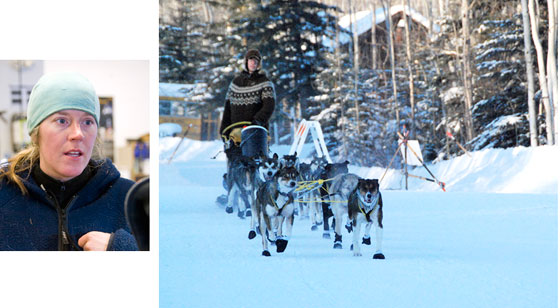
SETTING THE PACE – After departing Circle, Alaska in eighth place, Yukon Quest musher Lance Mackey was the first to arrive in Eagle, Alaska on Tuesday afternoon. Maren Bradley, left.
Photo by Sam Riches
SETTING THE PACE – After departing Circle, Alaska in eighth place, Yukon Quest musher Lance Mackey was the first to arrive in Eagle, Alaska on Tuesday afternoon. Maren Bradley, left.
After leaving the Circle checkpoint in eighth position Monday morning, Lance Mackey was the first Yukon Quest musher into the Eagle checkpoint, arriving at 2:08 p.m. Tuesday.
EAGLE, Alaska – After leaving the Circle checkpoint in eighth position Monday morning, Lance Mackey was the first Yukon Quest musher into the Eagle checkpoint, arriving at 2:08 p.m. Tuesday.
Just one minute behind Mackey was Hugh Neff. Allen Moore arrived in third position at 2:40 p.m.
Brent Sass, who had been leading the Quest since the Mile 101 checkpoint, was the fourth musher in, arriving 10 minutes behind Moore.
Sass, who reached the checkpoint carrying a dog in his basket, was not concerned with his fall in the standings.
"I was surprised to be leading for as long as I was,” he said. "I'm just running the type of race I want to run; I'm not concerned with the standings yet.”
Danish, the dog in question, woke up feeling stiff, said Sass. The decision to carry him was a preventative measure.
"I tried him for a bit but he couldn't really keep up so I loaded him into the sled and carried him 40 miles into here,” said Sass.
"But he got a good break in the sled, and he'll get a good break here and hopefully I'll be able to bring him along.”
The mushers are required to take a four-hour stop at the Eagle checkpoint.
Sass, who said he's had three hours' sleep since the 1,600-km race to Whitehorse began last Saturday in Fairbanks, was planning on resting beyond that point.
"I'm not feeling too bad,” he said, despite the lack of sleep. "When I get out there, I'm feeling good and I sing basically the whole time.
"The dogs react to the singing: it really pumps them up.”
When Sass left the checkpoint four hours later, Danish was back on the team.
Meanwhile, the race has lost another Yukon musher. Maren Bradley, of Carcross, returned to the Circle checkpoint Monday night and scratched for personal reasons.
The mushers still competing now move on to Dawson City, where they will be required to take a 36-hour layover.
The first team to reach the checkpoint will be awarded four ounces of gold. The current market value of the prize is just under $7,000 Canadian.
Sass said he's not concerned about the prize.
"I'm definitely not racing for the gold,” he said. "I'm racing to be within striking distance of my competition.”
Mackey, on the other hand, said he has his eyes on the gold but he's not going to sacrifice his team to achieve it.
"If it looks to me like it's going to jeopardize my team or the outcome of the race in any way by going after gold, then I'm going to hang out,” he said. "I love gold, but I'd rather have the big chunk at the end.
"I don't want to sound greedy but I want them both, simple as that.”
While some may be surprised that he arrived at the Eagle checkpoint in the lead, Mackey said, it's been part of his strategy from the beginning of the race.
"I said early on I was going to keep pretty conservative and get set up to race into Dawson as well as the finish line.
"I was the first one here, but that doesn't mean I'll be the first one into Dawson.”
Mackey, who was forced to pre-emptively drop a dog in Circle before the long stretch into Eagle, said the distance is beginning to wear on some of his young dogs.
"The team's got some nicks and dings. I think at this point, I have 11 pretty solid dogs. I drove 13 in here (to Eagle) but I might leave with 11.”
Mackey ended up leaving the checkpoint at 6:35 p.m ., with 12 dogs on his team. He was the first musher back on the trail.
"I only need nine or 10,” he said before he left. "I've got 10 I would put up against any team around.”
Neff was en route to Dawson just two minutes after Mackey.
Like Sass, Neff also said he wasn't racing for the gold.
"Gold's a fun thing to show symbolically about the Yukon, but the race finishes in Whitehorse,” he said.
"Coming into Dawson with a nice-looking team is what I'm looking for.”
Neff, who was passed by Mackey eight kilometres outside of Eagle, said racing against Mackey brings out the best of his abilities.
"For me, I'm racing against a good buddy of mine who is also the boy wonder,” Neff said of the four-time Quest champion.
"For any musher to beat him is a difficult mission, he's going to bring out the best in you, and he's taught me a lot.”
Neff attributed much of Mackey's success to his dedication and relentless pursuit of greatness.
"He's got such an incredible drive,” he said. "I'm doing pretty good in the race, but I haven't found the eye of the tiger yet, and I have to get that.
"People are waiting for me to get it, and I'm waiting to get it, but I've just got to figure it out. I've got a lot to learn here in the next day or two.”
Though their stay at Eagle was only a few hours, Mackey had nothing but praise for the remote community of about 180 people.
"Eagle is the place I should have a home. I love it here,” he said.
"In my opinion, Eagle is the kind of place that Alaska is known for. You think of remote wilderness, hard to get to, hard to get out – Eagle's that place. It's down to Earth living; that's the kind of person I am; I fit right in here.”
The Quest field has been narrowed to 19 mushers from the original 24.
Jason Weitzel, a rookie musher from Two Rivers, Alaska, also scratched at Circle after hurting his soldier, making it very difficult to lift anything. Weitzel was profiled in Tuesday's Star because he was using the race to raise money for wounded war veterans.
Russian musher Nikolay Etteyne returned to Circle on Monday night after initially venturing on to the next checkpoint to officially scratch.
In the Quest 300 race, Josh Cadzow of Fort Yukon, Alaska, took home first place in the event for the second time in his career.
Cadzow first won the race in 2007. The 24-year-old is preparing to run in the Iditarod Trail Sled Dog Race from Anchorage to Nome next month.
Rob Cooke of Edmundston, N.B., placed second. Cooke was the only Canadian in the race.
Cooke also received the Vet's Choice Award for exemplary dog care of his team of Siberian huskies.
See related coverage
In order to encourage thoughtful and responsible discussion, website comments will not be visible until a moderator approves them. Please add comments judiciously and refrain from maligning any individual or institution. Read about our user comment and privacy policies.
Your name and email address are required before your comment is posted. Otherwise, your comment will not be posted.
Be the first to comment