Low-impact technique called mining's ‘horseless carriage'
The future of low-impact mineral exploration is here, says Shawn Ryan, the Dawson City man credited with starting what's been called the Yukon's second gold rush.
By Chuck Tobin on March 28, 2014
The future of low-impact mineral exploration is here, says Shawn Ryan, the Dawson City man credited with starting what's been called the Yukon's second gold rush.
Jerry Asp, co-chair of this week's First Nations Resource Conference, agrees.
In fact, Asp believes Ryan's cutting-edge method for the early stage of exploration will soon be the new standard insisted upon by First Nations.
"This is the biggest advance in exploration that I have seen, and I have been 48 years in the exploration industry,” the Tahltan elder said in an interview Thursday after the close of the conference.
"Just from a First Nations point of view, I am a thousand times happier because of the low impact.”
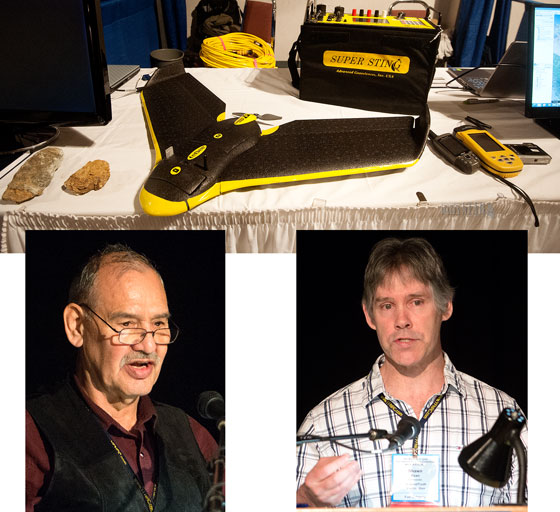
Ryan presented the conference with his new approach that includes two specialized tracked vehicles designed by him and his team at Groundtruth Exploration and an airborne drone that produces high-resolution 3-D maps of the target area.
Like Asp, Ryan too believes his program will become the new standard, and not just for the low impact it has on the environment compared to most early-stage exploration initiatives.
Work that would normally cost $500,000 to $700,000 and could easily take two summer seasons he can do in 15 days for $100,000 and come up with the same quality of information investors rely on to make decisions, Ryan explained.
He said because the environmental impact is near nil, there are very little if any associated reclamation costs.
With his method, Ryan said, he can be sitting in his wall tent at night sending the investor or geologist a computer-generated profile of what the exploration program turned up that day.
The geologist can plug the 3-D map into Google Earth and know exactly where the work is occurring.
Based on information from the field and the 3-D map, the geologist is able to redirect the exploration activity overnight if so desired.
Ryan's reputation as a leader in the early stages of exploration took off a few years ago with his involvement in the gold discovery near the confluence of the White and Yukon rivers approximately 160 kilometres south of Dawson City.
In 2011, he and his crew collected 170,000 soil samples in the White Gold District. It was the most aggressive exploration campaign in the world that year.
Ryan would fly in his trenching crew with a small backhoe to do digging. Another crew would follow to collect the samples, and the backhoe crew would return to fill in the trenches.
The crews were using small, low-impact backhoes light enough to be slung in by helicopter.
But Ryan wanted to reduce his impact on the environment even more.
His team, he said, are hunters and trappers like himself who learn from the land. They wanted their search for gold not only to be as economical as possible, but with the least impact to the land.
So they sought out to improve their methods.
Ryan said they've pulled together the best technology around the world and put it all under one roof.
In 15 days, they'll do what could have taken two seasons, without having to cut any line or dig any trenches.
The program starts by programming the drone with a grid of the exploration site. Hand-launch the drone, and it does the rest, flying itself 120 metres above the ground before returning to the launch site. No remote control required.
So detailed is the 3-D product that it can pick up bumps or depressions in the ground that may indicate archeological sites or old graves.
The crew follows up with an apparatus that sends electronic signals through probes pounded into the ground to obtain a subsurface profile that helps narrow down the target.
The geoprobe is on low-impact tracts, and can be slung in by helicopter in two loads. It manoeuvres in such a way that it can walk up to tree, go around it and continue on the same line without having to disturb the tree.
Where there was once a trench, it punches a six-centre hole and collects a soil sample.
The "ray gun” immediately provides and logs an assessment of the mineral content, though the samples are kept and sent to assay labs for confirmation.
Ryan provided a slide of the geoprobe working on a 45-degree slope in winter.
The third and final stage calls for the rotary air blast drill, RAB. The RAB is also on low-impact tracts, and can drill down to 30 or 40 metres, or up to 100 metres with a booster pack.
Five days using the resistivity apparatus to profile the subsurface, another five days on the geoprobe and the last five on the RAB and the program is done.
Fly the drone one more time and it will let you know if a gas can has accidentally been left behind. It can tell you if a five-centimetre rock has been moved.
Ryan said he and the Groundtruth crew have tested the quality of the information on nine advanced exploration sites where conventional methods were used and results were known. It works.
The Yukon Geological Survey is currently doing a peer review of the data produced.
Ryan said it'll probably take another year before the geological community gives the thumbs-up.
But Groundtruth is already planning to have three crews in the bush this summer – two in the Yukon and third available for anywhere in the world.
This is, he insisted, a major advancement for the exploration industry, and he wants to share it.
The industry, he said, is always painted with the same brush: if one company leaves behind a mess, everybody gets tarnished.
The method developed by Groundtruth leaves behind virtually no visible disturbance, and all the work fits under the Class 1 exploration category, the lowest level that does not require an environmental screening.
"All that is left is a little dead grass,” Ryan said of the site once his company is done. "So we are able to evaluate these sites without scaring them up.”
Ryan said he understands the ongoing debate in the Yukon around Class 1 activity, what should and shouldn't be allowed, and the need to consult First Nations.
Some day soon, he expects, the First Nations will demand the type of low-impact approach developed by Groundtruth as the industry standard for early-stage exploration.
"It will not only be the First Nations but it will be the investors in Toronto and Vancouver because they know this is going to be the best bang for their buck, and its the best for the environment,” said Ryan.
"It's here,” said Asp. "It's the horseless carriage, compared to the old horse and buggy.”
As for the eight low-impact backhoes Ryan used in his record-setting 2011 exploration, they're all for sale.
Comments (2)
Up 7 Down 6
Common Sense! on Mar 31, 2014 at 12:16 am
This is great and a real step forward.
The one thing I would question is the disturbance to wildlife. Not sure how much noise these things make and how much they would have to fly to get the results they need. How low do they fly?
Speaking of wildlife, more mining brings more people from the south. Had the pleasure of over hearing a conversation last night, where a new comer to the territory was picking the brain of a Yukoner about when he could go out and kill any animals? He was not interested in eating wild animals all's he wanted to do was kill. Yukon will need to think about how we are going to address that situation before the southeners start coming in droves.
Up 10 Down 3
Doug Martens on Mar 28, 2014 at 2:22 pm
Low Impact Exploration is definitely going to be the wave of the future for mining. Cut lines and bulldozed roads downgrade the wilderness feel for decades. Now, if only mineral extraction can be done on the same general basis, and with the same attitude of care, it would seem possible for all user groups to finally get along! Kudos and salutations guys!