Photo by Whitehorse Star
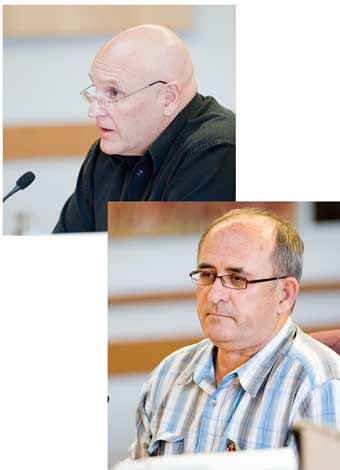
Top - Chamber chair Gerrard Fleming Bottom - Real estate association president Mike Racz
Photo by Whitehorse Star
Top - Chamber chair Gerrard Fleming Bottom - Real estate association president Mike Racz
The future of the city's Official Community Plan (OCP) is now in the hands of the Yukon government.
The future of the city's Official Community Plan (OCP) is now in the hands of the Yukon government.
City council approved second reading of the planning document Monday night. It must now wait for ministerial approval of the document before it can vote on third reading to adopt the document, which acts as an overall guide for city planning.
Last night's vote came after more than a year of public meetings, consultations, drafts and other processes to refine the document.
It also follows a public hearing last month where numerous residents spoke out against the possible development suggested for areas near McIntyre Creek, and between Boswell Crescent and Firth Road in Riverdale, among others.
In bringing forward second reading of the bylaw for the document, planners suggested a number of changes including priority planning for sites of significant interest in development.
Before granting unanimous consent on second reading last night with the changes, council members each expressed their desire to take a "balanced approach” in addressing the need for housing with sustainability and environmental stewardship.
As Coun. Florence Roberts pointed out, the issues brought up over the development will be scrutinized through future processes, like zoning, before anything can happen on the land.
"We will ensure the public is involved at all points,” she said, adding that "compromise” is a good word in describing the OCP.
Roberts and other council members also praised the extensive public consultation process that the planning department did in developing the document.
Coun. Dave Stockdale also had the word "compromise” at the ready.
The city, he explained, has to look at the entire community when it considers the document. It's important for residents to realize there has to be a compromise, and the city will do a lot of work to plan before any development happens.
"This infilling has to take place,” he said, stating the need for sustainability.
The city has reached a "tipping point”, Stockdale said, pointing to the price of lots and the need for development.
"We've given in a lot of areas,” Coun. Doug Graham added, speaking of the public outcry not to develop in certain areas and the city's proposal for priority planning before any work is done .
"Porter Creek D (near McIntyre Creek) will be studied,” he said. While there will always be pieces of the OCP he disagrees with, he added, he believes that overall, it is a good document.
As Coun. Betty Irwin said: "The OCP is a vision.” Like all plans, it doesn't always go in a straight line, she said.
Compromises had to be made, she said as she went on to stress that the growth of Whitehorse will end up encroaching on the natural environment.
Irwin suggested a better way to deal with wildlife and the natural environment is to make sure there's space for wildlife outside of the urban boundary within the city.
She added she looks forward to solving some of the issues brought up through the further planning.
Coun. Ranj Pillai was quick to point to the priority planning that will be done prior to development. One of the first things Riverdale will need before any infill can be looked at is a well-head study, he said.
In any case, infill is "a must”, Coun. Dave Austin said, noting that there are only certain areas of the city that will ultimately be developed.
Council spent the first part of last night's meeting listening to representatives of the Whitehorse Chamber of Commerce and Yukon Real Estate Association argue in favour of development.
Chamber chair Gerrard Fleming pointed to the negative impacts the price of housing is having on prospective workers coming to the territory. Real estate association president Mike Racz noted the situation is affecting access to housing, raising prices and exerting pressure on the rental market.
Both stated their support for the OCP sections aimed at opening up land for housing.
Fleming began by noting significant increases to the territory's population and a plunge in the amount of rental units available.
"The real estate market in Whitehorse is experiencing a decrease in listings and that, combined with the low vacancy rate, has created a situation within which people coming to Whitehorse to work are having a difficult time finding a place to live,” he said, reading directly from a letter he sent to council on Aug. 2.
While the territory has done a good job of luring investment, one of the side effects is the stress it creates on housing.
"As growth continues, the availability of housing must outpace it to balance the effect of supply and demand,” Fleming said.
"Early this year, the Yukon Bureau of Statistics presented facts that showed we have not been meeting our housing demands. The cost of housing in Whitehorse has increased by 90.1 per cent since quarter four of 2003 to quarter four of 2009, while inflation grew only 12.3 per cent over the same six-year period.”
The policy to keep a two-year supply of lots in order to keep property affordable has not been met, largely due to what Fleming termed "the ferocity of Whitehorse's ‘Not In My Backyard' – NIMBY – attitude.
"Although the city does have plans for Whistle Bend, at best it will be another two years before development begins.”
He went on to argue that by opening up lots, the city would increase its tax base so the money will be there to reinvest in older infrastructure.
"The Whitehorse Chamber of Commerce supports the city's efforts to develop infill housing areas around the city such as Riverdale and Porter Creek,” Fleming said, going on to note that the 25,690 residents in the city should be able to work together to solve the growth issues the city is facing.
"With proper planning, the environment of subdivisions, like Riverdale and Porter Creek can be protected, yet also help to meet the demands of a growing community,” he concluded.
The chamber will have about 500 members in the coming year, said chamber president Rick Karp.
Racz also stated his support for infill, noting it will help revitalize neighbourhoods.
He pointed out that while it may reduce green space directly in that area and expand the population, housing in neighbourhoods that have already been established is consistent with the area.
Infrastructure costs are also significantly lower, Racz said.
The association believes in taking a "balanced approach” to development, and that the city "must” consider the needs of all residents, he added.
In order to encourage thoughtful and responsible discussion, website comments will not be visible until a moderator approves them. Please add comments judiciously and refrain from maligning any individual or institution. Read about our user comment and privacy policies.
Your name and email address are required before your comment is posted. Otherwise, your comment will not be posted.
Comments (2)
Up 0 Down 0
Don McKenzie on Aug 11, 2010 at 2:47 am
So...The plan is, that sometime down the road, some council will have to make decisions?
Up 0 Down 0
SIDEWALK WANTER on Aug 10, 2010 at 8:44 am
Funny, the City wants to create more lots, and more subdivisions, but they can't even finish the ones they have now! look at the low income familiesd living on Centennial street, whos children have to walk to school along the side of a busy road, or in the bush as there are no sidewalks for them to use! Guess we will just have to wait until someone gets hit by a car going by before they will put in sidewalks!!! I BET THE NEW DEVELOPMENTS WILL HAVE SIDEWALKS, AND THEY WON'T BE LOW INCOME FAMILIES! FINISH WHAT YOU STARTED!