Long-term energy options exploration set
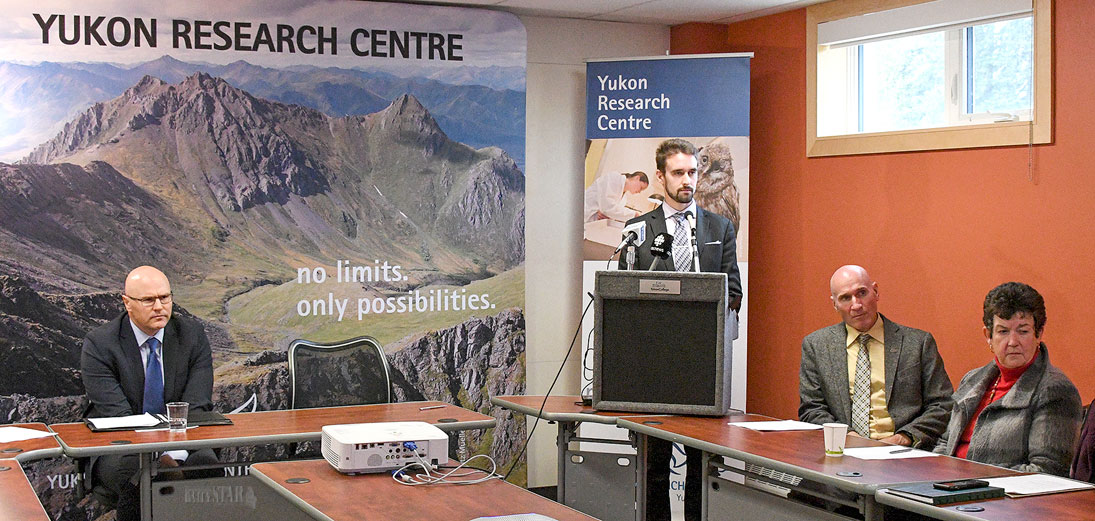
A new $2-million initiative to explore energy options for the North over the next five years was unveiled Monday at the Yukon Research Centre.
By Chuck Tobin on September 20, 2016
A new $2-million initiative to explore energy options for the North over the next five years was unveiled Monday at the Yukon Research Centre.
The project involves a partnership between Yukon Energy, ATCO Electric Yukon, the Northwest Territories Power Corp., Nunavut’s Qulliq Energy Corp. and the federal Natural Sciences and Engineering Research Council.
Yukon Energy president Andrew Hall and ATCO Electric general manager Jay Massie were on hand at the research centre for the announcement while senior representatives of the other two utilities participated by video conference.
The research council has also awarded Yukon College with an industrial research chair to head the Northern Energy Innovation exercise.
Dr. Michael Ross will chair the initiative while working closely with the Northern Energy Consortium made up of the four utilities which have each committed $50,000 annually for the next five years to match the $1 million from the federal research council.
Ross was introduced Monday at the press conference held to announce the project.
“The objective is to perform unbiased and independent research to address the identified needs that are common to the territories in order to advance the northern energy industry to the benefit of all northerners,” said Ross.
Representatives of each utility spoke briefly.
All agreed combining financial resources through the partnership presents research opportunities that might not otherwise be available to them as individual companies.
They also congratulated Ross for his appointment.
“Dr. Michael Ross has his PhD in electrical engineering from McGill University focusing on microgrid control with a high integration of renewable generation,” Stephen Mooney, director of Cold Climate Innovation at the Yukon Research Centre, said in his introduction of Ross.
“His areas of expertise also include energy storage systems and distributed generation, and he has gained practical experience through project implementation at the Hydro-Québec Research Institute.”
Representatives of the four utilities said they all face similar challenges in that all three territories are isolated from the North American grid, and each have a varying number of isolated communities relying solely on diesel generation for power.
In fact, every community in Nunavut relies on diesel generation while there are 25 diesel-dependent communities in the N.W.T. and six in the Yukon – Watson Lake, Swift River, Destruction Bay, Burwash Landing, Beaver Creek and Old Crow.
“I will be developing the applied research projects with the goal of producing implementable deliverables on the power systems and knowledge dissemination to communities throughout the territories,” Ross said.
The research chair said the utilities have identified six areas of interest to begin with:
• The integration of renewable energy into isolated community grids – how can we integrate a high level of renewables into isolated communities to reduce our reliance on diesel?
• Energy storage – what storage technologies are viable in the North and how can they help with integrating renewables?
• Diesel efficiencies – how can we operate existing diesel systems more efficiently to reduce both consumption and emissions?
• Residential and utility partnership – what technologies can support the public to be off grid?
• Demand side management – how can smart meters be best used to make energy consumption more efficient or to better match renewable generation?
Ross said he has talked to and will stay in touch with energy officials in Alaska regarding the advances the state is making using renewable energy to reduce diesel dependency among its isolated communities.
Emanuel DeRosa, president of the Northwest Territories Power Corp., said their goal is to reduce dependency on diesel generation by 50 per cent over the next 20 years. They’ve already achieved a 30 per cent reduction over the past 20 years, he said.
“This opportunity to collaborate and combine financial resources to find renewable solutions that work in the North will benefit everyone,” said Massie.
“ATCO has, and will continue to, evaluate the feasibility of renewables in all our communities and the NEC and the results from Michael’s projects will benefit not only our customers, but the entire North.”
The Yukon Energy president said the work guided by Ross and the Northern Energy Consortium will help to offset the cost of diesel generation and assist Canada in meeting its commitments to reduce green house gas emissions.
Another challenge common among the four utilities is how to adapt renewable technologies to fit with the northern grids, Hall said.
“Something that works in Southern Canada or elsewhere in the world is not necessarily a good fit for the North,” he said.
“Part of Michael Ross’ work will be to help identify the most suitable use of new technologies in northern energy systems.
“In particular, his research will focus on using storage technologies – for example batteries – to better integrate renewables into isolated diesel grids.”
Hall said if you can bring more renewable energy onto your system, you should be able to reduce costs for ratepayers.
Janet Moodie, interim president of Yukon College, said in addition to the partnership of the four utilities, the Aurora Research Institute at Aurora College in the N.W.T. and Nunavut’s Arctic College are also on board with the Yukon Research Centre.
“The chair and his partners will work to solve industrial challenges while sharing these results publicly and transferring this knowledge to industrial partners, students, and the scientific community at large, creating a mutually beneficial partnership,” she said.
Moodie also emphasized the college is proud to have been awarded its second industrial research chair following the appointment four years ago of Dr. Amelie Janin to head research into the challenges of mining in the North.
Mooney said while the initial arrangement is for five-year terms, if the research proves productive and cost-effective for the utilities, there is the possibility of extending the project to a second five-year term and even a third.
In an interview afterwards, he said while the annual budget for the Northern Energy Innovation project works out to be $400,000 annually, they will be using the core funding to leverage additional federal funds to boost research efforts.
Be the first to comment