LNG studied as option to burning diesel fuel
Yukon Energy has its sights set on natural gas.
By Chuck Tobin on November 16, 2012
Yukon Energy has its sights set on natural gas.
A senior staff member has been assigned full-time to investigate whether the publicly owned utility should replace its diesel generators in Whitehorse with generators that burn natural gas, the Yukon Utilities Board heard this week.
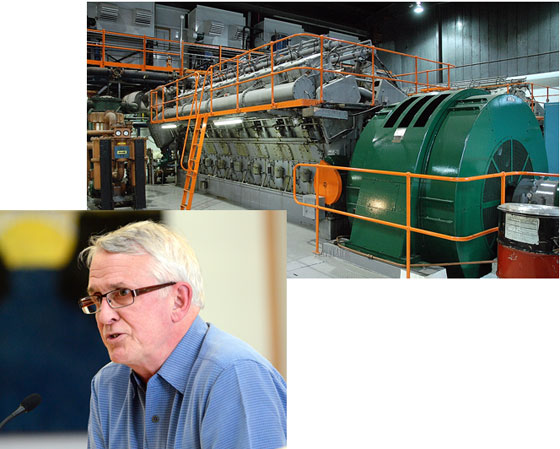
Yukon Energy president David Morrison told members of the board the life cycle for all seven diesel generators at the Whitehorse Rapids Dam will expire by 2018, or sooner.
The corporation is currently comparing the cost between new diesels and natural gas units, the cost of fuel for both and the logistics of trucking liquified natural gas to the Yukon, he said.
Morrison told members of the board there's also the issue of building a facility to store the natural gas here, and what it would cost.
Potentially, the president said, there may be an opportunity to switch out the diesels in Dawson City and Mayo as well, though the focus now is on Whitehorse to see if it's even feasible.
"I do not have a good cost right now,” Morrison said Wednesday during a break on the last day of public hearings into Yukon Energy's application for an increase in electrical rates.
"But if we are getting into the range where it is cheaper than diesel, then why wouldn't we do that?” he asked.
"We think it is significantly cheaper, but we do not know. We are doing that work right now.”
As an added advantage, he said, using natural gas generators would open the door to using waste heat opportunities for heating buildings in Riverdale, like the hospital and schools.
Morrison said two of the diesel generators in Whitehorse are due for replacement in the next three years.
To be ready, Yukon Energy needs to make a decision within the next year, one way or the other, he said.
Morrison told the board very little would be required in terms of redesign at the dam's diesel plant. Generators powered by natural gas would fit nicely in the areas already occupied by each diesel unit.
If fact, he said, natural gas units of the same size would have a greater capacity than the diesel generators – eight or nine megawatts of natural gas vs. five megawatts of diesel.
Morrison told members of the board the days of Yukon Energy having surplus hydro energy are over.
Growth over the last few years in all sectors – residential, industrial, commercial – has taken up whatever surplus there used to be during the peak winter time loads.
He said in the last couple of winters, diesel generation has been needed regularly.
Yukon Energy has submitted its 20-year resource plan to the utilities board for review. The plan identifies the use of natural gas as a near-term possibility.
Yukon Energy consultant Cam Osler told the board the interest in importing liquified natural gas as a viable option to power generators originated in discussions with a mining company looking at options to power a mammoth mining project.
If the Casino open pit project goes forward northwest of Carmacks, Osler explained, it would require more power than Yukon Energy has on its entire system.
Osler told the board Western Copper has indicated it's looking at importing liquified natural gas to power its own power plant on site at the Casino property.
Information provided to Yukon Energy last January during a workshop to examine the use of natural gas instead of diesel pointed to several benefits, including air emissions with a much higher quality than diesel.
Burning natural gas, for instance, produces half the greenhouse gases compared to diesel, according to information provided to the workshop.
To get the same muscle, says the information, natural gas costs half as much or less.
Generating capacity at the Whitehorse Rapids Dam is made up of four hydro units totalling a capacity of 40 megawatts, including the 20-megawatt fourth wheel added to the facility in the early 1980s.
There are seven diesel generators varying in size with a total capacity of 23 megawatts.
There are another 10 diesel units spread across the grid north to Dawson, with a total capacity of 14.1 megawatts.
"We could save a significant amount of money going forward by having LNG as a backup fuel for our Whitehorse plant and replacing our current diesel engines that are due for retirement with gas-fired engines,” Morrison told members of the utilities board when defending the $800,000 or $900,000 Yukon Energy spent this year researching the LNG option.
"So I think the LNG project meets – very much meets – the reasonable assurance test.”
Yukon Energy has applied for a 12.9 per cent increase in electrical rates for 2012 and 2013, retroactive to Jan. 1 of this year.
The board approved an interim hike of 6.4 per cent for half of this year, pending a final decision on the rate application. The 6.4 per cent began showing up on the monthly bill July 1.
The board has also approved an additional 3.5 per cent boost for 2013, beginning Jan. 1.
The board is not expected to make a ruling on the rate application until early next year.
See letter.
Comments (2)
Up 0 Down 0
north_of_60 on Nov 16, 2012 at 6:06 pm
"in the last couple of winters, diesel generation has been needed regularly."
A large amount of that diesel fuel is burned on cold winter mornings to provide electricity to thousands of electric hot water heaters, in unoccupied houses, after everyone has left for school or work. Forty years ago electric utilities were using relatively primitive technology to control electric hot water heaters to manage expensive peak loads. It seems like our current digital technology should be able to do that even more cost effectively.
We shouldn't be expected to pay more for electricity until they start using readily available, cost effective means to manage peak demand and use less diesel generation.
What happened to "Power Smart" thinking?
Up 0 Down 0
wundering on Nov 16, 2012 at 11:22 am
Why couldn't they use Yukon gas?