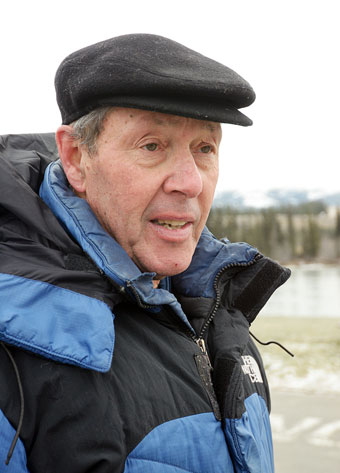
Photo by Whitehorse Star
Don Roberts
Photo by Whitehorse Star
Don Roberts
The Yukon government is seeking input on proposed regulations to guide the construction and operation of natural gas plants in the Yukon.
The Yukon government is seeking input on proposed regulations to guide the construction and operation of natural gas plants in the Yukon.
The regulations would also cover the construction and operation of facilities relying on a supply of liquefied natural gas (LNG).
Government spokesman Jessie Devost of the Department of Energy, Mines and Resources said this morning the department expects to have the regulations in place this summer.
Yukon Electrical Co. Ltd. is planning to switch one of its diesel generators in Watson Lake to a combination generator powered by diesel and natural gas, which would require the transportation of LNG from B.C.'s Lower Mainland.
Devost said the territorial government is aware of Yukon Electrical's plans and does not expect the development of the new regulations will interfere with the project.
Regulations, he pointed out, can be approved by the territorial cabinet under the existing Oil and Gas Act.
Once public input is gathered by the May 8 deadline, the department will prepare the regulations for review by the cabinet, he said.
"We are aware of that,” he said of Yukon Electrical's plans.
"If things proceed at the expected timelines, it should not interfere.”
Yukon Electrical believes that converting the diesel generator to a combination unit will be less expensive, with much cleaner air emissions.
Its proposal calls for displacing 50 to 70 cent of the diesel fuel with natural gas converted in Watson Lake from liquified natural gas trucked up the highway.
Yukon Electrical has indicated if the unit performs as well as the company anticipates, it would follow up next year with the conversion of the remaining five diesel generators to combination units.
Yukon Energy has also stated its intention to explore the conversion of its seven diesel generators at the Whitehorse Rapids Dam facility, beginning as early as 2015.
Yukon Energy president David Morrison has said publicly a couple of the diesels need to be replaced one way or the other because of age, and replacing them with natural gas may be more economical with cleaner emissions.
"We are still looking at it,” Morrison said this morning. "We have not made a decision yet.”
The public debate over the controversial practice of hydraulic fracturing to extract natural gas from deep shale deposits has spilled over to the discussion around the use of LNG instead of diesel.
Many argue that if the natural gas is extracted through the use of fracking, there may not be a net benefit to the environment if it's used to displace diesel, because negative impacts on ground water may outweigh benefits in air emissions.
In a press release this morning, the local organization concerned about oil and gas development in the Yukon suggested moving to LNG over diesel would only hasten the use of hydraulic fracturing in the Yukon.
Natural gas is available in the territory, and it would not make sense to keep importing LNG when a local source is available, said the release from former Yukon MLA Don Roberts, the chair of Yukoners Concerned about Oil/Gas Exploration/Development.
Roberts points out the bulk of natural gas in the Yukon is found in shale deposits, which requires fracking to extract the gas.
In order to encourage thoughtful and responsible discussion, website comments will not be visible until a moderator approves them. Please add comments judiciously and refrain from maligning any individual or institution. Read about our user comment and privacy policies.
Your name and email address are required before your comment is posted. Otherwise, your comment will not be posted.
Comments (1)
Up 0 Down 0
north_of_60 on Mar 11, 2013 at 12:04 pm
The overwhelming majority of new wells that are hydraulically fractured as a normal procedure during gas well completion have never exhibited any problems with groundwater contamination. Therefore the burden of proof is with the "Yukoners Concerned about Oil/Gas Exploration/Development" organization, to show that drilling and hydraulic fracturing Yukon gas deposits will cause harm to the ground water. Not maybe, not possibly, not hypothetically, but proof that it WILL cause harm.
We need regulations and enforcement with "teeth" to ensure that the valid concerns raised by "Yukoners Concerned about Oil/Gas Exploration/Development" are appropriately addressed. The organization's energies would be better spent working to improve O&G regulations.
Those regulations should ensure that any well to be hydraulically fractured must be specifically evaluated and the risk to the groundwater from hydraulically fracturing be quantified before any 'fracking permit' is issued.