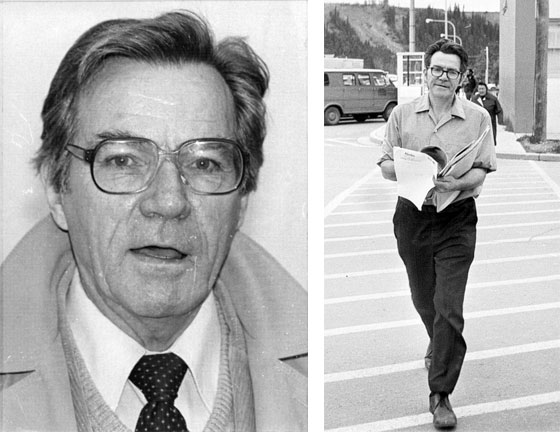
Photo by Whitehorse Star
A NEWSMAN THROUGH AND THROUGH - One of many major stories Bob Erlam covered was then-U.S. senator Robert F. Kennedy's 1965 ascent of the Yukon mountain named after his brother, slain president John F. Kennedy.
Photo by Whitehorse Star
A NEWSMAN THROUGH AND THROUGH - One of many major stories Bob Erlam covered was then-U.S. senator Robert F. Kennedy's 1965 ascent of the Yukon mountain named after his brother, slain president John F. Kennedy.
Bob Erlam was a storyteller at heart.
Bob Erlam was a storyteller at heart.
And for every tale he had, it seems there's one just as interesting about him.
After Erlam's death Thursday morning in B.C., Yukoners are remembering the former Whitehorse Star owner's boundless energy, endless curiosity, long stories and advice he passed down.
"He'd come into the room and the whole place would light up," former Star editor Max Fraser said in an interview Thursday afternoon.
Before selling the daily newspaper to current owner Jackie Pierce in 2002, Erlam and his wife Rusty owned it for 35 years, though Erlam's history with the paper began in the early 1960s, shortly after the couple returned to the Yukon, with a cartoon penned by Erlam of a dispute between a local resident and the electric company.
He pinned the cartoon to the door of the Star and it ran on the front page of the paper the following day with then publisher/owner Harry Boyle asking Erlam if he'd work for him.
Thus began Erlam's long career in the newspaper business following service in the Second World War overseas in North Africa and Italy followed by jobs in steam fitting, carpentry, electrical, and as a diesel operator after he and Rusty first came up to the Yukon in 1947.
The couple and their then 16-month-old son Paul came up to the territory at the insistence of one of Erlam's old army buddies who told him there were great opportunities here.
The family found themselves living downtown with two of Erlam's friends and their wives in a two-bedroom house that had no running water; Paul sleeping in a dresser drawer.
Many remember Bob and Rusty as an "inseparable" couple and together they were an integral part of the Whitehorse theatre scene directing and producing a couple of plays each year, with Bob building the sets and producing the plays while Rusty directed the productions which attracted audiences of upwards of 500.
The couple was also behind the construction of the Whitehorse Drama Club on Second Avenue in those years, with the building serving as a rehearsal hall until it was demolished in 2002.
The family left the territory for B.C. in 1958, but two years later they were back and Bob went to work at the Star not long after that.
In a 2002 interview, Bob remembered those early days that saw him doing a bit of everything at the newspaper.
"I thought it was the greatest job in the world to be doing everything," he said. "You know, you just weren't doing one thing in those days; you were doing everything, taking pictures, I got to takin' pictures, fixing presses and things like that. It was a ball."
The one thing he didn't do though was a lot of writing. As he pointed out, he couldn't spell so anything that might have been attributed to him as a writer had been vetted through Rusty.
All the while the couple was also raising their young son.
Paul remembers being very young when he and his dad would spend every Sunday heading out into the bush to go "hunting."
"He would track animals," Paul said Thursday afternoon, recalling carrying the .22 rifle his dad had cut down so he could lift it, and the days spent building a shelter and cooking lunch outside.
To this day, Paul refers to his mom and dad by their first names, something he picked up when he joined the Star staff years later after Bob had taken over the operations.
It was in 1963 that Bob arrived at work one day to find a note from Boyle saying he was now in charge since Boyle wanted to go back to law school.
While Boyle would go on to become a judge, Bob took over as publisher and then in 1967 bought the Star with Rusty.
He had convinced her to leave her government job in travel and publicity to write for the paper, under then editor Flo Whyard with Paul running the press for a few years already.
"It really was a family newspaper," Paul said, remembering initially when people would come in and ask to speak to the boss, he'd tell them he'd go get "Dad" only to be met with confused looks.
With each member of the family playing a role in the newspaper, the family told the tales of events of both local and international significance happening in the territory from municipal and territorial elections to the climb then U.S. senator Robert Kennedy made up Mount Kennedy - named for former president John F. Kennedy, after his assassination - in the Saint Elias range.
As Bob once told the story:
Time Magazine had phoned the paper to get the story so with Time footing the bill, Bob hired a plane to take himself, Wayne McDonald, "a young air force chap" who would take colour photographs, and Alex Van Bibber, a guide and big game outfitter in case "anything went wrong and we got caught in a storms, I wanted someone with me who knew what the hell he was doing in the wild."
At the Star, Whyard had to explain over the phone to Time's staff there was only one flight Outside per day and that to even get the film to the flight, it had to come off the mountain first.
On the mountain, photos of the Kennedy party were being snapped, Bob getting one of Kennedy "unshaven, tired but triumphant" after a day of climbing.
The next day Bob found himself waiting for a ride that wasn't coming.
"No one would take my film out, no pilots, no climbers," Bob wrote. "So I thought what the hell and asked Kennedy if he would. He said he'd be glad to. So that's how we got it out and my picture of him in Time (and on the front of the Star).".
When Gordie Ryder remembers Bob's years in the territory, it's not the Kennedy picture that immediately comes to mind, but rather a photo his friend took during a river trip one time when they came across two moose in the water.
The river trip was one of many the pair would share over the years, but it was rare to come across two moose like that so they slowed the boat down, Bob taking his camera out to get the pictures that would later turn up in the Star, Ryder recalled this morning.
"We had lots of fun," he said, recalling the many trips they made. The friends were also both members of the Yukon Order of Pioneers.
Weekend river trips with six or eight people in the boat at a time were often made in "celebration" of wrapping up the week with a 40-page paper, Ryder said.
Another river trip saw Ryder and Bob delayed for upwards of 16 hours after hitting rocks that banged up the boat so much it looked like cauliflower, Ryder said.
They had to stop to bang out some of the dents and then proceeded down the river at a slow two- to three-mile-per-hour pace.
Back at the Star, the newspaper continued to grow and change with staff and technology.
The Star moved away from letterpress printing to offset printing with Paul working in the midst of the switch.
Working in the pressroom on Main Street, Paul was surrounded by rolls of paper and dog sleds (belonging to friends of Bob's who would come by), another passion of Bob's and one he found himself sharing with radio listeners in the southern United States one day.
Setting up yet another story, Paul remembered his dad had between 15 and 20 sled dogs staked out in the forest until one day two were gone with a friend of his suggesting they had been eaten by a cougar.
Never actually having an office of his own at the Star, Bob was sitting in Pierce's office one day when the phone rang.
On the other end was the producer of a radio show who had dialed the wrong number, but as they got talking, told Bob his radio show has him phoning and interviewing interesting people.
"Bob said 'I'm interesting, put me on'," Paul recalled.
So with that, the talk show host interviewed Bob who told him at -56 C he had just run his dog team, but he was down two dogs that had been eaten by a cougar.
"The guy didn't know whether to believe him," Paul said.
It's one of many stories Bob would tell most anyone willing to listen.
To get the full effect of Bob's stories though, you had to hear them from Bob, Pierce said.
"We're all going to miss him," she said.
In 1972, Pierce met Bob when she dropped off her résumé at the Star. He added her phone number to the "hundred and hundreds" of others he had written up on the wall and she left the building thinking she would have to begin her job search once again the next day.
"I thought, 'there's no way this guy is going to hire me'," she said.
Instead, she got a phone call the next day that saw her become the Star's manager of advertising, the only person in the department at that time.
As the years passed, Bob became a mentor as she watched him run the business and he passed on advice, which admiringly she didn't always take.
He had his own way of telling people what he thought, Pierce said, recalling him saying at one time how much he could get done by coming to work at 5:30 a.m.
"That was his little hint," she said.
As she told him at the time she came into work on Saturdays and through the week had to make sure her kids got to school and couldn't make it here until 8:45 a.m.
Suggestions were also made to reporters, and in some cases they were harsher than others.
To this day, Fraser makes sure there's still a couple of shots available on his camera at any one time in case he comes across a picture while on the road.
It was a harsher piece of advice John Firth got when Bob fired him from his job as the sports reporter in the early 1970s. It's the only job Firth was fired from.
"It was the best thing that ever happened," he said this morning.
Just out of high school, Firth thought he was doing a decent job at reporting despite his lack of a formal education.
Then one day Bob took him aside and told him he was fired, stating that Firth could do better and should go to university.
There are few, if any, employers who would do that today, Firth said.
Firth would go on to get his degree in fine arts and creative writing, later returning to the Star as a reporter.
"I recognized what he did," Firth said of returning to the Star years later.
It was Erlam who Fraser remembers saying as a newspaper, "we're the opposition" to the government.
It was the job of the newspaper to criticize and expose wrongdoing, Fraser recalled, describing Bob as a "real champion of independent thinking."
The Star was continuing to grow with Pierce overseeing additional staff in the advertising department and the paper eventually moving from its Main Street location to its current Second Avenue building.
Under Bob's leadership, the Star never missed a paper during the move, Pierce said.
It was in 1979 that Pierce was offered a 25 per cent share in the company and in 1982 that she took over as managing editor when Bob and Rusty decided to move south, trusting Pierce with the day-to-day business.
Supportive of Pierce's decisions, she remembers in the mid-1980s as the economy was starting to pick up following the closure of the Faro mine a few years before when Bob gave her the go-ahead to purchase $200,000 worth of computer equipment for the Star.
"We had to do something to keep up," she said.
Each Friday, she would get a call from Bob who checked in to see how things were going.
Even after she bought the paper - which was proposed by the Erlams - the Friday phone calls continued.
"He sure loved this paper," she said.
A gathering of family members will be held in B.C. later this year to remember Bob.
In order to encourage thoughtful and responsible discussion, website comments will not be visible until a moderator approves them. Please add comments judiciously and refrain from maligning any individual or institution. Read about our user comment and privacy policies.
Your name and email address are required before your comment is posted. Otherwise, your comment will not be posted.
Comments (4)
Up 0 Down 0
Garth on Aug 19, 2023 at 12:10 pm
I still miss you, granddad. At least I'll always have your stories.
Up 0 Down 0
Deryn Hughes Erlam Blackmon on Mar 30, 2009 at 9:10 am
My heart goes out to Rusty and Paul and our sons/his grandsons, Christopher and James Erlam. My thoughts are, and will remain with, the whole Erlam family as they adjust to this great loss. I know he will be so very missed. I was a part of their lives during so many of the above noted 'events' and recall those days as some of the best and most interesting of my life, particularly because of Bob. He will live on in the hearts of all those who were lucky enough to have met him.
Up 0 Down 0
Mary McGuire on Mar 30, 2009 at 9:09 am
Bob was an old-fashioned newspaper man who loved to tell stories, but what I remember, too, was how much he loved doing a little bit of everything at the paper, from suggesting stories, to selling ads, to running the presses. He clearly loved owning and publishing that newspaper and that made it easy for us junior reporters to love working there, too.
Up 0 Down 0
Leslie D. on Mar 28, 2009 at 1:17 am
I was very saddened to read of Bob's passing. The Yukon has surely lost a treasure. Bob lasting legacy is the Whitehorse Star and its continued commitment to an independent free press. My condolences to his family and his many friends.