Leave remaining nature intact, scientist urges
David Suzuki says we're looking at the world through the wrong lens.
By Nadine Sander-Green on August 1, 2011
David Suzuki says we're looking at the world through the wrong lens.
Suzuki, who has been an icon in Canadian environmentalism since the 1970s , was in Whitehorse on Friday with his family.
They were en route to their two-week canoe trip in the Peel watershed.
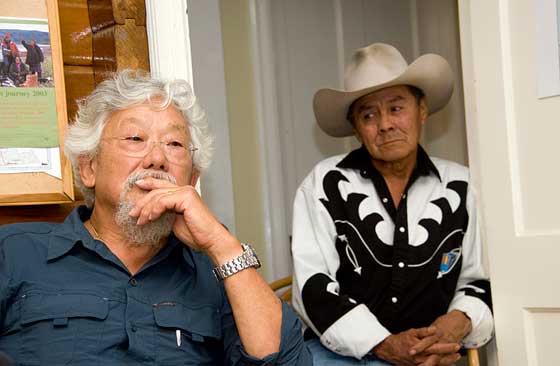
The 75-year-old made a stop at the Canadian Parks and Wilderness Society (CPAWS) office for a press conference late in the afternoon and made a presentation to the public at the Yukon Beringia
Interpretive Centre the same evening.
The subject? Protect the Peel watershed.
"We want to shoehorn nature into our agenda, and that's the problem here,” Suzuki said at the press conference.
If governments continue to depend on a kind of economy that sees nature as a way to feed the economy, instead of the very source of our survival, we're "doomed,” he said.
"We're one species out of 30 million species, and we think we can take over 88 per cent of the land and still survive,” he said. "It' s madness. It's completely suicidal.”
Suzuki explained that his mission now is to tell people the world is facing an unprecedented crisis.
"Human beings have become so numerous, our technology and consumptive demands have become so powerful that we are now altering the chemical, physics and biology of the planet.”
Suzuki's visit to the Yukon was timely.
Last Monday, the Peel Watershed Planning Commission released its final plan, which recommended – as it did in the previous plan – that 80 per cent of the watershed be protected.
The Tr'ondek Hwech'in and First Nation of Na-Cho Nyak Dun councils have already said they are willing to support the plan.
Local conservation groups and opposition parties are singing the same tune. The territorial government and the Yukon Chamber of Mines have yet to release any official response beyond that they have received the plan and are now reviewing it.
Although Suzuki admitted he didn't know anything about the Peel watershed beyond what he had read, the activist was clear on what he thought the Yukon government ought to do with the 68,000 square kilometres of wilderness.
He thinks it should preserve the whole thing.
"Quite frankly,” Suzuki said at the press conference, "I don't think any wilderness on the planet should be touched anymore.”
Suzuki said numerous times that preserving the world's intact wilderness is the one way we can "hedge against the uncertainty of the future.
"We've got to leave as much of nature intact as possible,” he said. "That is the source of our well-being. It is nature itself that creates the atmosphere that animals like us depend on. It's nature that filters water. It's nature that creates soil and gives us food.”
But Suzuki remembers not understanding this very thing.
"Around the world, indigenous people speak of the Earth as our mother. And I used to say, ‘Well, that's a good way of saying it,'” said Suzuki.
"And they'd say, ‘Listen, Suzuki, don't patronize me. You think we're speaking metaphorically or poetically; we mean it literally, we are created out of the Earth.'”
Suzuki asked reporters to imagine the world as a candy factory. In order to manage the factory, you need to have an inventory of every product and blueprints of how these products work, he said.
"We're trying to manage an entire planet, and we have no idea how many species we have,” said Suzuki.
Scientists estimate there are anywhere between two million and 100 million species on the planet. We only have detailed information, like what they eat and where they live, for less than 0.1 per cent of the species we do have accounted for, he said.
Suzuki said that he "guarantees” you could send an entomologist into the Peel watershed and every day, he or she would discover a new species.
"We just don't know anything,” he said.
Another issue Suzuki referred to is what UBC researcher Daniel Pauly calls shifting baselines. This is a theory that says society doesn't remember what nature used to be like after we have disturbed it.
"There are still arguments about oceans and whether they are in good shape or not,” said Suzuki. "The reality is, they're in terrible shape, but most people don't have any idea of what the oceans used to be like.”
At Friday evening's sold-out show, Suzuki screened the film about his final "legacy” lecture.
Force of Nature interweaves this lecture with the story of his life – from growing up in a Japanese internment camp to his days wearing bell bottom jeans and studying moths at UBC.
Simon Mervyn, chief of the First Nation of Na-Cho Nyak Dun council, and Eddie Taylor, the Tr'ondek Hwech'in chief, spoke at Suzuki's event.
"The lands around Dawson and our traditional territory are being staked and dug up like never before,” said Taylor.
"The surface values of those lands is what is important to our people, and that's what we need to protect and preserve. The land we have in Peel is the only place our grandchildren can see what our lands once was like: pure, clean, pristine and healthy.”
Taylor called his council's decision to accept the final plan a "painful compromise.”
Mervyn said that although the Na-Cho Nyak Dun's position has not changed, they too, are willing to compromise because it is important to move forward.
But before he said all this, Mervyn was clear on what his people want.
"Our environment is not for sale,” he said. "Period.”
During the question and answer period, most people spoke in support of the Peel and asked Suzuki how they can move forward from this point.
One audience member asked any politicians in the audience to identify themselves. NDP Leader Liz Hanson and Liberal Leader Arthur Mitchell stood up.
The only person to question Suzuki's logic was a young woman who moved to Whitehorse a year ago.
She said the economy has become our religion in the Yukon, and you can't "kill it” that quickly.
Suzuki agreed with the woman, saying the territory is in an especially difficult place at the moment.
"There is a sense of desperation,” said Suzuki. "People want to get into the Peel right now because that's where the money is.”
Comments (4)
Up 0 Down 0
Francias Pillman on Aug 3, 2011 at 10:22 am
A tree is happy living beside a toxic waste dump? That is the most retarded thing I have ever heard. I guess according to your logic we can put a hazardous waste dump on your property John. Hey, you are just living your life, right? The dump is expressing itself in it's own unique way. So you better not complain. *rolls eyes*.
Up 0 Down 0
John Calaghan on Aug 3, 2011 at 8:34 am
I agree with most of the preceding comment except that exploitation hurts. Exploitation is just an experience, neither good or bad. It is all from source and source does not judge.
Gaia is more than happy to look after things with more of our help as we move along. But it would be nice to get out of the judgement drama as it limits the potentials.
A tree in the Peel does not care if it is growing on the bank of the Wind River or beside a toxic waste site. It is just happy to be a tree and express itself in a unique way.
Up 0 Down 0
Evelyn Kaltenbach on Aug 2, 2011 at 2:52 am
My heartfelt thank you to David Suzuki and all the First Nations elders and chiefs who support the protection of our land.
It is imperative that we change our attitude toward "nature" - we are all (part of) nature. Exploitation of ANY part of our planet - be it water, landscape, forests, animals or people - is hurting everything and everyone.
We need to understand that all is interconnected, that life in all forms is precious and a gift. When we allow ourselves to sit still for a moment and reflect on the miracle of being alive on this planet, we "know" and feel the connection to all beings and things.
Only then are we able to take care of the land and each other.
Namaste.
Up 0 Down 0
John Calaghan on Aug 1, 2011 at 10:23 am
Gaia can take of Gaia, if you haven't heard. A lot of this is drama.