Photo by Whitehorse Star
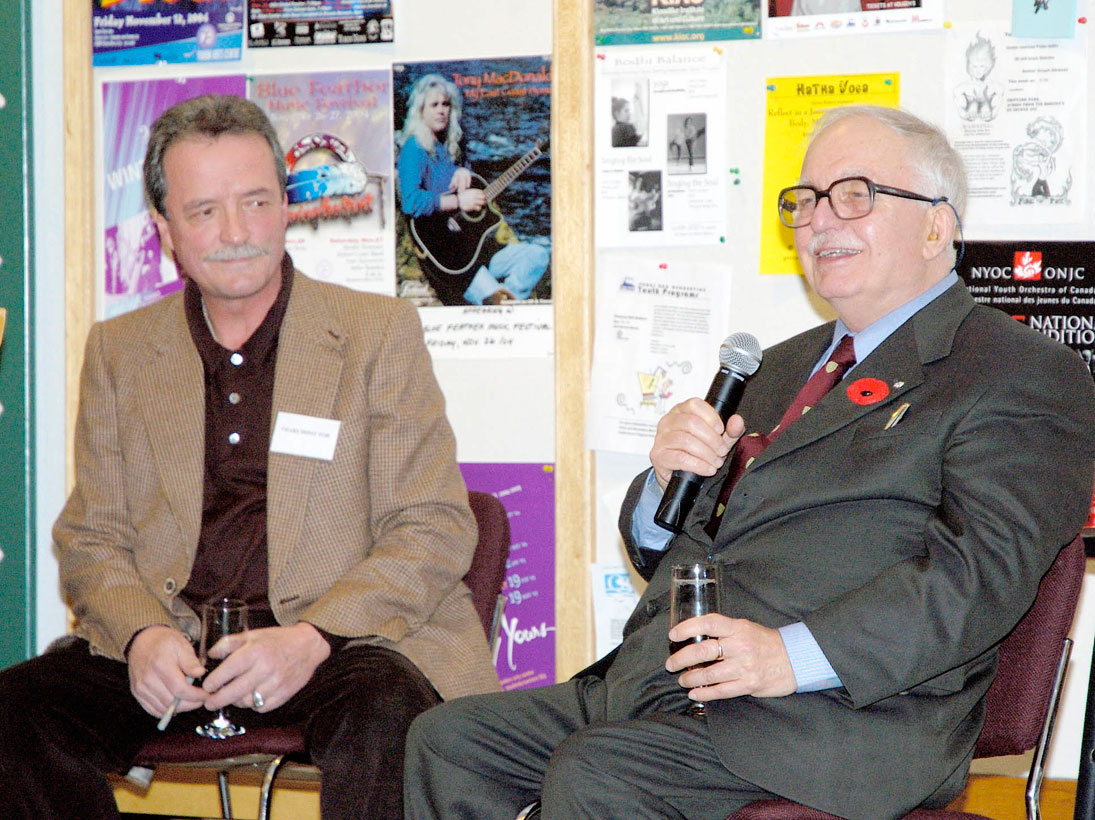
CHATTING WITH FANS – Ted Harrison (right) speaks during a benefit held in 2004 at the Yukon Arts Centre. On the left is Robin Armour, a catalyst in the creation of the Ted Harrison Artist Retreat at Crag Lake.
Photo by Whitehorse Star
CHATTING WITH FANS – Ted Harrison (right) speaks during a benefit held in 2004 at the Yukon Arts Centre. On the left is Robin Armour, a catalyst in the creation of the Ted Harrison Artist Retreat at Crag Lake.
“He was just so intensely in love with what he did — he loved art so much it made you want to love art as well.”
“He was just so intensely in love with what he did — he loved art so much it made you want to love art as well.”
Lee-ann Harder was in Grade 5 when she first caught a glimpse of Ted Harrison at the front of her class — an art course.
“I have this memory of him walking down the hall in his apron. He was just jolly, and I think that’s reflected in his art,” Harder, who was raised in the Yukon, said in an interview Monday.
The communal scenes depicted in bright lines and swirling colour across Harrison’s canvasses of the North — his muse, where he lived for 25 years — did indeed seek to uplift.
“We should all try to spread a little happiness wherever we may be,” Harrison said, effectively adopting that statement for his life motto, according to a 2014 biography, A Brush Full of Colour, by Margriet Ruurs and Katherine Gibson.
“There’s enough sadness and misery in the world without hanging it on our walls,” the internationally renowned artist stated.
Harder recalled some of the hardship that confronted rural Yukon residents in the 1960s and 1970s, when she was growing up.
“I often felt it was his way of being cathartic about what he sometimes was exposed to,” she said of Harrison’s paintings and prints. “It was a very big cultural shift for them to land in Carcross after coming over from England.”
Harrison was no stranger to character-building, however.
Having grown up in a hard-scrabble coal-mining community in northern England, he also served in the British military during the Second World War before heading across the pond with his wife, Nicky, and son, Charles, to teach in northern Alberta in 1967.
They moved to the southern Yukon the following year.
Nicky Harrison was Harder’s Girl Guide leader.
“She was extremely, extremely well-liked. She was a very big people person. And Ted was too, although he was very engaged in his art,” she said.
Harder learned under Harrison for a second time in Grade 10, when he taught her and her classmates more advanced artistic techniques at F.H. Collins Secondary School.
“He was always intensely excited about art and always inspiring that energy in other people. He wasn’t just an artist for himself.
“And that continued of course into his later years,” when Harrison illustrated numerous children’s books and volumes of verse — like Robert Service’s The Cremation of Sam McGee — Harder pointed out.
“Some of the people in some of those pictures, I absolutely could say in my heart I know who they are.”
Harrison donated many of his works to various causes around the Yukon, as well as his property on Crag Lake, south of Whitehorse, for the establishment of the Ted Harrison Artist Retreat.
Harrison both introduced and absorbed traditional cultural practices in his home in the North.
“He taught the ladies in the community highland dancing,” Harder remembered.
“He so appreciated what the native women were doing with beadwork. And they embraced that 100 per cent, with so much enthusiasm.”
Not everyone did, however.
“There were people who looked at his art and frowned. He was causing people to reach. And if you’re not New York and you’re not L.A., it’s easy to come across as not good art,” said Harder, an entrepreneur who now lives in southern Alberta and sometimes organizes charity art shows.
“He certainly had a lot of criticism. I remember my dad criticizing him, it was just out of his comfort zone.”
Harrison died last Friday in Victoria. He was 88.
Harder sighed: “Every time I look at his art, I can’t help but feel they were more simple times.
“He was trying to bring happiness into the world with his art. And I think he did.”
In order to encourage thoughtful and responsible discussion, website comments will not be visible until a moderator approves them. Please add comments judiciously and refrain from maligning any individual or institution. Read about our user comment and privacy policies.
Your name and email address are required before your comment is posted. Otherwise, your comment will not be posted.
Be the first to comment