Photo by Whitehorse Star
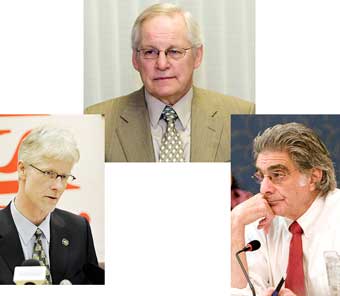
Tom Ullyett,Yukon Supreme Court Justice Ron Veale and Arthur Pape
Photo by Whitehorse Star
Tom Ullyett,Yukon Supreme Court Justice Ron Veale and Arthur Pape
It's another draw between the Yukon government and the Little Salmon-Carmacks First Nation, according to a Supreme Court of Canada decision issued this morning.
It's another draw between the Yukon government and the Little Salmon-Carmacks First Nation, according to a Supreme Court of Canada decision issued this morning.
The Supreme Court has upheld the findings of the Yukon Court of Appeal, which rendered a split decision in June 2008 over a dispute surrounding the Yukon government's approval of an application from Larry Paulsen for a parcel of agricultural land.
The case has drawn interest from across Canada.
Today's decision comes a year after the nine justices of the Supreme Court heard arguments from 14 provincial and aboriginal governments across the country, including the Yukon and Little Salmon-Carmacks.
Arthur Pape, the First Nation's lawyer who argued the case, said this morning that from the First Nation's perspective, the decision has upheld the most important of what was a two-part question.
The 129-page decision, he said, has provided clarity on the obligations of territorial and provincial governments to consult First Nations when they do something that affects their land or rights.
It upholds the original finding by Yukon Supreme Court Justice Ron Veale that there is duty to consult, even if it's not spelled out specifically in a land claim agreement or modern aboriginal treaty, Pape said.
Hopefully, he added, the decision will foster a stronger relationship between First Nations and the Yukon government to move forward, instead of fighting all the time.
The decision makes mention of how modern treaties are meant to be a means of building co-operation by establishing partnerships and understanding, Pape pointed out, referring specifically to the words of Justice Ian Binnie.
"Thoughtful administration of the treaty will help manage, even if it fails to eliminate, some of the misunderstandings and grievances that have characterized the past,” Binnie writes in his overview of the decision.
"Still, as the facts of this case show, the treaty will not accomplish its purpose if it is interpreted by territorial officials in an ungenerous manner or as if it were an everyday commercial contract.
"The treaty is as much about building relationships as it is about the settlement of ancient grievances. The future is more important than the past. A canoeist who hopes to make progress faces forwards, not backwards.”
Pape explained the heart of the case revolved around the Yukon government's insistence that because there was nothing in the final agreement specifying the need to consult on applications for agricultural property, there was no obligation to do so.
There are some 60 instances in the agreement laying out circumstances requiring consultation, but nothing on agricultural applications so the government didn't feel it had to do anything beyond the normal review of the application, Pape said.
He said the First Nation, on the other hand, argued the Yukon government had the obligation to meet the duty to consult established by the Supreme court of Canada seven or eight years, regardless if it was mentioned in the land claim agreement.
Justice Veale, the Yukon Court of Appeal and now the Supreme Court of Canada have not all agreed a duty to consult exists, regardless if it's mentioned in an agreement, Pape said.
He pointed out while Veale ruled the government had not met the standard of consultation required, the Court of Appeal found that even though the Yukon government denied its obligation to consult, the work that had been done to run the application through the land review process was sufficient to meet the obligation.
After the Yukon government approved the Paulsen application in 2004, the First Nation filed for a judicial review of the decision, arguing the Yukon did not fulfill its obligation to consult.
The government, however, argued it had lived up to its obligations to the letter of the law contained in the First Nation's final land claim agreement, and was not required to do anything else.
Veale disagreed, ruling the obligation existed and the Yukon had failed to meet it.
The government appealed the decision to the Yukon Court of Appeal.
The three justices of the Court of Appeal agreed and disagreed with Veale in their decision of 2008.
They agreed the honour of the Crown and the duty to consult remains in effect, even if it's not addressed specifically in the land claim agreement.
They did find, however, that the steps taken by the Yukon government to obtain the First Nation's input on the Paulsen application did fulfill the duty to consult.
The government appealed the finding that on the duty to consult existed even if it was not mentioned in the treaty.
And Little Salmon-Carmacks First Nation appealed the finding that the Yukon government had fulfilled its obligation to consult in the case of the agricultural application.
The Supreme Court of Canada upheld the Yukon Court of Appeal's decision, and today dismissed both the Yukon government's appeal and the First Nation's appeal.
"In this case, a duty to consult existed,” reads the 129-page decision issued by the nine justices, who went on to find: "There is no legal basis for finding that the Crown breached its duty to consult.”
The Supreme Court pointed to a couple of areas where the Yukon government could have behaved more professionally, but on the whole, steps taken to engage the First Nation were sufficient.
It went on to challenge the suggestion by the First Nation that had the Yukon government listened to its concerns, the Paulsen application would have been denied.
"The First Nation argues that in exercising his discretion to approve the grant, the Director was required to have regard to First Nations concerns and to engage in consultation.” reads a summary of the decision. "
"This is true. The First Nation goes too far, however, in seeking to impose on the territorial government not only the procedural protection of consultation but also a substantive right of accommodation.
"The First Nation protests that its concerns were not taken seriously — if they had been, it contends, the Paulsen application would have been denied.
"This overstates the scope of the duty to consult in this case. The First Nation does not have a veto over the approval process.”
At a press briefing this morning, Yukon government officials said the case provides the clarity it was seeking when it made the appeal.
"We're very happy we got that clarity,” said Tom Ullyett, assistant deputy minister of legal services, noting that was the reason the territory took the matter to the country's highest court.
Though pleased to have that clarity, they wouldn't term it a victory.
The decision marks the first time the court has considered the duty to consult in the context of a modern day treaty with nine judges making the decision. "In that sense it's monumental,” he said, noting that the Supreme Court only assigns a full panel of nine judges in matters considered most important.
The decision will impact both First Nations consultations throughout the Yukon and across the country, it was suggested.
Locally, the government made some changes to its dealings after the Yukon Court of Appeal decision was handed down, said Karyn Armour, the territory's assistant deputy minister of the land claims and implementation secretariat.
With the Supreme Court of Canada document being released only this morning, she noted the territory will do further analysis on it and see if any more changes are needed.
She noted the Little Salmon-Carmacks First Nation is likely also reviewing the document.
Though no meetings between the territory and the First Nation have been scheduled following the decision, Armour expects that will happen in the coming weeks after both sides have had a chance to review the document.
While the court case was continuing, the territory and several first nations saw their consultation protocols expire with all sides agreeing to hold off on drafting new protocols until the ruling came down.
That means the government and First Nations will likely soon begin looking at and renegotiating those documents.
"It would be great to renew (those protocols),” Armour said, noting the clarity the decision provides when it comes to implementation on agreements.
Though the decision may not have a huge impact on First Nations throughout Canada which fall under the federal Indian Act, it will have affect those falling under modern treaties and negotiations for those, said Lesley McCullough, the territory's lawyer on this court case and acting assistant deputy minister of the courts and regulatory services.
Officials could not provide an estimate on how much the territory has spent on the case. As Ullyett noted there were a lot of in-house resources, such as two of the three lawyers, used on the case.
And though the highest court in the land has finally ruled on the matter, the territory isn't likely to provide Paulsen with a permit any time soon.
Officials indicated he is no longer interested in the land.
Stephanie Waddell contributed to this story.
In order to encourage thoughtful and responsible discussion, website comments will not be visible until a moderator approves them. Please add comments judiciously and refrain from maligning any individual or institution. Read about our user comment and privacy policies.
Your name and email address are required before your comment is posted. Otherwise, your comment will not be posted.
Comments (2)
Up 0 Down 0
Don McKenzie on Nov 20, 2010 at 7:25 pm
A very interesting case, with ramifications that will echo across the nation.
Up 0 Down 0
Josey Wales on Nov 19, 2010 at 12:51 pm
What does the chief have to say on this?
Anyone know where he is?
One would think on such an important case he might have something to say...funny so quiet?
His people still wish to hear him right?