Land-based healing centre to be studied
A new working group to examine the possibility of establishing a central land-based healing centre will be created as the Yukon Forum wrapped up last week.
By Ainslie Cruickshank on April 16, 2012
A new working group to examine the possibility of establishing a central land-based healing centre will be created as the Yukon Forum wrapped up last week.
"Right now, there are a number of individuals that are sent out for addictions treatments to accredited facilities in other parts of Canada,” Premier Darrell Pasloski told a press conference held Friday afternoon following the forum.
The working group will look at the possibility of creating an accredited, land-based facility in the Yukon, he said.
"Many of the First Nations have similar types of facilities or smaller versions thereof, and I know that this has been something spoken about by First Nations for many, many years,” said Pasloski.
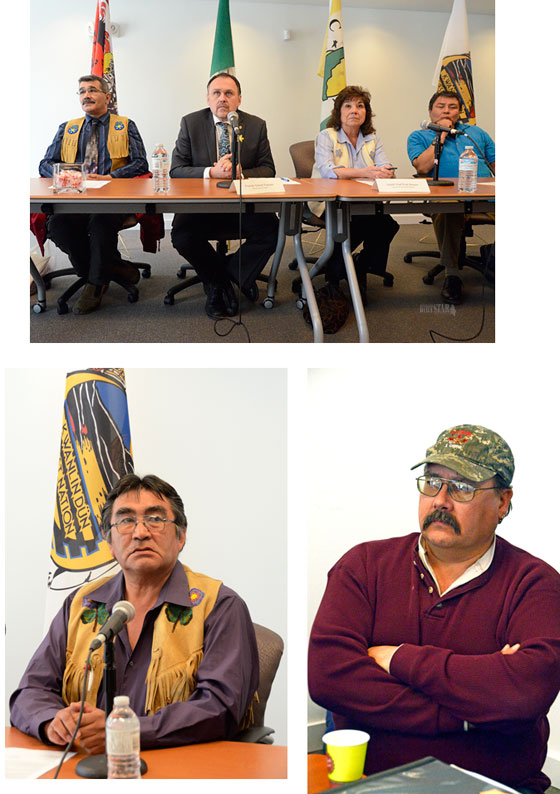
Chief Joe Linklater of the Vuntut Gwitchin First Nation told reporters there are financial considerations that need to be explored.
"I think, for Vuntut Gwitchin, there are a bunch of unknowns here. Before we can commit to anything or support anything, we need to know what the costs are and what the contribution is going to be from First Nations,” he said.
"We support the idea of a working group and then after that we can determine whether or not we can support the concept itself.”
Chief Charles Eikland of the White River First Nation said one solution could be to create a centralized centre that works in conjunction with the community programs.
"I think a land-based treatment centre is something that Yukon needs; we could also bring people from other provinces here for treatment,” he said in an interview Friday.
"At the same time, you wouldn't want to detract from the community-based treatment centres that are already there; a few bands have their own.
"I think the solution would be to have a central system that has the programming but also utilizes the community systems as part of the whole program.”
Champagne and Aishihik First Nation Chief James Allen agreed the best idea would be a co-operative program involving both the communities and the centralized program.
"The communities can start the healing path for community members and they can go to a longer healing process at this central healing place,” he said.
Allen served on the task force for acutely intoxicated persons at risk with Bruce Beaton, a local doctor, in 2010.
In an interview Friday, Allen said the results of that task force shouldn't be forgotten either.
"When Dr. Beaton and I did that report, we suggested that there be a place where people could be sobered up if they were picked up by the RCMP, there would be a central place to help do that and also a drop-in for people that want a place to sleep and they may be intoxicated, but also a detox centre at the same place and a place where people can be referred to longer-term treatment if they want,” he said.
Contrary to the recommendations of Allen's and Beaton's report, a secure assessment facility where acutely intoxicated people can be monitored was built at the new Whitehorse Correctional Centre, as was recommended by the RCMP.
The Beaton-Allen report recommended the facility be built downtown by a shelter and detox centre.
Resource revenue sharing and land use planning were also discussed during the Yukon Forum.
Yukon First Nations have put forward a proposal to modify the current formula that governs resource revenue sharing as it's laid out by the Umbrella Final Agreement.
Pasloski said Friday his government will respond to the proposal before signing a new agreement with the federal government. He said the proposal is currently under review.
Allen said the revenues are curtailed by the current formula.
"Back when land claims were negotiated, no one foresaw how big the mining revenues were going to be,” he said.
"Between Canada and the Yukon, they have looked at a new formula for royalty sharing and we as First Nations would like to see a new formula developed between ourselves and the territorial government too.”
Ruth Massie, grand chief of the Council of Yukon First Nations, said First Nations sought the commitment of the government to follow the obligations in the agreements as they apply to the land use planning process.
"We did get a commitment from Yukon government and their support on stepping up and moving forward with the land use planning process,” she said.
Asked about the government's Feb. 14 release of its eight guiding principles for planning the Peel watershed's future, Pasloski said his party was clear during the 2011 election campaign that the plan has to be balanced.
Chief Ed Taylor of the Tr'ondek Hwech'in said, "the eight principles were definitely outside the agreement and the process that the First Nation believed in.
"As far as trust goes, that's why we have meetings like the Yukon Forum, so we can build this trust, get to know each other in detail as to what the concerns in our communities are,” Taylor said in response to a question about whether the Peel planning process has shaken his confidence in the government's commitment to the land use planning process.
The governments agreed to hold another Yukon Forum later this year to report on progress.
"It was good to have these discussions between First Nations and the government and it should happen a lot more often so we can keep on top of issues as they develop,” said Eikland.
Be the first to comment