Photo by Vince Fedoroff
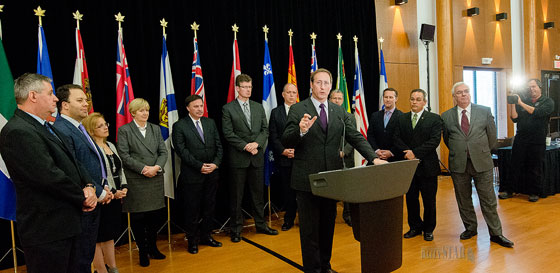
VITAL ISSUES ANALYZED – Backdropped by his provincial and territorial counterparts, federal Justice Minister Peter MacKay addresses Thursdayʼs news conference in Whitehorse.
Photo by Vince Fedoroff
VITAL ISSUES ANALYZED – Backdropped by his provincial and territorial counterparts, federal Justice Minister Peter MacKay addresses Thursdayʼs news conference in Whitehorse.
Funding for legal aid was the hot topic at the meeting of federal, provincial, and territorial Justice ministers held this week in Whitehorse at the Kwanlin Dun Cultural Centre.
Funding for legal aid was the hot topic at the meeting of federal, provincial, and territorial Justice ministers held this week in Whitehorse at the Kwanlin Dun Cultural Centre.
Asked about the issue at the closing press conference Thursday afternoon, federal Justice Minister Peter MacKay noted it was indeed a significant discussion topic.
Knowing laughter from the provincial and territorial ministers lined up behind him supported his statement.
"It is a very challenging subject,” MacKay noted.
Stepping up to the microphone, John Gerretsen, the attorney general of Ontario, explained that "access to justice is likely the most predominant issue for the ministers.”
But it's a constant conversation, he continued, a sentiment echoed by MacKay, who said there isn't "a simple, silver-bullet response.”
Issues surrounding underfunding for the Yukon's legal aid came to a head earlier this fall when poverty law services had to be suspended due to a $400,000 operational deficit.
The territorial government added $200,000 to the legal aid 2013/2014 budget, but the Legal Services Society, which runs legal aid, is hoping to see a longer-term solution in the form of an increased budget next year.
For the Yukon, as well as many other jurisdictions, Fetal Alcohol Spectrum Disorder (FASD) was another important topic at this week's meetings.
It's been an agenda item at the Justice ministers' meetings since 2010, thanks in large part to Yukon-led initiatives to bring attention to the issue, Justice Minister Mike Nixon noted.
The territory is undertaking an FASD prevalence study, which the minister expects will be completed within two years.
One hundred and fifty people at the Whitehorse Correctional Centre will be studied over 18 months.
"There was a lot of interest from a lot of the other jurisdictions because everybody is affected by that in some shape or form,” Nixon said in an interview late Thursday afternoon.
"So they're really paying attention, and we'll continue to update them on both a deputy ministers level and a federal, provincial, territorial ministers' level.
"But, it's baby-steps,” he said, explaining why there was little discussion of a Canadian Bar Association (CBA) resolution to amend the Criminal Code and the federal Corrections Act to allow for greater consideration of FASD.
Heather MacFadgen, the president of the Yukon branch of the CBA, noted this week that "judges across the country are acutely aware of the problem.”
But, she continued, "they lack the tools they need, such as the ability to order an assessment when FASD is suspected in a criminal case.”
During the press conference, MacKay said the ministers recognize very clearly the urgency of addressing the issues associated with FASD.
"That's why this study, I think, is coming at a perfect time, quite frankly. There has been a lot of information and statistics gathered already, but this will culminate and allow us to make a specific action plan which is what is needed,” he said.
FASD is one factor contributing to the over-representation of aboriginal Canadians in the justice system, the federal minister responded when asked about discussions regarding aboriginal justice issues.
"This is going to take a Herculean effort on the part of many departments to address the challenges that exist on First Nations,” he continued.
MacKay noted that different departments have taken various approaches to addressing First Nations issues across the country.
Thinking back to his time as minister of National Defence, which ended last July, MacKay highlighted his department's work to expand the Junior Ranger program.
Other important discussion topics at the meetings included forthcoming legislation on cyber-bullying and a Victims Bill of Rights.
MacKay noted the cyber-bullying legislation will give police and prosecutors the tools to intervene in cyber-bullying, particularly around the sharing of intimate photos against a person's wishes or without their knowledge.
But the federal minister went on to note that the issue of cyber-bullying will require a holistic approach.
"It's going to occur only when we include our education system, other organizations in the country that have taken up this cause and worked very diligently to reach out to young people, in particular, to speak about the seriousness of hitting send, and putting messages on the Internet that have such a detrimental impact to them and their friends,” MacKay said.
"Public education is going to be an incredibly important part of how we respond to the issue of cyber bullying.”
The federal government is currently "fine-tuning” its Victims Bill of Rights, MacKay said, but it's expected to come forward this fall.
"In my estimation, this will be transformative for victims. It will put them front and centre in our justice system where they need to be,” the minister said, noting it will provide better protections for victims, and better communication.
Victims, for instance, would be warned when an offender is being released back into the community.
One issue that was not discussed during the meetings, to the disappointment, if not surprise, of the United Steelworkers union, is the "Westray” law.
Named for the Nova Scotian mine where 26 workers were killed in an explosion in 1992, the law was passed in 2004.
It holds CEOs and executives criminally responsible for workplace deaths due to negligence, union director Stephen Hunt explained today.
But the law has never really been enforced. Only three convictions have occurred since it became law, and all of them were plea-bargains, he explained.
The union did meet with the ministers from Nova Scotia and Manitoba, but the Yukon's Nixon said he wasn't able to fit it into his schedule.
"You'd only need one or two CEOs to go to jail and we would see a paradigm shift in how workplaces are administered when it comes to health and safety,” Hunt said.
On Thursday, the Star asked the Department of Justice what the federal government is doing to ensure the law is enforced.
Employment and Social Development Canada media relations staff sent a response this morning.
"The minister of labour is committed to promoting safe, fair and healthy work places,” the response reads.
"As a result of the Westray coal mine explosion, changes have been made to the federal Criminal Code making it possible to charge corporate owners and managers for their failure to protect employees.
"It is the responsibility of the police and provincial Crown attorneys to investigate violations of the Criminal Code.”
MacKay reflects on Justin Trudeau while in Whitehorse ....
In order to encourage thoughtful and responsible discussion, website comments will not be visible until a moderator approves them. Please add comments judiciously and refrain from maligning any individual or institution. Read about our user comment and privacy policies.
Your name and email address are required before your comment is posted. Otherwise, your comment will not be posted.
Be the first to comment