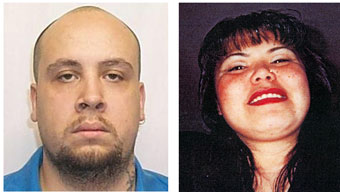
Photo by Whitehorse Star
Norman Larue and Christina Asp
Photo by Whitehorse Star
Norman Larue and Christina Asp
It was a ruse that began in front of a Burger King at a Calgary mall's food court and ended in murder charges.
It was a ruse that began in front of a Burger King at a Calgary mall's food court and ended in murder charges.
For months before Yukoners Christina Asp and Norman Larue were arrested for the killing of Gordon Seybold, Asp believed she was travelling around the country as part of a powerful criminal organization.
She eventually took steps to bring her then-boyfriend, Larue, into the fold.
In fact, everyone the pair interacted with was a police officer.
After nearly two months in Yukon Supreme Court, the jury in Larue's first-degree murder trial is beginning to hear more information about the complex undercover operation, dubbed Project Monsoon, which led to the arrests.
On Tuesday, two of the officers involved in the operation took the stand — the officer in charge who organized the various undercover activities, and the officer who would become closest to Asp. Their identities are protected by a publication ban.
Much of Tuesday's testimony centred around Asp, the primary target of the investigation when it began in February 2009 and ended when the pair was arrested in August.
Asp has already been convicted for her role in Seybold's death. She has not testified in this case.
Earlier this month, she took the stand but refused to swear an oath or answer questions. She was cited for contempt of court.
The officer responsible for much of the planning took the jury through the broad strokes of the investigation.
Known as a "Mr. Big”-style operation, this investigation involves convincing a target — in this case, Asp — that the undercover operators are an elite gang led by one powerful figure who's capable of covering up crimes.
The officer explained to the jury that undercover officers often use perceived criminality — in this instance, smuggling weapons — to make their stories convincing. Any weapons were always fake, but Asp didn't know that, the officer said.
In this case, officers decided to make their bogus leader a female, something that had never been done in this type of investigation.
The goal is to "create an environment where the target feels comfortable discussing past criminal offences,” the officer said.
It began in early February 2009, nearly a year after Seybold's Ibex Valley cabin burned to the ground and human remains were found inside.
Police had to wait until Asp was released from prison, where she was serving the remainder of her time for an earlier manslaughter conviction after having stabbed a man she had been dating.
The jury has already heard that Asp and Larue were arrested on Canada-wide warrants for parole violations weeks after the fire at Seybold's property.
Asp was approached by two undercover officers at the Calgary food court.
They asked her to help with a job. The women were portraying themselves as private investigators of sorts, the officer testified, taking photos of apparently-cheating spouses. Like with the many other situations, even the "spouses” were undercover officers.
Through the month, the "crimes” progressed from the apparent extortion to weapons smuggling.
Over the course of the investigation, Asp made various admissions, the officer said. She also met with the undercover officer portraying the powerful leader.
Eventually, in early March 2009, she went back to the Yukon to participate in a "re-enactment” under the guise of helping her new friends destroy any left-over evidence from Seybold's death.
After that March 3 re-enactment, the investigation could have ended, the undercover operator testified.
Instead, the RCMP in the Yukon decided to continue the operation until Larue was released from prison near the end of July 2009.
In the months between early March and the end of July, Asp continued to "work” for the organization. She travelled around the country, including to Toronto, Montreal and Halifax.
She made $1,000 a month, mostly to cover rent and living expenses, he said.
The police wanted Asp "to recognize there were opportunities for Mr. Larue” and eventually make an introduction, the officer testified.
He told the court he believed Asp's aspirations were for Larue to work with another undercover officer who was portraying himself as a former millitary officer and contract killer in need of computer help.
The trial began in April, with the jury hearing a secretly recorded "job interview” between Larue and that officer.
In it, Larue describes attacking Seybold, beating him, slicing his throat, and burning down his home. His lawyer, Ray Dieno, has told the jury Larue was lying.
Larue and Asp were arrested on Aug. 4, 2009, days after the meeting.
During cross-examination, Dieno questioned the officer on the stand about the methods used during the undercover operation.
A common theme throughout the officer's testimony was the faux gang's belief in "trust, honesty and loyalty.”
Those were the "pillars of the organization,” he testified, and Asp was frequently reminded of this.
She agreed that these values, along with accountability, were her values too, the officer said.
Dieno asked how the officer could know if Asp was telling the truth.
"Maybe Christina Asp is a better liar than you are,” he said.
The officer agreed undercover police used techniques that would not normally occur in a standard interview.
Dieno went as far as to suggest Asp may have believed the organization had the power to kill her if they wanted to.
"That wasn't the objective,” the officer said.
"It doesn't matter that wasn't the objective,” the lawyer replied. "Someone could easily jump to the conclusion, if I don't do what these people want, they could kill me.”
The officer testified that Asp was never threatened with violence nor forced to do anything she didn't want to do. She was always given an "out,” he said.
The officer said Asp repeatedly agreed that she believed in "trust honest and loyalty.”
She also mentioned the importance of accountability, particularly when talking about how she had been held accountable after her manslaughter conviction.
"She mouthed those words; it doesn't mean she meant them at all,” Dieno said.
The officer admitted police did not have the same amount of time to develop a strong relationship with Larue. He testified he believed Asp's and Larue's relationship was one of trust, even though Asp cheated on Larue while he was in custody.
Before the day ended, the jury began to hear the testimony of the undercover officer who would become closest to Asp during the investigation.
The officer testified to bonding with Asp after revealing a made-up backstory which involved her pretending to have killed someone and having her "uncle,” a high-ranked member of the gang, take the fall.
Asp told her, "We have more in common than you think,” the officer testified.
Asp said "she had a secret with Norman” and "someone had ended up dead.”
In court, Justice Scott Brooker urged the jury to pay close attention to what the undercover officers say Asp told them and what will be seen on video recordings.
He told them to take great care and listen for discrepancies.
He pointed out that Larue's lawyer will not have a chance to cross-examine Asp on anything.
The officer is continuing her testimony today.
In order to encourage thoughtful and responsible discussion, website comments will not be visible until a moderator approves them. Please add comments judiciously and refrain from maligning any individual or institution. Read about our user comment and privacy policies.
Your name and email address are required before your comment is posted. Otherwise, your comment will not be posted.
Be the first to comment