Photo by Whitehorse Star
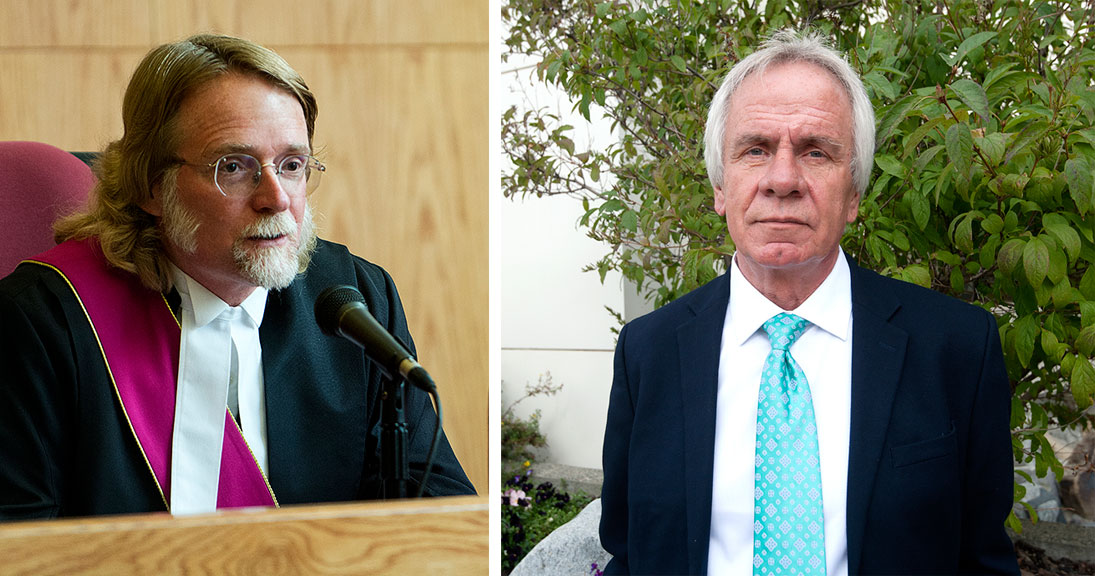
Yukon Supreme Court Justice Leigh Gower and Steve Walsh
Photo by Whitehorse Star
Yukon Supreme Court Justice Leigh Gower and Steve Walsh
The Ross River Dena Council is asking Yukon Supreme Court Justice Leigh Gower to make new law in Canada, but the federal government is saying no way
The Ross River Dena Council is asking Yukon Supreme Court Justice Leigh Gower to make new law in Canada, but the federal government is saying no way.
Ross River wants Gower to order Ottawa to release a confidential cabinet document it believes calls into question the very foundation of aboriginal land claim settlements in the Yukon.
Federal lawyer Suzanne Duncan argued in court last week the document falls under solicitor-client privilege.
The Supreme Court of Canada has said before the courts order the release of documents protected by client-solicitor privilege, the case must meet one of three specific and serious tests, and a fishing trip is not one of them.
Duncan argued the Kaska of Ross River are indeed on a fishing trip, because they don’t know what the memo says.
The 1993 memo was to the federal cabinet from federal lawyer Ross Burnett, whose job was to provide legal advice to cabinet, she pointed out.
Duncan said Ross River’s request for release of the document doesn’t come close to meeting the conditions set out by the Supreme Court of Canada, which she cited: (1) when the innocence of the accused is at stake; (2) when communication between a solicitor and his client is criminal; (3) when the safety of the public is at stake.
“The importance of solicitor-client privilege cannot be overstated in the justice system for Canada,” she told Gower.
“Privilege must be kept as absolute as possible, and can only be set aside on the rarest of cases.”
Ross River is one of three Yukon First Nations that do not have final land claim settlements. Eleven have final agreements.
Gower reserved his decision after hearing arguments last Wednesday.
Federal documents openly indicate the Burnett memo is about the ratification of the Umbrella Final Agreement (UFA) in 1993.
The UFA sets out the ground rules for settling land claim agreements in the Yukon, such as establishing financial compensation, the amount of land for each First Nation, the principles of co-management over the Yukon’s resources and so on.
Ross River argues the 1989 agreement-in-principle among Ottawa, the territorial government and Yukon First Nations stated a specific process was to be established and agreed to for the eventual approval of the UFA.
For years now, Ross River has continuously asked Ottawa to describe how that requirement under the agreement-in-principle was fulfilled, because Ross River maintains the UFA was not legally approved, the lawyer for Ross River argued last week.
Steve Walsh said Ross River has asked Ottawa to describe the voting process used to adopt the UFA, and how that process was agreed to, as required by the agreement-in-principle.
He said Ottawa simply keeps referring to a vote in February 1993 at a board of directors meeting for what was then the Council for Yukon Indians, but has never provided any information about how the voting process was agreed to.
Two Ross River representatives voted no at the February meeting, when the UFA was supposedly ratified, Walsh pointed out.
Burnett sent his memo in April 1993, following the February meeting and a month before a grandiose celebration held in Whitehorse to herald the approval of the Umbrella Final Agreement. The Kaska did not attend.
Walsh said there’s a strong suspicion the Burnett memo to the federal cabinet following the February meeting discussed a concern regarding the lack of an agreed process to approve the UFA.
Otherwise, Ottawa wouldn’t have any reason to go to such great lengths to keep the document suppressed, Walsh suggested.
First of all, said Walsh, the memo was classified as a confidential cabinet document. There is no better way in Canada to make sure a document remains suppressed than making it a confidential cabinet document, he said.
Walsh said now that the 20-year protection afforded cabinet documents has lapsed, the federal government is using client-solicitor privilege to keep the memo under wraps.
The problem for Ottawa is that the honour of the Crown, a constitutionally enshrined doctrine, is in play, Walsh said.
The Supreme Court of Canada has stated repeatedly that when federal, provincial or territorial governments deal with First Nations, their conduct must be honourable, beyond reproach.
Walsh told Justice Gower if the federal government knows the Burnett memo questions or raises concerns about the UFA’s ratification, Ottawa has a legal and moral obligation to provide that information to the Ross River Dena Council.
In this case, Walsh argued, the honour of the Crown outweighs solicitor-client privilege.
“The honour of the Crown is a constitutionally enshrined principle; solicitor-client privilege is not,” Walsh told Gower. “So the honour of the Crown wins.”
He said the federal government cannot be allowed to hide dishonourable conduct when the honour of the Crown is at stake.
Of particular concern is how Gower has suspended the trial on a 2005 lawsuit filed by the Ross River Dena Council, Walsh reminded the judge
In that case, Ross River is arguing the Order of 1870 by Parliament created a legal obligation requiring the federal government to settle the interests of the Kaska before making their traditional territories available to third parties – miners, settlers.
After a hearing more than a week of arguments on the case, Gower decided this past spring to suspend his decision. The judge ruled that he would first hear and rule on the Kaskas’ 2006 lawsuit, which is similar to the 2005 action.
The 2006 case involves a claim for specific compensation because the federal government failed to live up to its obligation to deal honourably with the Ross River Dena Council.
In his ruling to suspend the 2005 case, a ruling which is under appeal by the Kaska, Gower explained for the purposed of hearing the 2006 lawsuit, he will assume the 1870 Order did create a legal obligation to settle the interests of the Ross River Kaska before alienating their lands.
He will then hear arguments and rule on whether the federal government did act honourably when it tried to negotiate a settlement with Ross River post-1973 era.
It was in 1973 when then-prime minister Pierre Trudeau and then-Indian Affairs minister Jean Chretien created the federal policy to negotiate comprehensive land claim agreements, following a landmark Supreme Court of Canada decision.
Yukon First Nations were among the first in the line to begin negotiations.
Gower has indicated he will focus his attention on determining whether Ottawa’s post-1973 behaviour did fulfill the honour of the Crown with initiatives like attempting to negotiate a land claim settlement with Ross River.
Walsh argued last week that since Gower has made the honour of the Crown such a pivotal issue in Ross River’s case, the situation demands that Ross River know what the Burnett memo says.
Ottawa, said Walsh, is arguing it attempted to reach a settlement with Ross River under the UFA’s terms. But Ross River has consistently rejected those terms as the foundation for negotiations because it’s never been properly ratified, Walsh pointed out.
He said if Ottawa is saying it acted honourably by trying to settle the Ross River claim under the terms of the UFA, which may not even be legally binding, Ottawa has a big problem, and Ross River is entitled to know about it.
The federal lawyer, on the other hand, said solicitor-client privilege is written in stone, and is of critical and fundamental importance to the country’s system of justice.
The Supreme Court of Canada has said for a court to order a breach of that confidentiality, the grounds must be serious and rock-solid, Duncan told Gower.
She said the highest court has said the question of whether to order a breach of that confidentiality must not be weighed on a case-by-case basis. It must meet one of the three conditions established by the high court, the Supreme Court has ruled, she said.
Duncan insisted Burnett was providing the federal cabinet with legal advice regarding the UFA, just as any lawyer provides his or her client with legal advice – advice that is protected by the highest level of confidentiality.
What of the next dispute in negotiations between a First Nation and Ottawa, she posed to Gower: does a First Nation get to slap down the honour-of-the-Crown card and demand to see the legal advice Ottawa is receiving on the file?
Duncan said ordering Ottawa to turn over the Burnett memo would establish new law in Canada.
Such a question, the judge acknowledged, has never been litigated.
Gower also acknowledged he has been provided a copy of the Burnett memo to assist him with his decision.
But he asked the lawyers if he decides not to order the memo’s release because he doesn’t find it to be essential for Ross River’s case, how far down the road does he have to go in explaining the memo’s contents to justify his decision?
To the very end, Walsh suggested.
Walsh is also seeking an order compelling a senior official with the federal Aboriginal Affairs department to testify on sworn statements she has provided regarding the UFA’s ratification.
There is conflicting evidence in the affidavits, and the statements do not describe whether the official has personal knowledge of the information she has provided, or whether she was getting the information from another source, he told Gower.
By law, he said, sworn statements to the court must detail the source of information.
The senior official was involved with the local federal department in the days of the UFA ratification and is still with the department.
In order to encourage thoughtful and responsible discussion, website comments will not be visible until a moderator approves them. Please add comments judiciously and refrain from maligning any individual or institution. Read about our user comment and privacy policies.
Your name and email address are required before your comment is posted. Otherwise, your comment will not be posted.
Comments (1)
Up 10 Down 3
ProScience Greenie on Oct 22, 2015 at 8:10 am
A well written article covering a complex legal situation.
It is interesting that the leader of the Yukon NDP Liz Hansen was a big shot at INAC back in those days. Wonder what her roll in this might have been?