Judge outlines parties' guilt in rock shower
The Yukon government, a local contractor, and a site supervisor have all been found guilty of permitting an unsafe blast and for failing to immediately report the incident.
By Justine Davidson on May 11, 2010
The Yukon government, a local contractor, and a site supervisor have all been found guilty of permitting an unsafe blast and for failing to immediately report the incident.
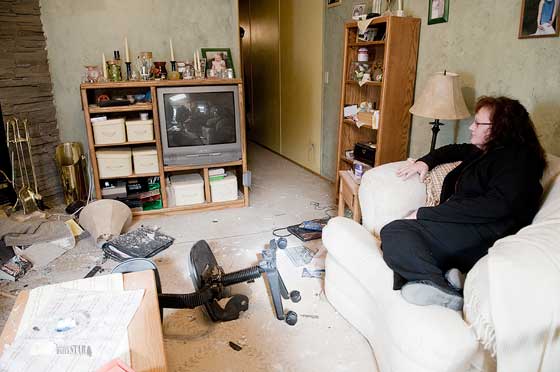
The territory's Department of Community Services, PS Sidhu Trucking Ltd., and William Cratty were all charged under the Occupational Health and Safety Act (OHSA) following a blast on the Hamilton Boulevard extension project which sent rocks raining down on the Lobird Park trailer court in May 2008.
Officials at the Yukon Workers' Compensation Health and Safety Board welcomed the decision.
"I would say it's an important step forward in accountability in health and safety practices,” spokesman Mark Hill told the Star shortly after receiving the decision this morning.
As territorial court Judge John Faulkner described in his judgment: "The rock (called ‘flyrock') varied in size from small pebble-sized pieces to missiles weighing 22 kilograms.
"One demolished a shed; another crashed through the roof of a trailer and landed in the occupant's living room. One tenant, who was outside, was forced to run for cover. Remarkably, no one was injured or killed.”
The case went to trial, with each party making its own arguments, all of which Faulkner rejected in his 20-page judgment.
After establishing each party's role in the project, and their responsibility for ensuring workplace safety, Faulkner dismissed the first argument that no workers were injured in the blast, so the OHSA does not apply.
He pointed out that sections of the act and regulations "are clearly designed to protect the general public and extend beyond the boundaries of the workplace.”
Even if the particular section under which the charges were laid don't mention public safety, he said, public safety is in the spirit of the act.
"In short, it is not an answer to the present Occupational Health and Safety Act charges to simply say that ‘my activities didn't endanger my workers; they only endangered the public,'” Faulkner wrote.
During the trial, the court learned that blaster Peter Hildebrand, who pleaded guilty to related charges last year, didn't know how close he was to the trailer park.
Various blasting proposals written by Cratty show an estimated distance of 400 to 600 metres, when in fact, the trailer court was just 139 m from the offending blast site.
It wasn't until "well after” the the May 6 blast that Hildebrand ever saw a map showing the distance between the boulevard extension and the homes.
"I have no hesitation in finding that both Sidhu Trucking and Mr. Cratty failed in their duty because they did not ensure that Mr. Hildebrand was properly oriented to the site so as to be aware of the close proximity of persons or property likely to be affected by the blasting operations,” Faulkner wrote.
"Moreover, blasting is an inherently dangerous undertaking, and it would be common sense to be well aware of the distance to persons or structures – especially in an urban area.”
The defendants went on to argue that even if Hildebrand had known how close the trailers were, it wouldn't have changed the way he conducted the blast.
They pointed to expert testimony from veteran Richard Scott Parker, who said the rock shower was likely caused by "unforeseen matters unrelated to distance” such as a crack in the rock or a too-shallow hole which misfired.
But as the judge pointed out, Hildebrand himself testified if he had known the trailer park was so close, he would have conducted the blast differently.
Faulkner also noted that guards had been posted 350 m away; "consequently, it is difficult to argue that knowing there were persons within 150 m wouldn't have made any difference.”
To say the incident was not foreseeable "misses the point,” Faulkner wrote.
"The distance to structures was knowable. The risk from having structures or buildings nearby was entirely foreseeable even by someone with no blasting experience whatsoever.”
As for the Department of Community Services, which Faulkner defined as the owner and constructor of the project, it had a supervisor on-site who looked over Hildebrand's blasting proposals and "maintained a considerable amount of control over the blasting operations.”
The supervisor should have noted Hildebrand's "wildly inaccurate” estimate of the distance between the blasting site and the trailer park, Faulkner said.
Even without any blasting experience, "the distance to structures was a fundamental, obvious and easily verifiable fact,” he said, but the supervisor only looked at the proposal to make sure it was filled out, "without conducting any actual review of the contents.”
Faulkner added a footnote to his judgment, clearly directed at the workers' compensation board.
He asked "whether or not it might be necessary in certain circumstances for those in a supervisory capacity to possess specialist knowledge in order to discharge their duties.”
Hill said the current act, which requires supervisors to be "competent”, might need to be worked on.
"I'm not suggesting that every supervisor be as skilled as every one of their workers, but I am saying some clarification might be warranted,” Hill said.
Finally, Faulkner found all parties guilty of failing to immediately report the incident.
Although at least one witness testified to phoning the workers' compensation board offices that evening, no one at the board actually heard about it until later the next morning.
Normally, convictions under a territorial act would result in a fine, but as Faulkner pointed out, this would merely result in the Yukon government paying itself.
He asked the defendants and prosecution to come up with some alternative before the sentencing hearing, which will be scheduled on Friday.
Comments (1)
Up 0 Down 0
marsha flumerfelt on May 11, 2010 at 2:02 pm
Regarding the fact that the government would pay the fines of their employees; am I the only one who finds this just a touch odd.
Say I'm driving a semi trailer owned by X trucking, I get a speeding ticket, you can bet your last dollar the owner of X trucking will not only NOT pay the fine, but I probably will not keep my job if it happens very often
Why as a tax payer do I have to help pay for the incompetence of their employees
This of course depends weather the judge decides to fine
hmmmm