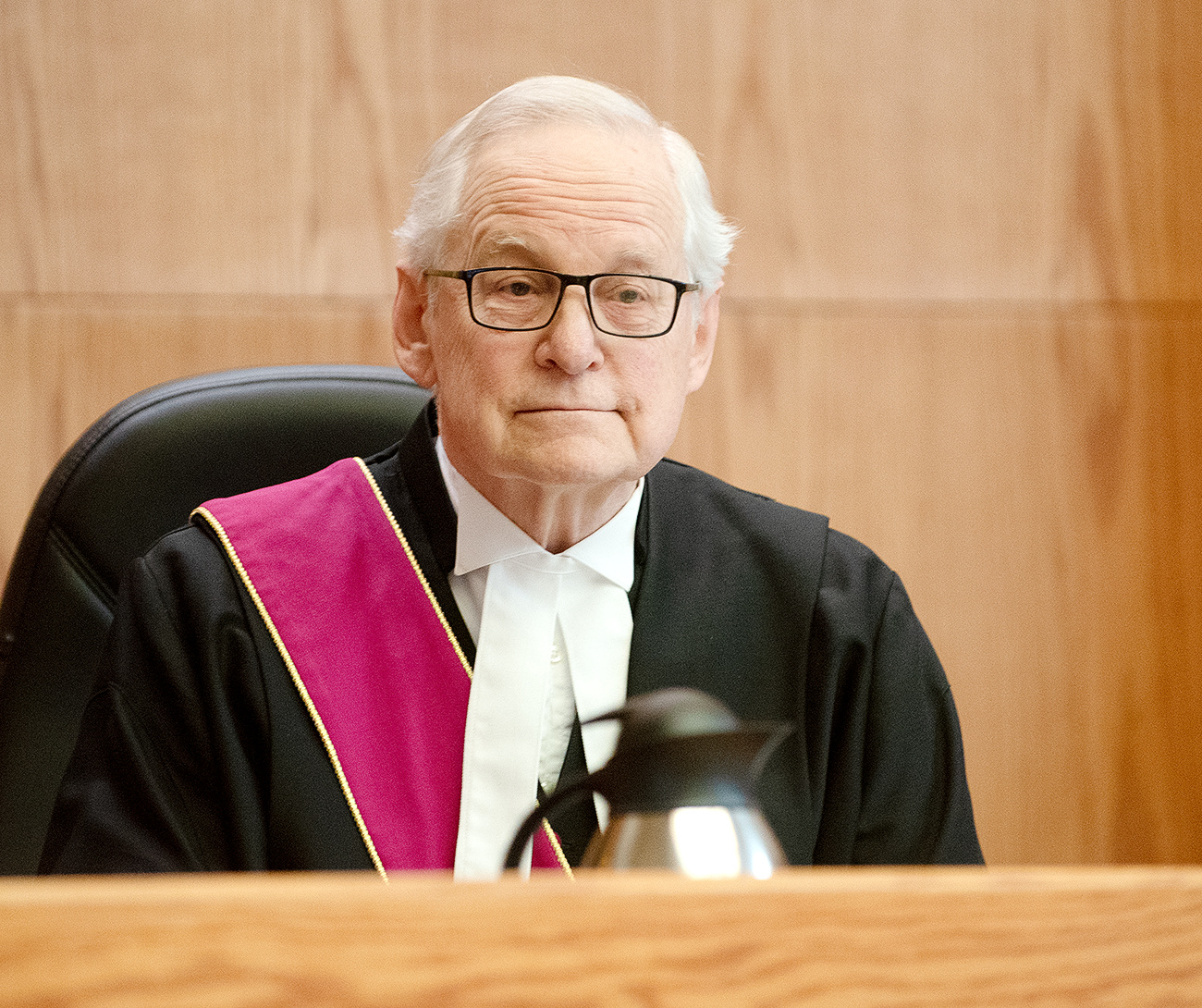
Photo by Whitehorse Star
Justice Ron Veale
Photo by Whitehorse Star
Justice Ron Veale
A Yukon Supreme Court justice has awarded dissenting shareholders US$71.46 for every share he or she owned in a company purchased by ExxonMobil Canada.
A Yukon Supreme Court justice has awarded dissenting shareholders US$71.46 for every share he or she owned in a company purchased by ExxonMobil Canada.
Justice Ron Veale issued his written decision on Feb. 18.
Veale ruled that ExxonMobil’s acquisition of InterOil Corp. came from a flawed process.
He ordered that the dissenting shareholders were entitled to the increased share price.
He added it should be paid with “a reasonable rate of interest” and must be paid within 30 days after the judgment.
Charles Carlock, one of the dissenting shareholders, brought forward the litigation to get the fair value of the shares he and the others held. The value would be deemed fair as of the market circumstances of Feb. 22, 2017.
ExxonMobil paid US$45 per InterOil share on July 21, 2017. This deal made InterOil a subsidiary of ExxonMobil.
“The dissenting shareholders say that a fair value of an InterOil share is US$71.46 based upon a discounted cash flow analysis,” Veale said in the decision.
The shareholders argued that the process of determining value was troublesome. They said this is because a “whole company sales process” was never explored when ExxonMobil acquired InterOil.
They felt a discounted cash flow analysis should have been used to determine share value.
ExxonMobil disagreed with every point, stating the offer was fair.
Veale touched upon court history of this matter.
The Supreme Court approved the first agreement between the two companies on July 21, 2016.
The Court of Appeal of the Yukon set this decision aside the following November. This was due to the agreement being deemed neither fair nor reasonable.
ExxonMobil argued that the corporate governance of InterOil is improved but did not disclose any information about negotiations.
Veale explained that the court will have to determine the value of the shares. Should either side propose a value, it would have to provide “evidence on a balance of probabilities”.
He pointed to five ways an acceptable stock value could be determined, including:
• the price as listed on the stock exchange;
• the valuation of a company’s net assets;
• the capitalization of maintainable earnings;
• taking into account capitalization of future profits in the discounted cash flow method; and
• any mix of the previously listed options.
He said the court must consider all evidence and facts of the case. In doing so, it will lead to the best judgment possible. He added this could lead to a conclusion that the original price was fair.
“There is no doubt that where the court is dealing with undeveloped assets, the negotiated price must be considered with some caution,” Veale said in the decision.
He looked at InterOil’s history. The company has six gas licences in Papua New Guinea.
It has four Petroleum Prospecting Licences and two Petroleum Retention Licences. The former allows the company to explore and the latter grants the rights to raw gas in the area.
The company did not have any Petroleum Development Licences. That licence would have allowed the company to produce and sell petroleum in the applicable area.
InterOil’s most developed property is a “pre-commercial development raw gas asset” in the Elk and Antelope gas field in Papua New Guinea.
The company held a 36.5 per cent ownership interest in this venture. Two other companies owned significant stakes in the project, including Total S.A. with 40.1 per cent and Oil Search at 22.8 per cent.
The project did have other investors but that accounted for 0.5 per cent.
The agreement called for each partner to pay for its share proportionally of the developments costs. The project was estimated to be between $14.5 billion to $20 billion. The partners planned to use debt financing to cover 65 per cent of the development.
InterOil’s board of directors became concerned about the company’s ability to cover its part of the deal.
In October 2014, the company considered selling some of its other smaller assets, but not its share of the Papua New Guinea project.
The company sought out potential buyers the following March. In 14 months, it did not find any “suitable bids.”
By early 2016, the company received offers for smaller stakes in the Papua New Guinea project.
“The bids did not have sufficient implied share values and might possibly have downgraded the share value of InterOil,” Veale said in the decision.
He pointed out InterOil did have shares on the New York Stock Exchange and had an “active defence program to repel takeover bids.”
In March 2016, the company received three offers for a “whole company transaction”.
Exxonmobil offered $35 per share. This would have been paid in Exxonmobil shares.
Total S. A. offered $38 to $40 per share, to be paid in cash.
Oil Search made an offer for $34 per share, paid in cash, Oil Search stock and other methods.
“None of these approaches had been solicited by InterOil as whole company transactions,” Veale said.
InterOil formed a transaction committee that same month. Both ExxonMobil and Oil Search offered revised bids in the spring of 2016. Total S. A. withdrew its bid on a deal struck with Oil Search.
On May 20, 2016, InterOil’s board decided to take Oil Search’s revised offer. This was the first instance of a whole company transaction being considered.
The deal prevented InterOil from seeking out other offers unless they were better.
ExxonMobil made a third offer, unsolicited, on June 23, 2016. It had the terms subject to this decision.
The following July, the board decided this was a superior offer – one which Oil Search would not match.
InterOil decided to take ExxonMobil’s offer on Feb. 14, 2017. It was approved by 91.24 per cent of shareholders.
As for the share evaluations, both companies had expert opinions on fair value. The dissenting shareholders’ expert argued that $71.46 was fair, while Exxonmobil’s maintained their offer was fair.
Veale pointed out that there is evidence to show the price was fair.
He said InterOil’s stock was on the New York Stock Exchange. The company had three interested parties in buying their stake in the Papua New Guinea project.
That said, he also had to consider that InterOil never sought out offers to buy the entire company, and the Court of Appeal had criticized ExxonMobil’s bid.
“I conclude that the transaction price was established in a flawed corporate governance process,” Veale said.
He said the Court of Appeal found that the InterOil’s CEO was in a conflict, the independent transaction committee was not free of management and there was a “lack of necessity for the deal.”
He felt the transaction price cannot be deemed fair because of the flawed process.
Veale said the costs of this action could be discussed at a future case management conference if needed.
In order to encourage thoughtful and responsible discussion, website comments will not be visible until a moderator approves them. Please add comments judiciously and refrain from maligning any individual or institution. Read about our user comment and privacy policies.
Your name and email address are required before your comment is posted. Otherwise, your comment will not be posted.
Be the first to comment