Photo by Whitehorse Star
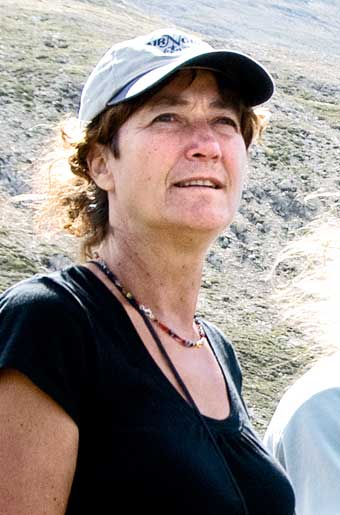
Karen Baltgailis
Photo by Whitehorse Star
Karen Baltgailis
The long-awaited joint response to the land use plan recommended by the Peel Watershed Planning Commission was delivered Friday.
The long-awaited joint response to the land use plan recommended by the Peel Watershed Planning Commission was delivered Friday.
It asks the commission to rewrite the plan to make it simpler to understand and easier to implement, and to deliver its final recommendation no later than early July.
The three-page joint submission also indicates the five individual governments party to the planning process will submit individual responses, in addition to the joint response.
None of the individual responses had been received as of this morning.
Commission member Ray Hayes said today he had not yet seen the joint response.
Hayes pointed out the commission will meet next week for the first time since it delivered its recommended plan in December 2009, and the joint response is on the agenda for discussion.
Karen Baltgailis, executive director of the Yukon Conservation Society, described Friday's response as dealing largely with format, and not substance.
The individual responses, she expects, will identify the substantive issues and set out where each party stands with regard to the land use plan recommended by the commission.
Chief Norma Kassi of the Vuntut Gwitchin First Nation said this morning staff are working today on the individual response, and will likely have it ready for delivery Tuesday or Wednesday.
"The northern chiefs are working very closely together, and we are all coming together on how we should protect the Peel River watershed,” Kassi said.
The watershed, she suggested, is of world-class significance because of its vast pristine wilderness.
Kassi said she expects the individual responses from the four First Nation governments will be quite similar.
Yukon government spokesman Rod Jacob said this morning the Yukon government's response was expected "very, very, soon,” perhaps even this afternoon.
The debate over the Peel watershed's future has been passionate and divisive, with the pro-wilderness protection camp lining up against the pro-industry lobby.
The Yukon Chamber of Mines maintains if the land use plan recommended by the commission is accepted as is, it would virtually kill exploration and mining inside the 68,042 square kilometres that make up the watershed.
The First Nations are seeking maximum wilderness protection.
The Yukon government, however, indicated in December 2010 the recommended plan does not provide the necessary balance to allow for current uses, including mineral exploration and the potential for mining.
The recommended plan, it went on to say, does not meet the Yukon government's view of what type of land use plan is required under the aboriginal land claim agreements.
Because 97 per cent of the watershed is territorial Crown land, the Yukon government will have the final say if consensus among the parties cannot be reached.
Friday's joint response was agreed to by all five governments: Mayo's First Nation of Na-cho Nyak Dun, Dawson City's Tr'ondek Hwech'in First Nation, the Gwich'in Tribal Council of Fort McPherson, Old Crow's Vuntut Gwitchin and the territorial government.
The parties agree that:
• The Peel watershed is unique for its largely pristine character that encompasses areas of cultural and environmental significance, and some of those areas should be protected from development;
• Once the regional plan is adopted, the commission should not remain active to handle matters that arise during implementation. Settling issues that come up will be the responsibility of the five governments;
• Rather than propose the development of up to 19 different land use plans under the regional plan, the commission should instead provide more general management goals which would simplify implementation of the land use plan;
• Similarly, the commission should consolidate some of the 24 different land management units set out in the recommended plan, as a means of simplifying the regional plan.
• It should again provide more general management guidelines, as the recommended plan is quite detailed, which could make implementation difficult;
• The commission deliver its final recommendation no later than early July.
Under the schedule agreed to last month, the five governments committed to making a decision on the final recommended plan no later than the second half of October.
Baltgailis said she's not sure if and how work on the final recommendation will be affected by the impending territorial election, which must be called by Oct. 14.
"Frankly, I think it will be great to know where the Yukon government stands before we have an election,” she said. "That would be a good thing for people to know, what is being proposed by this government.
Baltgailis said she fully expects the individual responses by the five governments will be made public.
In the joint response, the five governments pointed out the Yukon government has extended the moratorium on staking new mineral claims inside the planning area for another years, until Feb. 4, 2012.
The moratorium also includes no new oil and gas rights, or coal mining rights.
In order to encourage thoughtful and responsible discussion, website comments will not be visible until a moderator approves them. Please add comments judiciously and refrain from maligning any individual or institution. Read about our user comment and privacy policies.
Your name and email address are required before your comment is posted. Otherwise, your comment will not be posted.
Be the first to comment