'It's time to implement the hunt'
"It's going to be one of the most complex hunts that we've had to run."
By Stephanie Waddell on July 30, 2009
"It's going to be one of the most complex hunts that we've had to run."
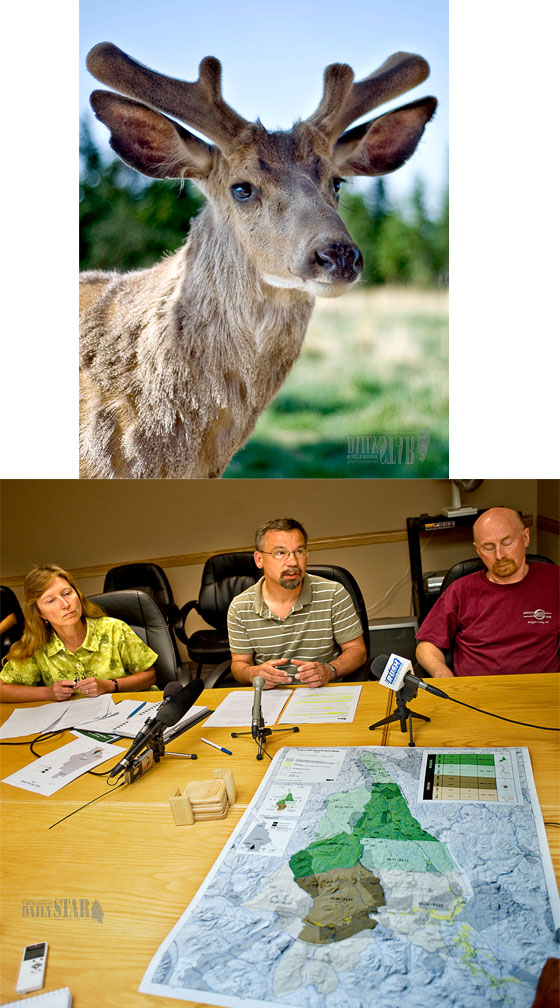
That's how Rob Florkiewicz, Environment Yukon's manager of species programs, described the planned elk hunt announced Wednesday afternoon in the department's building off Burns Road.
Those trying to get one of 40 permits to hunt in four separate areas - being the traditional ranges of the Takhini and Braeburn herds - will have to specify where they will be hunting and the sex of the elk they will pursue.
"We've broken the areas down into zones related to herds; the Braeburn elk herd and the Takhini elk herd, and within each herd range there's a sort of a core area where some of the management interest is in favouring or support elk and then a buffer zone where we've got an outlying area where the interest there is to reduce the number of elk in those areas or ... to have a lower population level," Florkiewicz said.
Four permits for the entire core and buffer area will be available for the Braeburn herd, with permits for one cow and one bull to be hunted in the core from Sept. 15 to Oct. 15.
The area sits along the North Klondike Highway starting just north of Fox Lake. It continues north of Braeburn, with another section east of that and to the south, with the Nordenskiold River running through it.
The other two permits for the Braeburn herd will be for another cow and bull to be hunted between Sept. 1 and March 31, 2010 in areas to the buffer zone to the north, east and south of the core.
The hunt also sets the same timelines for the Takhini herd in its core and buffer zones with the one-month hunt for a cow and a bull between Sept. 15 and Oct. 15 in an area along the Alaska Highway with boundaries of the Mendenhall River on the north and east, Little River to the west and south of the Alaska Highway.
The surrounding buffer zone to the east, west and south of that area would be the remaining sites for the majority of permits that will be drawn with 19 cows and 15 bulls that could be hunted between Sept. 1 and March 31.
While hunters will have until Aug. 14 to apply for those permits, with names drawn shortly thereafter, the rest of the territory - with the exception of Vuntut National Park, Kluane National Park, Ddhaw Ghro Habitat Protection Area and Game Management zones 10 and 11 - will be an elk exclusion area, open to all elk hunters with permits available at no charge through Environment Yukon. That season will run from Sept. 1 to March 31.
As Environment officials described Wednesday, the hunt is designed to reduce conflicts such as collisions with vehicles and being in agricultural areas, further reducing the risk of winter ticks and "increasing the appreciation and value of elk as a wild food."
Those wanting to get their names in the draw for the other zones will have to pay a $10 application fee or $20 for a joint application fee.
The announcement of the hunt comes more than a year after Premier Dennis Fentie approved a limited elk hunt as one of a number of changes to the Wildlife Act.
Since then, Environment staff have been coming up with the plan for the hunt and regulations that go with it.
Elk were originally introduced in the territory in the 1950s to allow additional hunting opportunities, but with the population remaining at the same level for many years, that didn't happen.
There was a special permitdraw done for four in the 1980s, with three elk harvested at that time.
"This is actually the first formal hunt that we've developed after some pretty significant consultation over the last couple of years," Florkiewicz said.
"And really, it's driven by the process that we went through in developing the elk management plan."
Biologist Rick Ward pointed out that among the objectives in the plan is a hunt itself, and not increasing the two herds beyond their current levels at around 85 for the Braeburn herd and 175 for the Takhini herd.
"It's time to implement the hunt," he said.
In the last decade, the elk population has begun rising, particularly in the last few years.
"I wouldn't say they've taken off and they're threatening to occupy the entire Yukon landscape, but they have done a bit better, and over the last couple of years as well as part of our winter tick management program, we've increased recruitment by holding the elk ... so more calves survive," Ward explained.
The winter-tick program, which started in 2007, saw the government capture as many elk as possible and keep them in a fenced area during the winter before they were released in the summer.
As Ward pointed out that meant more calves, being away from predators, survived into adulthood.
Successful elk hunters will be required to submit the animal's entire hide - to be rolled up in a way that preserves anything on the hair - to Environment Yukon so biologists can continue looking at the tick situation. Officials stressed the ticks would not impact the quality of the meat.
Also required of the hunters is the elk's head so officials can check for Chronic Wasting Disease.
Both the hide, which will be de-haired, and the head will be returned to the hunter later if requested.
Hunters will also be required to report their kill and submit the hide and head within 72 hours of the kill.
While it's expected the number of permits will remain high in the first couple of years of the hunt, after that the number will likely go down depending on population sizes.
Officials will decide next year whether to do an aerial count of the herds, but will also be monitoring the number of kills and radio collars on the elk. The government department also has the ability to terminate the hunt if necessary.
Wildlife harvest specialist Carol Domes is encouraging prospective elk hunters to visit Environment Yukon's website (www.enviornmentyukon.gov.yk.ca) to get the elk hunt information package, which includes maps of each hunting zone and detailed information of the hunt.
She, Ward, and Florkiewicz all noted the interest they expect to see in the hunt, given the many questions they've had from people wondering about hunting elk.
"It's exciting," she said. "People are happy there's an elk hunt."
Be the first to comment