‘It's a difficult trail and tough terrain'
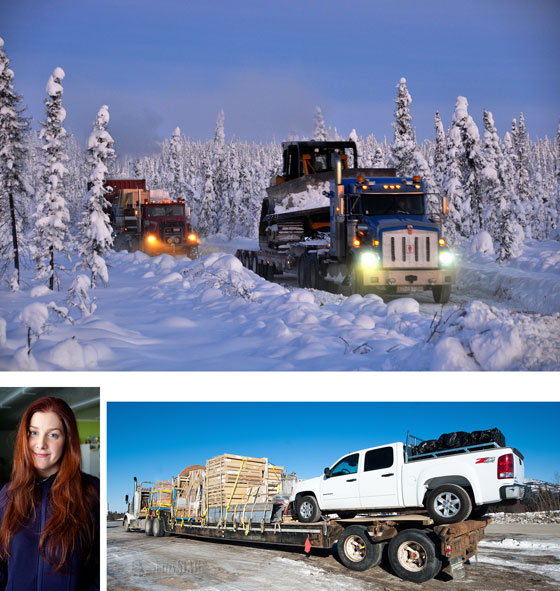
The second convoy of transport trucks loaded with supplies for the community of Old Crow will depart Eagle Plains Thursday, but in smaller numbers.
By Chuck Tobin on March 5, 2014
The second convoy of transport trucks loaded with supplies for the community of Old Crow will depart Eagle Plains Thursday, but in smaller numbers.
The initial convoy of 12 trucks left last Thursday on the winter road but was much slower-going than anticipated because of the sheer numbers, Pauline Frost, the director of intergovernmental affairs for the Vuntut Gwitchin First Nation, explained Monday.
She said it's been decided to reduce the convoys to four trucks, with a 24-hour separation between each one to allow for required maintenance.
Randy Shewen, the director of the road project for the First Nation, said Tuesday one has to appreciate this is not a smooth ice road, but rather a 260-kilometre stretch across Eagle Plain.
"Just being a snow road, you just can't sustain that many trucks that are fully loaded with chains on,” Shewen told the Star.
"It's not like an ice road. It's across the tundra, which is a whole different scenario.”
Shewen said the convoy is led by a tractor-trailer unit hauling a bulldozer which is unloaded and reloaded every time the convoy requires assistance.
"When the trucks come across a grade they can't summit themselves, the winch-cat pulls them up and they go again,” he said.
"And that has been normal operations on that road every time it has operated.”
Over the course of the next couple of weeks, somewhere between 40 and 50 loads are scheduled to go in.
The Vuntut Gwitchin First Nation in 2011 was given a 30-year-permit to build winter roads along the same general route used in 1998 and 2003, a route that goes back to the early days of oil exploration in the 1950s.
It's expected the road will be built every handful of years, as required.
This winter's road is estimated to cost somewhere between $900,000 and $1.4 million, with the cost being split equally between the Vuntut Gwitchin and Yukon governments.
The first road under the new permit was scheduled for construction last winter but Eagle Plain did not receive the snowfall needed to provide for the minimum snowpack.
The last full-blown winter road was built in the winter of 1998 to move in supplies to replace the community school which had been destroyed by fire – the second time that had happened in 17 years.
The 2003 trail was a freight trail using sleds pulled by heavy equipment.
The First Nation, various Yukon government departments, the RCMP, Yukon Electrical Co. Ltd. and individuals are taking advantage of this road to haul in supplies and haul out waste that is too expensive or too large for air freight.
The trucks are moving everything from building supplies for 10 new houses to be built by the First Nation over the next couple of years to personal items such as washers and dryers.
Two new trucks are going in for the Yukon government, and two older models are coming out.
Between 12 and 15 loads of scrap metal are being shipped out by the Department of Community Services.
Highways and Public Works is shipping in heavy cut blades for their graders and loaders, vehicle batteries and enough supply of oil and other petroleum products to last a couple of years.
Two pieces of old heavy equipment, an old road packer and five-tonne dump truck, will be coming out.
Lisa Marino of Mercer Contracting, one of two Whitehorse trucking companies co-ordinating the freight haul, said there's a wide range of customers and the loads going in and coming out are "incredibly diverse.”
While Mercer was hoping to have its freight list nailed down by Feb. 24, the company is not turning anybody away at this point, said Marino, who owns and operates the Mercer Contracting with Ross Mercer.
"We will do everything we can to help, but it is definitely getting late in the game.”
Marino said from her office in McRae that Sidhu Trucking will be sending in four loads tomorrow, and her company will be following with four loads Friday.
Reducing the convoy to four trucks instead of 12 will likely be more efficient. When 12 trucks travel and stick together, there are 12 opportunities for a truck needing assistance instead of four.
"It's just a difficult road, a difficult trail and tough terrain,” Marino said. "It's tough driving.”
Marino, however, is confident the project will end successfully.
"Everybody is doing the best they can to help this work out.”
Comments (2)
Up 4 Down 1
Bob Magill on Mar 5, 2014 at 1:15 pm
The old equipment being hauled out, does it still work and could it do some work in some areas in summer months, to help assist winter road construction? Sounds like a fun job their doing and good luck to all involved, what a great time for Old Crow
Up 8 Down 8
Geoff Capp on Mar 5, 2014 at 9:51 am
Why not build an all-weather base starting about 10 or 15 km off the Dempster where there's a supply of rock and gravel, most of the way, then when a winter road is required, you only need to build the beginning and ending of the road, and the rest is solid to take the load. Leaving a gap at each end would discourage unauthorized non-seasonal use.