It took dogged determination to track elusive payload
Followers of the renowned neon orange drink cooler — which achieved local fame last week when it was launched into space for several fleeting, flighty hours — found closure Tuesday evening at an event trumpeting its trajectory.
By Christopher Reynolds on February 5, 2014
Followers of the renowned neon orange drink cooler — which achieved local fame last week when it was launched into space for several fleeting, flighty hours — found closure Tuesday evening at an event trumpeting its trajectory.
Part of a promotional effort for innovation and invention in the Yukon, the Balloon Invasion at the Westmark Whitehorse Hotel announced the fate of that bundle of balloon, styrofoam and tech gear.
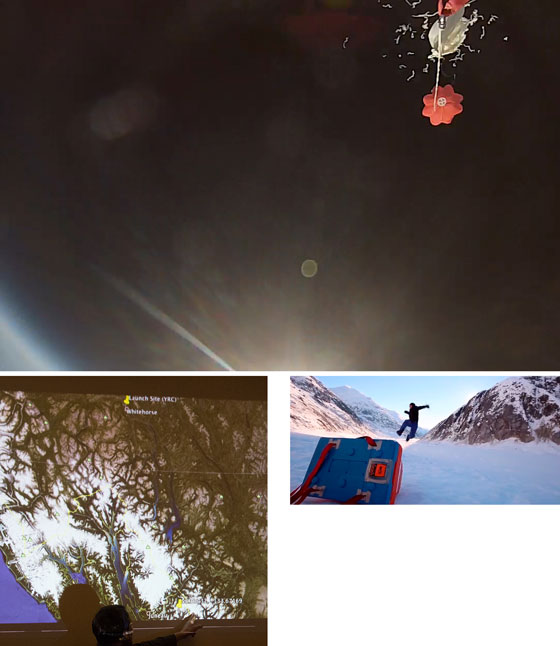
The gathering, organized by YuKonstruct and Cold Climate Innovation, featured on film the launch, hangtime, descent and retrieval of the little cooler that could.
The payload's two GoPro cameras captured the entire journey — including the curvature of the Earth and the white-laced topography of the North — while the on-board GPS spot tracker kept them on the map. At least at first.
"Then the beeps just stopped,” said Stephen Mooney, the director of Cold Climate Innovation.
The beeps, which were issuing from the payload's periodic location updates, ceased abruptly as Mooney's team tried to follow its course post-launch last Thursday.
"I thought, ‘that's it, it's frozen up completely,'” Mooney told an audience of roughly 60 people.
He didn't realize the satellite-based GPS device typically stops communications when it's more than eight kilometres from the ground. The cooler was destined to soar higher than 30 kilometres.
The goal of the launch was not simply to fling something into the stratosphere — perhaps the first time such a thing has happened in the Yukon — but to capture the journey on film. If the landing point couldn't be tracked nor the payload retrieved, the mission was lost.
But, as footage shown via projector last night proved, the GPS tracker resumed communication with its terrestrial owners, touching down after a peripatetic flight path on foreign soil.
The cooler and popped helium balloon landed nearly 50 kilometres east of Juneau, Alaska, and more than 280 kilometres from Whitehorse as the crow flies.
Ben Sanders, the driving force behind YuKonstruct, is a senior advisor with the Department of Economic Development. He hopped into a Capital Helicopters choppers along with a pilot and videographer to hunt down the elusive payload last week.
"This shows that YuKonstruct is already getting ideas off the ground,” Sanders said.
"I think we're well on the way to seeing YuKonstruct become a funnel for great ideas on their way to commercialization at Cold Climate.”
Attendees were encouraged to guess the landing zone, before it was revealed, with a map and pins.
The winner received a framed print by a local artist.
No spy- or drone-related conspiracy theories about any covert intent of the operation have yet been floated.
Also announced at the event — which helped wind down the third annual Research, Innovation and Commercialization workshop, put on by Cold Climate Innovation with Yukon College's Yukon Research Centre — was the winner of an invention idea contest.
Steve Roddick received the most online votes for his proposal (out of more than 80 posted): "an app that lists the weather — current and forecasted — and trail conditions for popular Yukon hiking and mountain biking areas.”
Air North doled out two return tickets for its new direct-to-Yellowknife-Ottawa route as the prize.
Cold Climate Innovation ties applied research to commercial prospects, usually with an eye to the challenges of living and working in frosty environs.
YuKonstruct, a makerspace still awaiting real estate, looks to provide space and tools to foster invention, skill-sharing collaboration, Sanders said earlier this month.
Be the first to comment