Photo by Whitehorse Star
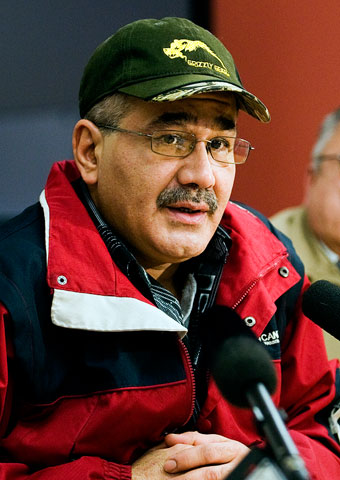
Tr'ondek Hwech'in Chief Eddie Taylor
Photo by Whitehorse Star
Tr'ondek Hwech'in Chief Eddie Taylor
Tr'ondek Hwech'in Chief Eddie Taylor says there's no need to elevate the Brewery Creek gold mine proposal to a higher level of screening.
Tr'ondek Hwech'in Chief Eddie Taylor says there's no need to elevate the Brewery Creek gold mine proposal to a higher level of screening.
In a letter Tuesday to the Yukon Environmental and Socio-economic Assessment Board (YESAB), the chief asks the board to reconsider its decision to bump the assessment up to the executive committee level.
Brewery Creek operated successfully and responsibly from 1997 to 2002, after receiving all the required permitting following a "comprehensive review from 1995 to 1997,” Taylor writes in his letter to the board.
The chief insists there is no reason why the project should be forced through another exhaustive and full-blown screening.
The assessment can and should be reviewed by the board's designated office in Dawon City where the application by Golden Predator Corp. was received last month, says the letter.
The chief also points out the Brewery Creek mine not only operated with a clean record, but has been held up as a mining project to be admired.
"During the five years of Brewery Creek operation, the heap leach pad and gold extraction process worked well,” says Taylor's letter.
"There were no issues regarding water quality. In fact, the Brewery Creek mine is oftentimes cited as the sterling example of environmental stewardship in the long history of Yukon and hard-rock mining.
"In light of the comprehensive review, the Brewery Creek mine has already been subjected to, and the unblemished record of past operation, we do not believe that an executive committee screening is required for this project.”
Golden Predator and the Tr'ondek Hwech'in have worked closely together in anticipation of reopening Brewery Creek.
The company did provide a commitment to create jobs and economic development opportunities for citizens of the First Nation and residents of Dawson in general.
The company submitted its proposal to the Dawson office, believing it was simply carrying on with a mining plan that had already been screened and approved, but had been cut short by low gold prices back in 2002.
Dawson's designated office, however, announced late last week the assessment board determined the nature of the project proposal legally required that it be handled at the executive committee level.
As a result, the company issued a statement to the stock market Tuesday indicating it was discontinuing its active pursuit of the Brewery Creek project. Instead, it was downshifting the proposal into a neutral state of care and maintenance.
Company vice-president Janet Lee-Sheriff said Tuesday that hopes of beginning the $25-million construction phase this summer are now impossible.
The company, she said, will lay off 11 of its 12 full-time staff in the Yukon. Golden Predator is obligated to its shareholders to operate responsibility, she pointed out.
Lee-Sheriff said acting responsibly means cutting costs while the company determines how to proceed, now that the project assessment could take years at the executive committee level, and not months at the designated office level.
Lee-Sheriff explained there is the ability to challenge the decision in Yukon Supreme Court, but judicial reviews cost money.
And with no guarantees, she added, a judicial review may not be in the best interest of its shareholders, but the company will explore all of its options.
Lee-Sheriff said Brewery Creek is still an asset, and the company will continue advancing its interest in the project on behalf of its shareholders, but at a much slower pace, as money becomes available.
Golden Predator has taken down a $10-million advance on a $35-million financing package to restart Brewery Creek, though the second draw was contingent on securing all the permits required.
The Brewery Creek property still has a mining licence and a water licence, but the requirement for amendments to both licences were anticipated.
In a letter to the assessment board last November, the Yukon's director of mining described the Brewery Creek project as a proposal to continue operations where they left off in 2002, and not starting up a brand-new mine.
Stephen Mills, chair of YESAB's executive committee, defended the decision by the designated office to move the Brewery Creek proposal up to the executive committee.
The Dawson office, he said Monday, did not make the decision in isolation, but was involved in thorough discussions with the central office.
Mills had given Golden Predator a heads-up in a letter last Nov. 1. He wrote that while the assessment board hadn't received an application, from what it understood at that point, the company should be aware the project might have to go through a lengthier executive level screening.
When the project proposal was received in Dawson on Jan. 13, there was a two-pronged approach to the file, Mills explained.
He said staff carried out the regular analysis of the technical information received to determine if more information was required.
On the other track, staff, including himself and the assessment board's lawyer, reviewed the file to determine if it had to be bumped up to the executive committee, said Mills. He said it was determined the Brewery Creek site had been officially closed down, and reclaimed.
The proposal amounted to a new mine, and the amount of tonnage the company was proposing to process every day legally required that the project be assessed by the executive committee, he explained.
Purely by coincidence, Golden Predator is undergoing a change in identity, as it's being rolled into the assets of Americans Bullion Royalty Corp.
The plan to move under the wing of larger parent company was announced last year, well ahead of submitting the Brewery Creek proposal to YESAB.
The Golden Predator stock fell off by almost 30 per cent since YESAB released its decision a week ago.
In order to encourage thoughtful and responsible discussion, website comments will not be visible until a moderator approves them. Please add comments judiciously and refrain from maligning any individual or institution. Read about our user comment and privacy policies.
Your name and email address are required before your comment is posted. Otherwise, your comment will not be posted.
Comments (2)
Up 0 Down 0
ML on Feb 23, 2013 at 7:03 am
The question is, does it take years to walk out there, use your eyes, ears, nose, instruments, and brains to figure out impact, and then walk back and file the right report? In government and union circles it does I guess. If its going to take 2+ years to move forward now, why would they even bother developing the mine...$25 million just for the starting construction to get the ball rolling, no income flowing from it for some time to come, far too much bureaucracy in the way. So much for the employment and tax revenue, Dawson and Yukon...and unlike the other First Nations relations issues, this company was prepared to do everything right and have good relations with all, but not to waste away money while waiting for years of red tape to resolve itself, and all at the company's expense...if the tax payer wants to pick up the review costs while the bureaucracy dithers through its cushy 2 hrs a day of work, fine, but not the shareholder.
Up 0 Down 0
JLB on Feb 22, 2013 at 12:39 pm
Looking over the project proposal documents, information about the previous mine operation and the YESA Act and regulations, it seems pretty clear that the YESAB had no choice but to deal with the proposal at the Executive Committee level.
Rather than make ill-advised comments, both Janet Lee and Chief Taylor should recognize that it is in both of their interests that the Board did the appropriate legal work to determine the lawful course of action rather than take an "expedient" approach that would open the process to successful legal challenge.
There's no question that there are groups and individuals out there that would be all over the YESAB were they to make an unlawful decision. That would make for a much longer delay than that which Lee and Taylor are now concerned with.