Photo by Vince Fedoroff
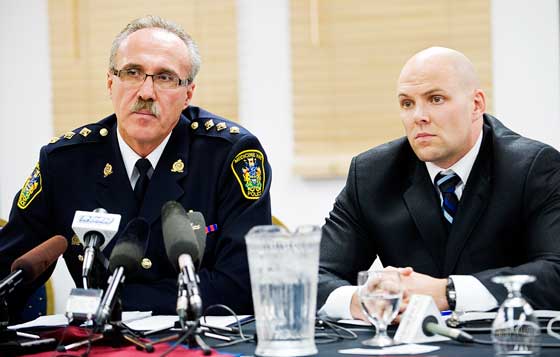
INVESTIGATION DISCUSSED – Medicine Hat Police Service Insp. Glen Motz (left) and Staff Sgt. Brent Secondiak are seen at Monday afternoon's news conference in Whitehorse.
Photo by Vince Fedoroff
INVESTIGATION DISCUSSED – Medicine Hat Police Service Insp. Glen Motz (left) and Staff Sgt. Brent Secondiak are seen at Monday afternoon's news conference in Whitehorse.
The Yukon's chief coroner has announced an inquest into the sudden death of Robert Stone in Whitehorse.
The Yukon's chief coroner has announced an inquest into the sudden death of Robert Stone in Whitehorse.
Monday afternoon's announcement came shortly after an Alberta investigation team held a news conference to say the police were in no way to blame for the 34-year-old man's death.
"Sometimes an inquest is held because it's mandatory – the person died in police custody, for instance – sometimes it's just to clarify the facts for the family and the public,” chief coroner Sharon Hanley said of why an inquest is necessary.
"In this case, it's to clarify things for the family and the public.”
Speaking on behalf of the Medicine Hat Police Service, Insp. Glen Motz said his investigators spoke to "dozens and dozens and dozens of people” during the investigation.
They took over the probe from the Whitehorse RCMP in the days following Stone's death on Sunday, May 2, 2010.
At 10:00 that morning, the Ta'an Kwach'an Council man was found dead in his room at the Sarah Steele Building detox centre, just 26 hours after having been released from jail.
At the time, police reported Stone had been picked up by ambulance on the night of May 1, but had become "combative” with paramedics and was arrested.
He spent about five hours in the drunk tank, according to police, and was then taken back to Whitehorse General Hospital because he was complaining of chest pains.
Once he was released from the hospital, he checked himself into the detox centre, where he died about four hours later, according to Hanley, who gave a preliminary report following Stone's death.
All this happened in the days following the coroner's inquest into the in-custody death of Raymond Silverfox. During that inquest, the public learned of callous and unprofessional behaviour on the part of police and cell guards.
Motz noted that was partly what prompted the local RCMP to call in an independent police force to take over the investigation into Stone's death.
"We have to be careful we don't blanket one incident with another,” he said, adding the circumstances surrounding the two deaths are in "no way connected.”
Motz reiterated a number of times that in this case, investigators found no evidence of police negligence nor misconduct, nor any criminal actions.
"Although tragic, (Stone's) passing was not the result of violence,” he said. There was "no use of force on Mr. Stone whatsoever,” he said, citing video and audio recordings from surveillance cameras around the city and in the RCMP cells.
Motz said he and lead investigator Staff Sgt. Brent Secondiak met with a member of the Stone family Monday morning "to remove any ambiguity, any accusations, any doubts” about the RCMP's role in his death.
At the time of Stone's death, there was some speculation he had been beaten up or otherwise injured before he died.
He had some soft tissue injuries, Hanley said in her preliminary report, and his body was
sent to Vancouver for an autopsy.
When his body was returned, family members told reporters they suspected Stone had been Tasered or had had his head slammed in a door because of marks around his temples and on his face.
Motz addressed some of those specifics. Witnesses who had seen Stone during the day on May 1 saw abrasions on his cheek and nose before he was picked up by the ambulance, Motz said.
Other marks and apparent injuries, he said, were likely the result of the autopsy.
"The dynamics of an autopsy change a person's appearance significantly,” he said.
"Imagine how different a person would look if their chest cavity had been laid open ... and the skin taken off their head and laid down on their chest to see the skull.
"I always advise people against having an open casket after an autopsy,” he added. "It can be very upsetting.”
But apart from some comment on the effects of autopsy, Motz passed most questions about Stone's health, physical condition and cause of death to Hanley.
She would not add any details, however, saying all the information she has will be made public in the course of the inquest, but not before.
Although no date has been set for the inquest, Hanley said she hopes it will happen by next spring.
In order to encourage thoughtful and responsible discussion, website comments will not be visible until a moderator approves them. Please add comments judiciously and refrain from maligning any individual or institution. Read about our user comment and privacy policies.
Your name and email address are required before your comment is posted. Otherwise, your comment will not be posted.
Be the first to comment