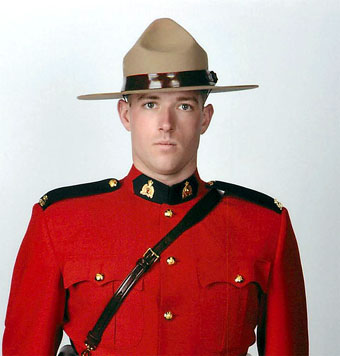
Photo by Whitehorse Star
Const. Michael Potvin
Photo by Whitehorse Star
Const. Michael Potvin
The inquest into the death of a Mayo RCMP officer heard its final pieces of evidence Saturday.
The inquest into the death of a Mayo RCMP officer heard its final pieces of evidence Saturday.
Much of the testimony on the final day focused on changes the Yukon RCMP have made to their policies since Const. Michael Potvin drowned in the Stewart River in July 2010 while taking the boat out for its first test run of the season.
Staff Sgt. Roger Lockwood gave evidence describing his job as the M division's Water Transport Co-ordinator.
The position, which is part of RCMP national policy, began in the Yukon after Potvin's death.
In his role, Lockwood looks after the maintenance of boats, is involved with Transport Canada and has spent the last two years developing the detachment's new water policies.
Each detachment has a co-ordinator of its own who reports to him, Lockwood said.
Each officer in the territory is now provided with his or her own personal floatation device (PDF) as opposed to giving them to the detachments.
Potvin was not wearing his PDF when he drowned, the inquest has heard.
Earlier Saturday an employee with the equipment's manufacturer testified the PFD would have held up a person, even in full RCMP gear.
Lockwood said that a reminder to wear a PFD is now part of a to-do list attached to the keys for every RCMP boat.
That list also includes reminders to make sure the boat's bilge pump is working and that a capacity plate is present.
The Mayo boat Potvin was in did not have a functioning pump or a plate which indicates the maximum size allowed for a motor.
Marine experts have testified that the weight of the boat's 150 horsepower motor, along with a smaller recently-added auxiliary motor and holes in the vessel's cut-down motor well combined to allow water to come into the back of the boat.
It is still unclear when and where some of these modifications — particularly the holes in the motor well — took place.
Any modifications to boats now have to be approved by him, Lockwood said.
Before approving any changes, Lockwood consults with the boat's manufacturer, a divisional expert and if necessary a marine architect, he said.
The territory currently has 12 vessels, the oldest of which was purchased in 2006.
Reports and logs are filled out every time a boat is taken on the water and more detailed inspections are done at the beginning and end of every boating season.
Inspections were required before Potvin died, but the jury has heard about limited paperwork being available on the history of the boat.
The new inspections include checking the electrical system, the motor, the structure of the boat and the safety equipment.
Lockwood said the division performs spot checks to ensure the paperwork is being done.
Boating courses are now being offered in the Yukon to officers, Lockwood said.
Some officers take a 26-hour small vessel operating course, offered by Transport Canada and focusing on safe operation of a boat.
Others take an additional eight hours to be trained in marine emergencies.
Potvin's father Mark, who is representing the family at the inquest, expressed some skepticism about whether or not the new polices would change the mentality of officers when it comes to personal flotation devices.
The inquest heard from officers in a variety of ranks who admitted to not wearing PFDs when on the water before Potvin died even though it was — and still is — RCMP policy.
Cpl. Brent Chapman, who was on the boat with Potvin the day it capsized, testified the men were wearing PFDs when they began there trip, but took them off after stopping to get gas after the engine stalled.
"How do I know this is not just a paper tire?” Mark Potvin asked regarding the effectiveness of the new policies.
"I can't change the past but I can influence the future,” the officer said, adding that Potvin's death has had an effect on all officers in the territory.
Lockwood said there are mechanisms in place to address non-compliance with RCMP policy.
Two code of conduct reviews were conducted after Potvin's death, the jury heard.
After Lockwood's testimony, the jury was given the opportunity to ask questions of the officer.
One jury member queried whether there were repercussions for any officers involved.
Karen Ruddy, a territorial court judge who is acting as coroner in this case, told the jury that because of privacy and concerns regarding legal privilege, Lockwood could only give an answer of yes, no or I don't know.
In the end, he testified he didn't know.
The boat Potvin was riding in the day he died has been taken off the water and will never be used again, Lockwood said.
Five other custom-made boats, built by the same manufacturer, were reviewed by Transport Canada and deemed to be safe, he said.
They have since been sold.
Tomorrow afternoon, the members of the jury will get final instructions from Ruddy and begin their deliberations.
It will be up to the jury of six to decide how Potvin died. They will also have the option of giving recommendations on how a similar death could be prevented in the future.
In order to encourage thoughtful and responsible discussion, website comments will not be visible until a moderator approves them. Please add comments judiciously and refrain from maligning any individual or institution. Read about our user comment and privacy policies.
Your name and email address are required before your comment is posted. Otherwise, your comment will not be posted.
Be the first to comment