Photo by Vince Fedoroff
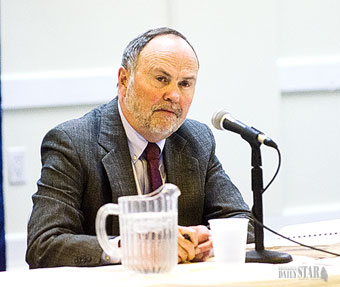
HEARING GRIM TESTIMONY – Territorial judge John Faulkner, acting as a coroner, is seen this morning at the inquest into the deaths of five people being held at the Gold Rush Inn.
Photo by Vince Fedoroff
HEARING GRIM TESTIMONY – Territorial judge John Faulkner, acting as a coroner, is seen this morning at the inquest into the deaths of five people being held at the Gold Rush Inn.
The chimney of the house filled with deadly carbon monoxide gas had been completely blocked off for at least nine days before the bodies of five people were found in the home, according to an expert engineer.
The chimney of the house filled with deadly carbon monoxide gas had been completely blocked off for at least nine days before the bodies of five people were found in the home, according to an expert engineer.
Juergen Korn, an expert in ventilation systems and housing, gave evidence Wednesday at the inquest into the January 2012 deaths of the Rusk family and their friend, Donald McNamee.
Based on the amount of snow found on top of the chimney, Korn used Environment Canada data to estimate how long it had been since heat had made it to the top of the stack.
The Rusks – Valerie, Bradley, Gabe and Rebekah — and McNamee were found dead of carbon monoxide poisoning in their rented home in Porter Creek on Jan. 29, 2012.
Witnesses have testified to everyone in the house feeling unwell before their bodies were found, but it is still unknown exactly when they died.
Korn, an engineer with the Yukon Housing Corp., said the brick chimney would have been an "ongoing cause of indoor air quality problems and potentially poor occupant health.”
Korn's report echoed earlier testimony that places blame on a faulty and degrading chimney, filling with ice and debris, with no proper lining having been installed.
The report suggests debris from the chimney's lining built up in the chimney "likely, over a period of years.”
This was not a problem that had sprung up over a short period of time.
"The failure of the venting system which led to the release of carbon monoxide in the home was not a sudden catastrophic event,” Korn concludes.
"It was a slow process starting with the lifelong degradation of the masonry chimney, that was inappropriate for the sub-Arctic environment.
"The freeze-thaw degradation process culminated in debris from the chimney liner, obstructed the vent reducing heat flow up the chimney and increasing gas spillage and CO production.
"The reduction of heat flow was followed by ice build-up in the chimney and the smoke stack being sealed shut with ice and frost.”
The brick chimney on the 1972-built A-frame house was not only oversized in terms of width, but it was also much too short to meet building code standards, Korn told the inquest.
This chimney, which connected to the family's oil burning heat system, was seven feet shorter than required.
A safe chimney according to code needs to be two feet higher than the highest point on the house, Korn said.
Those deficiencies would have made the exterior chimney cold and much more prone to wind.
Without a proper, approved metal liner, the inside ceramic liner became saturated with water, froze, cracked and fell to the bottom of the chimney were it contributed to the blockage.
While a former contractor has testified to installing a metal liner 20 years ago, Korn agreed with others who have testified to seeing no evidence of installation.
The engineer's tests estimated that the heating system in the house produced about 3.4 litres of water per hour.
As part of the investigation, he took a chainsaw and cut open the chimney.
"You could see these kind of growth rings, where it had melted and frozen back up,” he told the inquest, describing layers of soot between ice and frost.
The tragedy which ended in the deaths of five people could have been prevented at various points in the home's history if proper building code rules had been followed, Korn said.
"There were many seemingly obvious signs of risk, failure and non-compliance with the applicable codes,” he writes in the report.
Observations could have come from the original installers, subsequent installers, service technicians, owners, and even the tenants, he said.
First, when it was built, the original chimney should have been recognized as an inappropriate size.
Later, in 1991, a permit was issued to install a stainless steel chimney liner.
The work was approved by an inspector but no evidence of that liner could be found.
In 2006, a wood stove was installed, with a permit.
Carbon monoxide detectors required by code when a new system is installed, were not present.
Yet, the installation was approved by an inspector.
In 2009, when a used boiler was installed in the home, no permit was ever obtained.
The chimney was also never lined with the required stainless steel or replaced.
The necessary carbon monoxide detectors were not installed.
Finally, when the equipment was serviced in 2010 and 2011, the chimney problems were again not addressed.
The volume of debris found in the chimney suggests it was "maybe cleaned once in its lifetime,” he said.
Carbon monoxide detectors were not required when the home was built. But, the rules in place when both the home's wood and oil heating systems were installed, require that the detectors be included.
Korn also exposed some confusion over whether or not the City of Whitehorse has the authority to step in if it believed there was a problem.
In the city's building and plumbing bylaw it appears that if the city had witnessed the frosted-up, unsafe chimney, they would have the authority to order the problems fixed, he said.
However, it is city policy not to conduct inspections without a permit having been issued for the work.
No permit was issued for the oil-burning heating system in the Rusk home, the jury has heard.
The final page of Korn's 42-page report offers an observation of the current situation in the territory:
"Unfortunately, this installation is very similar to many others in the Yukon,” he wrote. "A quick drive through an older subdivision like Riverdale in Whitehorse will reveal the high number of unlined masonry chimneys that still exist.”
Before concluding his testimony, Korn was asked for any opinions on how to improve things in the territory.
"What strikes me is the low level of building literacy,” he told the jury.
"Not understanding some very basic things that could save people's lives and make them healthier.”
It is not enough to know that turning a thermostat increases heat; it is important to have some basic understanding of how it works.
That education could start as early as elementary school, he said.
Korn stressed the importance of not just focusing on one part of a house or one piece of equipment. Instead, people need to understand how everything works together.
"I'm really amazed by how little society knows about buildings and how they operate.”
The inquest continued with the final witnesses this morning.
The jury is scheduled to hear from a number of people, including the toxicologist who examined the bodies.
After the inquest is complete, the jury will be asked to make recommendations on how to prevent similar deaths.
In order to encourage thoughtful and responsible discussion, website comments will not be visible until a moderator approves them. Please add comments judiciously and refrain from maligning any individual or institution. Read about our user comment and privacy policies.
Your name and email address are required before your comment is posted. Otherwise, your comment will not be posted.
Be the first to comment