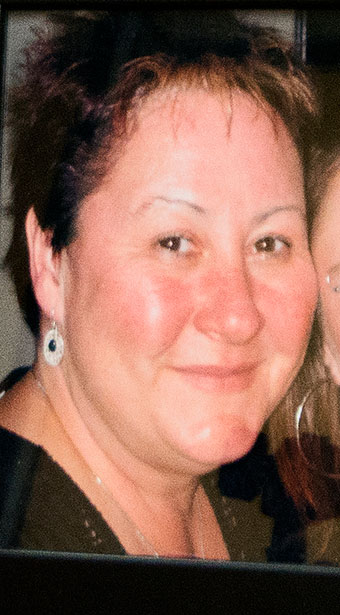
Photo by Whitehorse Star
Teresa Scheunert.
Photo by Whitehorse Star
Teresa Scheunert.
There was significant discussion around charting practices Wednesday as nurses and other staff from the Watson Lake hospital testified before the coroner's inquest investigating into the death of Teresa Scheunert.
There was significant discussion around charting practices Wednesday as nurses and other staff from the Watson Lake hospital testified before the coroner's inquest investigating into the death of Teresa Scheunert.
She died on June 21, 2012 in hospital. She had been admitted on June 7, 2012 for severe back pain sustained during a CPR training course the previous April.
Vitals and charting
Dr. Tanis Secerbegovic initially ordered Scheunert's vitals to be taken four times a day, along with her glucose levels, as she was a type two diabetic.
During testimony from Carol Chaisson, the Watson Lake hospital's administrator, it was noted that vitals were never recorded four times daily over the course of Scheunert's in-hospital care.
On June 7, vitals were charted once, on the 8th twice, on the 9th once; they were not taken on the 10th, 11th, nor 12th, but taken once on the 13th, 14th and 15th.
Her vitals were once again not taken on the 16th, but taken twice on the 17th and 18th, once on the 19th, and not at all on the 20th nor 21st.
Counsel for the coroner noted that meant Scheunert's vitals were not taken at all in the last 48 hours before her death.
It was also noted that there was little monitoring, or at least little written evidence that Scheunert was being monitored before and after she was administered narcotics for pain.
All three nurses who testified Wednesday, however, maintained they hadn't observed any signs nor symptoms to suggest Scheunert was suffering from an overdose of narcotics.
Laurence Demayo, the first nurse to testify, recorded in the nurses' notes from June 18 that Scheunert felt "whacked-out” from a dose of oxycotin, but noted that nothing in her appearance, behaviour, nor speech gave him any cause for concern.
Symptoms that would have been of concern include a low respiratory rate, blueing of the lips and fingernail beds, slurring of the speech, or issues walking, he said.
He was also questioned about Scheunert's elevated heart rate of 125 beats per minute, which he recorded when he took her vitals.
But Demayo said the rate hadn't concerned him because it's common for pain patients to have elevated heartbeats.
He said he would have been concerned and contacted the doctor if her rate had closed in on the 150-beats-per-minute range.
Ruth Lourens, another nurse, testified later on that flexeril, a muscle relaxant Scheunert was taking, could also have elevated her heart rate.
Lourens was working the two days before and the day that Scheunert died.
"It was the worst day of my nursing career,” she told the inquest, which is taking place in Whitehorse.
When questioned about her own charting practices, Lourens said she noted anything that was out of the ordinary.
She explained, for example, that she did not mention Scheunert's distended stomach because it was consistent with the symptoms she was admitted with, and her other care providers were aware of it by June 19.
Lourens had been on holidays when Scheunert had been admitted to hospital, returning to work on June 19.
By that time, Scheunert had already been spending considerable time outside the hospital on day passes.
Lourens noted she did have concerns about the day passes, which she expressed to Scheunert, because the absences inhibited her ability to monitor Scheunert's pain.
She didn't express concerns about monitoring Scheunert's reaction to any of the narcotics. She noted Scheunert had a high tolerance for narcotics given that she had been taking them regularly even before she'd been admitted to hospital.
When queried on the number of times Scheunert had expressed feeling dopey, dizzy, and not herself, Lourens said Scheunert hadn't exhibited any worrisome symptoms on the days she was under her care to suggest she was suffering from a narcotics overdose.
Similarly to Lourens and Demayo, nurse Katherine Relkoff was questioned on her limited charting and why she didn't appear to have taken Scheunert's vitals as the doctor ordered.
She too said she hadn't observed any concerning signs that Scheunert may have been at risk for narcotics toxicity.
It was noted numerous times that Scheunert was often able to walk outside for a cigarette. She also walked home and back to the hospital almost everyday she was in care.
Fentanyl
For most of her treatment in hospital, Scheunert was receiving fentanyl, a narcotic pain reliever, via a patch applied to her skin.
The dosage was doubled the day before her death, to two patches.
The inquest heard Wednesday that Watson Lake hospital's policy regarding fentanyl required nurses administering the drug to record what time they applied the patch, where on the body the patch was placed, and when the old patch was removed and destroyed.
Both Relkoff and Lourens were questioned Wednesday about why the policy wasn't followed.
While the times were often noted that the new fentanyl patch was applied, there was no indication where it had been placed nor what had happened to the old patch.
Questions were also raised because only one fentanyl patch was found on Scheunert's body during the autopsy.
There should have been two, according to the new order, to raise the dosage from 75 micrograms to 150 micrograms on June 20.
Under questioning from Gordon Johnson, the lawyer representing the Yukon Hospital Corp. at the inquest, Lourens said Scheunert may have removed one of the fentanyl patches herself.
Chaisson, the hospital administrator, noted during her testimony that many of the drugs administered to Scheunert are now governed under high-alert policies that they weren't subject to in 2012.
She also noted all doctors' orders are now reviewed by a pharmacist, which also wasn't standard two years ago.
Constant frustration
The inquest also heard Wednesday from Beverly Lister, a hospital care attendant and Scheunert's best friend.
Lister, along with the three nurses, highlighted Scheunert's extreme frustration with the Yukon Workers' Compensation Health and Safety Board for the time it was taking to complete the investigation into the injury she'd sustained during the April training course and ultimately to order her an MRI.
Her doctors explained Tuesday that the MRI was requested through the board because that entity can often get an MRI much more quickly than if it's ordered by the family doctor. Both physicians commented it wasn't uncommon for it to take up to six months to get an MRI.
But Lister also commented that Scheunert had said she was displeased with the care she was receiving at Watson Lake hospital and that she wasn't treated like a patient because she was a nurse.
Lister testified that Scheunert had told her she didn't feel she was getting the proper care and treatment for her injury, and that she felt no one believed her.
The hospital attendant said Scheunert had said she often had to walk over to the nurses' station to ask for her medication.
The nurses said adamantly that their working relationships with Scheunert had not impacted their provision of care.
It has been suggested, though, that Scheunert had more sway in the care she was given because of that relationship.
For instance, Tanis Secerbegovic suggested she might not have doubled Scheunert's dose of fentanyl had Scheunert not been insistent. She also called the day passes a bit of a professional courtesy.
On the night before Scheunert died, Lister said, Scheunert had told her she wasn't feeling well and that she was scared and worried about her health; that "something was wrong.”
She said Scheunert told her to tell her daughters that if anything happened to their mother, they should sue the hospital.
Lister commented that she had observed or heard Scheunert complain on a number of occasions of feeling nauseous and dizzy, and had seen her unsteady on her feet at least once.
When she brought it to the nurses' attention, they seemed unconcerned, noting that Scheunert had just been given her
medication.
The inquest has heard other testimony, including from Scheunert's daughters, that Scheunert had been quite upset on the night of June 20, and had expressed fears about her health status.
June 21
The next morning, Lourens was back at the hospital and serving as Scheunert's primary care nurse.
At 8 a.m., the start of her shift, Lourens said she checked in on Scheunert and found her sleeping and snoring. She didn't awaken her because she'd been made aware that Scheunert had had a rough night.
At 8:30, Lourens checked on her again, this time leaving Scheunert's diabetes medication next to her bed to take when she awoke and before she ate breakfast.
Lourens checked on her once more at 10:15 and found her still sleeping. She said she observed the normal rise and fall of Scheunert's breath, and wasn't at all concerned that she was at any immediate risk.
It was Margaret Dickson, the hospital cook, who found Scheunert unconscious at around 11 a.m. when she was collecting the breakfast meal trays.
Dickson testified today that she noticed Scheunert was not breathing and tried to rouse her, when she couldn't she called for a nurse.
Lourens testified that when she turned Scheunert onto her back for CPR, her skin was blue-ish, but couldn't remember whether she was warm or cool to the touch.
"It was a very good effort that was put out,” she said, testifying to the resuscitation measures that were undertaken.
Wanda Zimmerman, Scheunert's sister, questioned whether Lourens had considered administering narcan, a drug used to reverse the effects of a narcotics overdose, during those efforts.
Lourens said she hadn't for a number of reasons, including that she had never observed Scheunert to be exhibiting any symptoms that would suggest she was suffering from narcotics toxicity, and that the last dose of dilaudid, a morphine-based narcotic, had been administered 14 hours prior to her death, meaning the only narcotic she was under was the fentanyl patch.
The inquest, being presided over by a B.C. coroner, is continuing today and is expected to conclude Friday.
In order to encourage thoughtful and responsible discussion, website comments will not be visible until a moderator approves them. Please add comments judiciously and refrain from maligning any individual or institution. Read about our user comment and privacy policies.
Your name and email address are required before your comment is posted. Otherwise, your comment will not be posted.
Be the first to comment