Photo by Vince Fedoroff
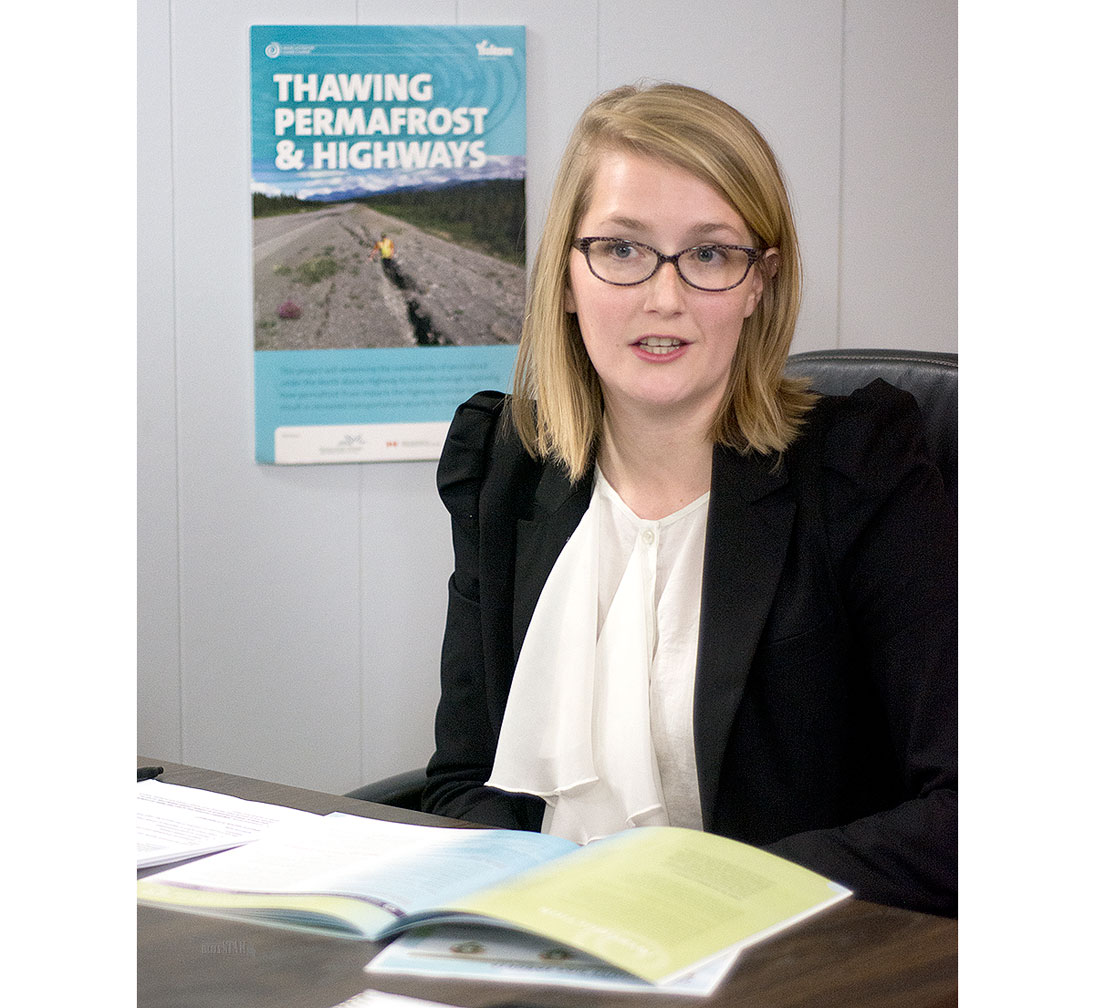
SPELLING IT OUT – Kirsten Burrows, the senior analyst for the Yukon government’s Climate Change Secretariat, briefs the media on the climate change report Thursday.
Photo by Vince Fedoroff
SPELLING IT OUT – Kirsten Burrows, the senior analyst for the Yukon government’s Climate Change Secretariat, briefs the media on the climate change report Thursday.
Just in time for the COP21 conference in Paris, the Yukon government released a progress report for its 2009 Climate Change Action Plan.
Just in time for the COP21 conference in Paris, the Yukon government released a progress report for its 2009 Climate Change Action Plan.
The nearly 50-page progress report states that in the six years since the first plan was created, the “majority” of the government’s 33 original goals have been completed or are underway.
The report itself, however, provides little information as to what’s actually been done in those six years to comprise that majority.
“I don’t think in the report it’s actually gone into saying specifically what’s been completed and what hasn’t been completed,” Kirsten Burrows, the senior analyst for the government’s Climate Change Secretariat, said Thursday.
Part of that is due to the fact that some of the long-term goals are just that, long-term.
In 2012, the government created sector-specific greenhouse gas reduction targets – of the 11 in total, there are four goals that are to be completed by 2015, and one in 2014.
Several other targets have completion dates for 2020.
One target is to have the transportation sector decrease its emissions by 10 per cent by the end of this year.
“We won’t know until 2017 if we’ve met this target because of the industry standard time-lag in terms of reporting,” Burrows said.
From what is shown now, the Yukon is just one kiloton away from meeting the transportation goal – but it will take 18 months to know for sure, Burrows said.
Emissions for the transportation sector have seen a decrease overall since 2011.
Burrows partly attributes this drop to the decline in the mining industry – since there are some off-grid mines in the territory that are no longer operating, there are fewer large trucks travelling to those mines, thus decreasing greenhouse gas emissions.
The sector seeing an increase in its emissions, ironically, is the Yukon government.
Preliminary data show that between 2010 and 2013, the government jumped from 0.3 kilotons of greenhouse gases to 42 kilotons.
“This data is subject to revision,” Burrows points out.
As with the transportation sector goal, final data will be known in 2017 – but it is highly unlikely that the territory came remotely close to quashing 20 per cent of emissions by the end of this year, as stated in the 2012 target.
The report dedicates five pages of initiatives to attempt to stifle the emissions used in the Yukon government’s internal operations.
The majority, 65 per cent, of the government’s emissions come from heating more than 550 government buildings.
One initiative to combat this is to establish modern buildings that are energy efficient.
The example Burrows mentioned is the new F.H. Collins Secondary School, which is touted to use 20 per cent less energy than a standard building would.
The government’s contribution to the territory’s total emissions is low, roughly six per cent.
It is transportation that makes up the majority of total emissions, sitting at about 57 per cent in total.
It has taken a while to understand the toll of which transportation takes.
Part of the problem, was in the reporting of emissions – as of now, the territory is switching up how it tracks its carbon footprint.
Historically, the territory has relied on Environment Canada and Statistics Canada to supply the data for greenhouse gas emissions.
But when officials at the Department of Environment had a hunch that emissions were being under-reported, a report was commissioned by Research Northwest in 2013 to gain more insight into the issue.
Its main finding confirmed the hunch – Environment Canada’s data for the transportation sector was off by 70 per cent one year, and 92 per cent another year.
“As a result, Yukon GHG emissions were considerably under-reported in Environment Canada’s analysis for the period 2009 through 2012,” the report states, thus making it difficult to gauge whether or not the territory is meeting its emissions goals on time or not.
Burrows said the territory has found a way to get more accurate emissions data, from the Department of Finance – more specifically, by calculating the amount of tax collected by the government from fuel sold in the territory.
Going forward, the department is confident in its methods for tracking emissions.
The report states that planning for reducing emissions can be a tricky exercise – population growth and weather trends can influence whether a target will be hit or missed.
“We’re aware that these targets are ambitious,” Burrows said.
But it doesn’t mean that the territory will stop working to address climate change challenges, she added.
The report identifies 28 new climate change actions, mostly focused on adaptation and mitigation.
There is no timeline set for the next possible progress report.
See commentaries.
In order to encourage thoughtful and responsible discussion, website comments will not be visible until a moderator approves them. Please add comments judiciously and refrain from maligning any individual or institution. Read about our user comment and privacy policies.
Your name and email address are required before your comment is posted. Otherwise, your comment will not be posted.
Comments (7)
Up 11 Down 1
Max Mack on Dec 8, 2015 at 7:55 pm
Still waiting for my comment to be published from the other day.
I stand by my statements. Research Northwest's methodology has flaws and these need to be questioned by our journalists, rather than championed. A little less bias and a little more objectivity from our media would be really, really good. Is that too much to ask?
Up 13 Down 2
scam on Dec 7, 2015 at 3:10 pm
I saw dinosaur tracks in the Ross River school last time I was there. I wonder if we will ever have a temperate climate up here again? Warm enough for giant reptiles!
We are currently pulling out of an ice age and I am glad we are not experiencing 'global cooling' as happened about 10,000 years ago.
I am all for not polluting, but there are far greater risks than global warming, and far more direct causes than CO2 'per se'. Nobody seems to be talking about the fact that the human population of the earth has doubled in the past 55 years, while over half the animals have disappeared (not species, but numbers).
If they were attending a conference on birth control options for the developing world I would be a lot more supportive. Or a conference on enforcing laws against illegal fisheries which are stripping our oceans of life.
But nope. Climate change and 'carbon tax / carbon credits'. Another scam to put money in the pockets of the rich and take money from the regular people in the first world. That's what this is. So many people have been sucked in. Pollution is bad, agreed. But take a look at who you are working for. Who owns the carbon exchanges? Al Gore, the Rothschilds, etc.
Money talks and the puppeteers are holding the strings, as always.
Lastly, if any of our politicians had integrity on this issue, they would forgo the party and stay at home to save on all the emissions they are producing with their international flights. The hypocrisy is stunning.
Up 13 Down 7
JC on Dec 4, 2015 at 9:59 pm
The Climate Change Scam!!! All those useful people are just making people like Al Gore and David Suzuki richer. David Suzuki has at least 3 mansions worth several millions dollars each. Why doesn't he release his carbon footprint to the public. That would be too embarrassing. But then the useful people wouldn't believe it anyway. I give my donations to real charity, not to millionaires.
Up 8 Down 12
Lost in the Yukon on Dec 4, 2015 at 7:03 pm
Interesting isn't it ... The Pharmacist gets raked over the coals (no pun intended) over failure to report progress on a commitment that is years old, suddenly produces one that is so full of holes you could drive a Yukon Party back room boy through and he sends out a low level bureaucrat to face the media.
Nice leadership Mr. Pharmacist.
ABYP
Up 5 Down 2
Calling down employees does not help anything on Dec 4, 2015 at 5:42 pm
Get with the facts. 65% of our C2 are created by auto's heating fuels.
Look at all the trucks going through the Yukon every day to Alaska.
Up 2 Down 7
unattended government vehicles idling on Dec 4, 2015 at 4:34 pm
“The government also has a target of reducing emissions from its light fleet by five per cent by 2015. As of 2014, those emissions had increased by three per cent.”
Far too often we see unattended government vehicles idling at the curb.
The government’s most recent pretense to care about the environment is sending an entourage to the Paris Climate Party. If they’re going to talk like they care then they should be held accountable when their actions clearly show an ongoing attitude of blatantly wasting energy and polluting.
If the government actually cared about the environment, then wouldn’t there be a government wide policy to prohibit leaving unattended vehicles idling?
Up 8 Down 1
June Jackson on Dec 4, 2015 at 3:54 pm
"But when officials at the Department of Environment had a hunch that emissions were being under-reported, a report was commissioned by Research Northwest in 2013 to gain more insight into the issue."
Not much here that could be taken as truth. "under reporting" does tend to unbalance all the numbers.