Infamous tar pit will finally be drained
In 1958, after the death of a man who became trapped in the Marwell tar pit, a coroner's jury looking at the death "strongly recommend that the oil pool, which has proven to be a hazard to life, be removed by whatever means necessary as soon as possible.”
By Stephanie Waddell on June 30, 2010
In 1958, after the death of a man who became trapped in the Marwell tar pit, a coroner's jury looking at the death "strongly recommend that the oil pool, which has proven to be a hazard to life, be removed by whatever means necessary as soon as possible.”
More than a half-century later, on Tuesday, in the federal government building on Range Road, federal and territorial officials announced a more than decade-long, $6.8 million project to clean it up.
"This announcement has been a long time in the making,” said Joanne Wilkinson, regional director general for the Yukon region of Indian and Northern Affairs Canada (INAC).
She and others cited a long, complicated history over the years that essentially meant the site was never cleaned up.
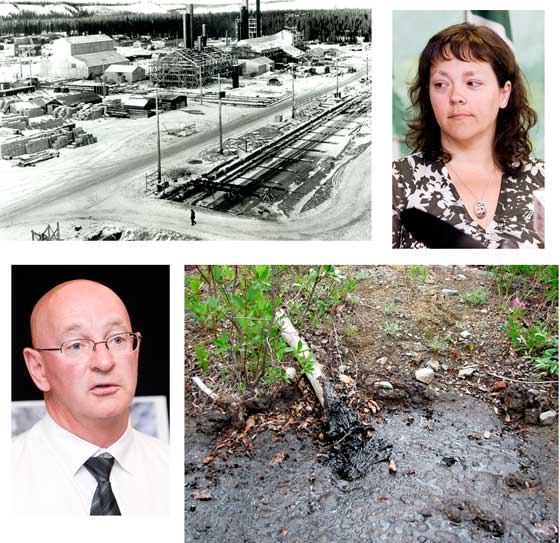
That history, outlined in a report provided to media, began in the 1940s, when the United States Army Corps of Engineers contracted Standard Oil from California to build and operate an oil refinery near the tar pit.
The refinery was built to process oil from Norman Wells, N.W.T., and operated for just a year from 1944 to 1945 before the U.S. government shut it down.
A photo of the site taken in 1946 shows no signs of a tar pond, but there is a hydrocarbon storage tank on the property surrounded by a berm that still has remains at the site today.
It's estimated the tar pit was created sometime between 1946 and 1952, based on the next aerial photo taken in 1952 showing the black pool of liquid on the site. By that time, the refinery, purchased by Imperial Oil Ltd. in 1947, had been dismantled and removed.
After the man's death, the site was fenced off. In the years that followed though, various government bodies looked at the situation and a court case involving Imperial Oil was heard, but no one could reach a decision on who was ultimately responsible for the mess.
"Jurisdictionally, it was very complicated,” said Brett Harshore, manager of waste management programs for INAC.
When all is said and done though, both levels of government will end up sharing the costs to clean it up.
Ottawa will bear the brunt of that, covering 70 per cent to a maximum of $4.76 million while the territory funds the remainder and takes the lead on actually doing the work.
"This agreement will make it possible to remove an environmental hazard that has long been of concern to Yukoners,” territorial Environment Minister John Edzerza said in a statement.
"Cleaning up the site will benefit the people working in the area, improve local ground water quality and help the environment overall.”
It's estimated there are about 27,000 cubic metres, or the equivalent of 2,700 dump truck loads, of soil to remediate, though government officials also said they don't yet know if any of the contaminates in the soil have moved.
It's unknown how much of each contaminant – benzanthracene, heavy and light extractable hydrocarbons, naphthalene and manganese – is in the ground.
As of more than a decade ago when the site was last looked at, there was nothing indicating the contaminates had seeped out, but that may have changed.
"It's only a matter of time,” said Jon Bowen, the territory's director of environment programs.
Though the announcement was made Tuesday, it could be five years before any work begins on the site, with a planning stage being the first of three phases.
It is in the planning stage that issues like employment, agreements with the Kwanlin Dun First Nation and Ta'an Kwachan Council, the submission and approval to groups like the Yukon Environmental and Socio-economic Assessment Board and looking at how the project will fold out will be decided.
"There's a lot of emerging technology out there,” Bowen told reporters, adding officials will be looking at those technologies as it decides how to proceed.
One of the first steps will be to hire a project manager dedicated to overseeing the initiative, he said.
The planning phase will be followed by a two-year remediation phase that will involve removing and treating the soil, risk management and stabilization.
The final phase of post-remediation is expected to happen over four years and include monitoring and a regulatory review.
It's expected that will wrap up in 2020 or 2021.
Comments (2)
Up 0 Down 0
Don McKenzie on Jun 30, 2010 at 2:05 pm
What's another 5 years between friends?
Up 0 Down 0
Bedrock Billy on Jun 30, 2010 at 9:38 am
Five years to plan! What is so difficult that it has to take five years to plan? Five years to discover how to load 2700 dumps trucks? For crying out loud call in the US Army Engineers, they'll do it 6 months. And why would it take five years to get an agreement with the Kwanlin Dun First Nations. Wouldn't a phone call be just as good. One would think they would be glad to have it done as soon as possible. There's something wrong with this picture. It appears that the planning stage is going to be a weekend project. Or is it just another scam to make a few lawyers rich. Just get in there and do it! Fifty two years is long enough.