Photo by Whitehorse Star
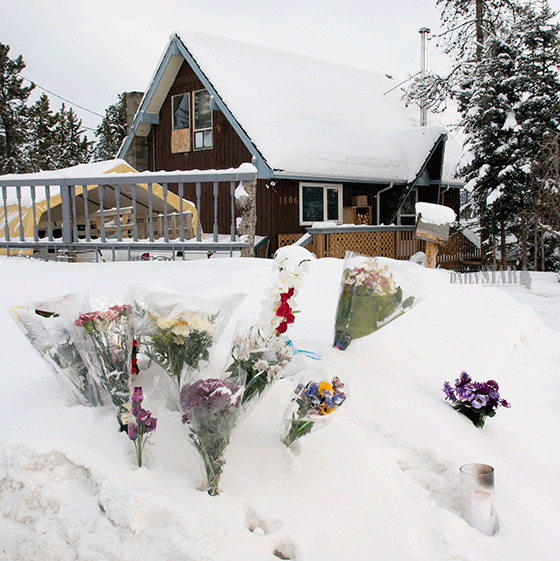
EXPRESSIONS OF SYMPATHY – Bouquets of flowers were placed outside the Centennial Street house in which five people died in January 2012. The rented home was demolished later in the year.
Photo by Whitehorse Star
EXPRESSIONS OF SYMPATHY – Bouquets of flowers were placed outside the Centennial Street house in which five people died in January 2012. The rented home was demolished later in the year.
Nearly four feet of ice and debris blocked off the chimney of a home filled with toxic gas, killing five people.
Nearly four feet of ice and debris blocked off the chimney of a home filled with toxic gas, killing five people.
The inquest into the January 2012 deaths of the Rusk family and their friend heard testimony Tuesday from people who worked on the Porter Creek home's oil burner heating system and those who tried to piece together what happened after the victims died.
Brad, 45, Valerie 37, Gabe, 13 and Rebekah Rusk, 11, and their 47-year-old family friend, Donald McNamee, were found dead of carbon monoxide poisoning in their Centennial Street home on Jan. 29, 2012.
A deputy fire marshal along with the territorial government's chief mechanical inspector testified to various factors they say contributed to the build-up of ice.
Pair that ice with a crumbling brick chimney, and the deadly gas could not escape the house, they said.
"The exhaust needed somewhere to go,” explained deputy fire marshall Kevin Taylor. "In this case, the path of least resistance is through the sight glass.”
That's the same spot on the oil heating system where first responders have testified to seeing flames shooting out on the day the bodies were found.
Taylor, who completed one of many reports following the tragedy, pointed to a number of contributing factors which led to the blockage.
The boiler was manufactured in 1993 and bought used to install in the home in 2009.
It was not as efficient as the new burner bought and installed with the boiler at the same time.
As a result, the system did not produce enough heat to properly vent the gas — and the moisture it contains — out of the house, Taylor said.
He also pointed out that if the family did not use their oil heating system on a regular basis, as has been suggested by some witnesses, that could also contribute to the freeze/thaw cycle which damages the chimney.
The Yukon government's chief mechanical inspector focused much of his testimony on the size of the chimney itself.
Paul Christensen said the boiler and burner could have worked together properly if they had been matched with a smaller chimney.
He told the jury the diameter of the exterior masonry chimney on the house was "grossly oversized” for the heating system.
A smaller chimney would mean the gases would have been more efficiently expelled from the home, he said.
Much of Tuesday's testimony again focused on whether there was a metal liner in place inside the chimney.
Taylor testified a liner could have helped keep the large amount of masonry and other debris from falling in the chimney and contributing to the blockage.
Earlier in the inquest, a former contractor testified to installing a metal liner about 20 years ago.
Records show that permits were taken out for the job.
Both Taylor and Christensen testified they found no evidence of any such liner during their investigation.
Both men said they would have expected to find some signs of the liner even if it had degraded over time.
A galvanized pipe was at the top of the chimney just below the cap, along with about six inches of metal going down into the inside of the brick structure, they said.
As for the heating system itself, a mystery remains as to how the appliance was running on the day the five bodies were discovered.
Lance Couch, the owner of Certified Heating and Services, testified his company serviced the oil-fired heating system annually starting in 2008 – first an older system, then one installed in 2009.
These service calls involved taking the equipment apart, cleaning it, testing its efficiency and watching for wear and tear, he testified.
When the safety tests had been done in 2010, the newly-installed heating system was found to be working properly, Couch said.
However, when they arrived to perform the same test the next year, the system had no oil in it and the red seal certified employee was unable to complete his work, Couch said.
Without oil, no safety tests could be done on the chimney, exhaust nor backdrafts.
Couch testified his employee shut off the system from the master switch and told the family to call again when they had oil so the tests could be completed.
Couch said his company was never called to restart the system and complete the tests.
Whoever restarted the equipment would have had to turn the power back on, unscrewing multiple screws on the back to access the boiler and bleed the lines to get the air out, he said.
A red seal certified oil burner mechanic himself, it was Couch who recommended to landlord Craig Tuton that the old system be replaced after servicing it in October 2008.
"Craig, this boiler is very old and poorly installed at that,” the invoice reads. "I recommend that a new boiler be installed in the spring if possible.”
The document also notes: "Recommend having boiler and chimney cleaned as soon as possible.”
Tuton said he spoke to Couch about getting a new system, but never read the recommendation that the chimney be cleaned.
It's possible the invoice may have gone directly to his accountant to be paid, he said.
In 2009, the new system was installed by Steve Thrower, the long-time owner of Hidden Valley Mechanical and a trained plumber.
In the Yukon, there is no requirement that the person who installs a oil-burning appliance have any specific certification.
Thrower told the inquest he has installed about 100 heating systems of this type in his career.
Much of the testimony in the morning centred around the codes in place for installing this type of equipment.
Tuton told the inquest he trusted the people he hired to know the various codes surrounding oil-fired appliances.
But no permit was ever issued by the city for the installation of the new boiler and burner.
Thrower said he's not sure how that slipped through the cracks. Sometimes, he gets the free permits himself and other times he asks the homeowner to do it, he said.
Without a permit, the newly installed system was never inspected to make sure it passes code.
Thrower admitted he is not familiar with CSA B139-04, the installation code for oil-burning equipment.
He said he's never had an installation not pass inspection and believed he was doing everything necessary to make the equipment safe.
He believed the boiler and burner were the appropriate size.
Thrower told the inquest he did what's called a mirror test on the chimney. That involved looking up the chimney and confirming there were no blockages.
During his testimony, Couch noted that the used boiler that had been installed was not equipped with a blocked flue switch which would have shut off the system if there was a blockage.
Those are required under code for any equipment installed in 2007 or later, he said.
The inquest is scheduled to last until the end of the week. Territorial judge John Faulkner is acting as the coroner.
The jury heard today from only one witness: an engineer who completed his own report following the deaths.
In order to encourage thoughtful and responsible discussion, website comments will not be visible until a moderator approves them. Please add comments judiciously and refrain from maligning any individual or institution. Read about our user comment and privacy policies.
Your name and email address are required before your comment is posted. Otherwise, your comment will not be posted.
Comments (7)
Up 0 Down 0
CabComms on Feb 12, 2013 at 10:37 am
A fair point, if a tad minimizing. Some contractors do not follow up with the owners, and they should, though resident education is still important. Regardless, the responsibility lies with the owner. You followed up, and so you should! It's your property, your hire, your money, your responsibility
Up 0 Down 0
north_of_60 on Feb 12, 2013 at 10:33 am
Contractors are responsible to the person who hired them to do the work.
Landlords are responsible to make sure tenants have safe accommodation, regardless of who they hire.
Up 0 Down 0
Landlord on Feb 12, 2013 at 6:52 am
Just wanted to point out that not all contractors do get in touch with the landlords....they end up communicating with the tenants (even when they are told to call the owners). This recently happened to me ... a repair was being done that I didn't know about. I followed up with the contractor about the visit and was then informed. Contractors also need to be held accountable! They do not report to tenants, they report to landlords.
Up 0 Down 0
Jonathan Colby on Feb 12, 2013 at 4:33 am
Ah, but there you are caught!
"I can also understand how a note, written on an invoice may not be seen by the owner, if bills are sent to an accountant for payment."
So, as is often the case, the owner does not meet with the technician on site to discuss matters of interest. And, as may be the case, the owner does not even see the invoice, as they do not pay it directly. Therefore, because they have not spent any time attending to matters concerning properties that are owned by themselves, owners bear no responsibility whatsoever to any matters of liability related to the purview of service companies hired by them.
That sounds logical, because I am a donkey.
I wish such foolishness didn't seem so ubiquitous among individuals equipped with one or both of brains and influence. The owner is responsible for the system that failed. It's right there in the Landlord and Tenant Act in Section 76 "Landlord's Responsibilities."�
Up 0 Down 0
Atom on Feb 9, 2013 at 12:11 am
Cathy....is it just a bit dubious that there is no actual building to inspect anymore, as the owner had it torn down as quick as he could?
In this situation suggesting the owner can hide behind contractors to save guilt (or his soul) is a stretch.
'We need laws with ‘teeth' to ensure that landlords do more than just collect rent.'
Up 0 Down 0
Cathy Routledge on Feb 7, 2013 at 10:00 am
Whoa folks - from the coverage I've read, the landlord hired professionals to install and maintain the heating system in his rental property. And professionals are paid to know this stuff - that's why we hire them.
There were opportunities for these contractors to point out short comings in the system - and did, in at least one case. I can also understand how a note, written on an invoice may not be seen by the owner, if bills are sent to an accountant for payment.
There seems to be a real breakdown in the permitting/inspection services provided by the City and the tragedy is, there were opportunities for several different people to have affected the outcome of this senseless accident. That they didn't, is something they all have to live with for the rest of their lives.
Up 0 Down 0
north_of_60 on Feb 6, 2013 at 9:43 am
Isn't it the landlord's responsibility to ensure that heating, ventilating, and plumbing systems are in good working order? The cause of this incident didn't happen suddenly. This is a case of shoddy maintenance over many years.
We need laws with 'teeth' to ensure that landlords do more than just collect rent.