'I still do not know what their motive is'
Legal fees are being covered by a national agency to assist a local housing co-operative involved in a life and death struggle with the territorial government and its Yukon Housing Corp.
By Chuck Tobin on March 14, 2008
Legal fees are being covered by a national agency to assist a local housing co-operative involved in a life and death struggle with the territorial government and its Yukon Housing Corp.
Members of the non-profit Whitehorse Housing Co-operative say they have no idea where Yukon Housing is coming from with its attempt to take ownership of their 12 housing units.
But a national law firm retained by the housing co-op believes it will win if the matter ever sees the inside of a courtroom, Doug Bishop, vice-president of the co-op, said in an interview Thursday.
"I still do not know what their motive is," Bishop said, wondering out loud why a publicly-owned social housing agency would be chomping at the bit to evict 12 families.
He said he understands how Yukon Housing might see this as an opportunity to gain a valuable asset with no investment, and with very little effort.
But he really doesn't understand why.
Yukon Housing was appointed by the court in 2003 to act as a receiver on behalf of the co-op after the non-profit organization ran into management problems and fell behind three months of mortgage payments.
The co-op has been operating in the black since, and is back on track with an asset base of over $3 million, more than twice the outstanding mortgage, Bishop explained.
Normally, said Bishop, receivers are appointed by the court to help a business or organization get back on its feet, not to effect a takeover.
Two months ago, however, Yukon Housing - with the blessing of Premier Dennis Fentie and his management board of senior staff and cabinet ministers - sent eviction notices to the tenants of the 12 units.
The letter tells the occupants that Yukon Housing plans to seek a court order to transfer the co-op's assets and liabilities to the Crown corporation.
"The effect of this order would be that the co-op would be dissolved and the 12 housing units would be incorporated into the YHC's social housing portfolio," says the Jan. 16 letter to the tenants.
"The Yukon government has accepted our recommendation to pursue this action, and we are now preparing to proceed with an application to the court."
The letter goes on to say the six tenants who pay full rent will have a year to move.
"YHC will advise the rent supplement tenants if they are considered over-housed, and where applicable, will place them on a relocation list in 12 months' time; and rent supplement tenants who are suitably housed may continue to occupy their unit," the letter reads.
Bishop said Yukon Housing is trying to sugar-coat the situation with tenants on subsidized rent. When it comes down to it, he said, it's likely all six will also be evicted and told to move into other social housing units more appropriate to their needs.
There is a senior couple, for instance, who live on subsidized rent and have lived in one of the 12 co-op units for years.
In all likelihood, Yukon Housing will decide the couple doesn't need all that room in their modest two-bedroom home, and will want them to move somewhere else, into something Yukon Housing determines is more appropriate, Bishop said.
He said he's not sure what Yukon Housing is telling others about the co-operative's situation, but he knows the Crown corporation told the registrar of non-profit societies in January that the co-op was bankrupt.
Yukon Housing has also indicated the co-op is without a functioning board of directors, he said.
He and others maintain nothing could be further from the truth.
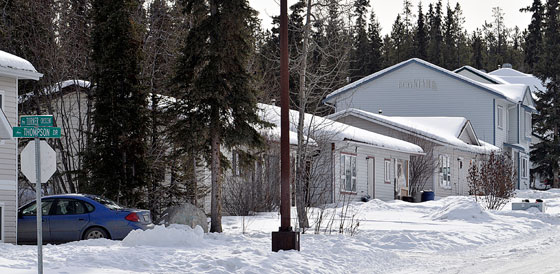
The 12 housing units owned by the co-op on Turner Crescent in the Granger subdivision have recently been appraised at a total value of $3.2 million, while the outstanding mortgage with First Financial of Toronto is $1.4 million, Bishop pointed out.
The co-op ran fine for 15 years, until the management problems arose in 2003, he said. And it's run fine ever since.
When the co-op went public recently with its concern about the attempted takeover, Yukon Housing officials did respond publicly to explain its position. This week, however, the corporation is no longer commenting, saying the matter is before the courts. No court documents have been filed.
There was no response from the cabinet office to speak with Yukon Housing Minister Jim Kenyon.
Rudy Couture, chair of Yukon Housing's board of directors, said this morning he could not comment extensively on the matter. He did say the statement that the co-op was bankrupt was incorrect, and a letter to the registrar of societies is being prepared to correct the record.
Couture said Yukon Housing decided to try to take ownership of the 12 units because the Whitehorse Housing Co-operative has not displayed the stability and consistency to form a board of directors necessary to manage its affairs.
It was felt that, even after a restructuring process, there would still be a danger of the co-op falling off-track again, resulting in Yukon Housing spending more time and money to jump back in again and manage matters, he said.
Couture also noted, however, that there has been talk of simply asking the court to remove Yukon Housing as the receiver, instead of proceeding with a court order to transfer ownership of 12 units. At this point, he said, it is only been mentioned in passing, with no debate or decisions made one way or the other.
The chair of the board also acknowledged it's not clear how Yukon Housing would handle the $1.7-million difference between the $3.2-million value of the housing units and the $1.4-million outstanding mortgage.
Bishop said technically speaking, representatives from all 12 households make up the board of directors for the co-op. There is a duly-appointed executive, and about three-quarters of the households are represented on average at the regular monthly meetings, which are also attended by one or more officials from Yukon Housing.
Bishop said he doesn't know how Yukon Housing can suggest there is no tangible board of directors for the co-op.
He also emphasizes the national organizations that represent and assist some 800 housing co-operatives across Canada are standing by ready to help the Whitehorse co-op with a restructuring plan.
There's been no movement in that direction because the receiver, Yukon Housing, has not been co-operative, Bishop said.
He pointed out the Federal Co-operative Housing Stabilization Fund did approve a $297,000-loan 3 1/2 years ago to pay off the missed mortgage payments and provide some money required for regular maintenance.
The national organization is in the sole business of providing assistance to help housing co-operatives absorb the bumps along the way, and isn't in the habit of throwing good money after bad, he said.
Bishop emphasized the fact that the national organization has offered to assist the Whitehorse Housing Co-operative speaks volumes about the viability of the organization.
Housing co-operatives work on the basis of some tenants paying regular market rent while rent for others is subsidized through social housing programs, Bishop explained.
He said the dynamics of co-op rent promote a nice mix of neighbours, just as it has on Turner Crescent.
None of the tenants own any of the assets, and when a vacancy comes up, they jointly help clean, paint and generally prepare for the next tenant, which is selected by the co-op, he pointed out.
Yukon Housing, Bishop suspects, can't wrap its head around the concept, and only sees its way of doing things when it comes to providing social housing.
Bob Nardi, a local consultant, was retained by the Co-operative Housing Federation of Canada, the national umbrella group to 800 co-operatives across the country, to help the Whitehorse co-op get back on its feet.
"They are quite concerned about what is going on here," Nardi said of Yukon Housing's decision to seek ownership of the units.
"That they are willing to help the co-operative through the payment of legal fees is quite unusual but they are watching this very, very closely.
"The issue is fundamental to co-ops across Canada if receivers can do this; it's bigger than just 12 units."
Be the first to comment