Photo by Photo submitted
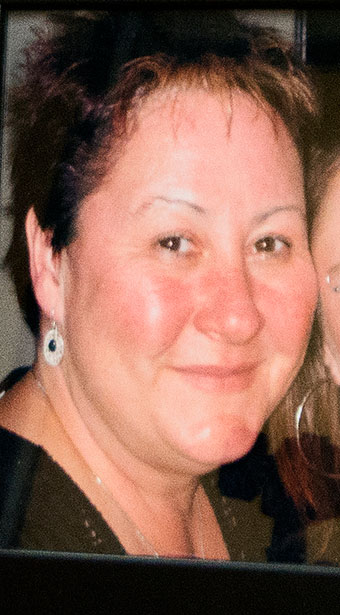
SEEKING ANSWERS – An inquest headed by a coroner visit ing from B.C. is investigating the June 2012 death of Teresa Scheunert (above) at the Watson Lake hospital in June 2012.
Photo by Photo submitted
SEEKING ANSWERS – An inquest headed by a coroner visit ing from B.C. is investigating the June 2012 death of Teresa Scheunert (above) at the Watson Lake hospital in June 2012.
Teresa Scheunert called both her daughters the night before she died at the Watson Lake hospital in June 2012, a coroner's inquest heard Monday in Whitehorse.
Teresa Scheunert called both her daughters the night before she died at the Watson Lake hospital in June 2012, a coroner's inquest heard Monday in Whitehorse.
Crystal Thomas and Chandre Burchell were the first of three witnesses to take the stand yesterday, the first day of the inquest into Scheunert's death.
The inquest is being overseen by Norman Leibel, a coroner from B.C.
Thomas noted her mother called her five times on June 20, 2012, the day before she died.
When she was able to speak with her mother, she said Scheunert was "tearful,” "irrational,” and "all over the map.”
Sheunert kept saying she needed to leave, said Thomas.
Her mother also spoke with younger sister Burchell at around 10 p.m. Alberta time.
Scheunert was "bawling” and said she was scared, Burchell testified.
She explained that she tried to calm her mother down and suggested to her that maybe the medications she was taking were making her emotional.
She was always a "drama queen,” said Burchell, but that night was different; she sounded depressed.
Scheunert called Burchell from home, where she'd been on a day pass, and was heading back to the hospital for the night, Burchell testified.
Scheunert had admitted herself to the hospital for pain management on June 7, following a back injury the previous April.
Throughout her hospital stay, Scheunert was able to leave on day passes to spend time at home, returning in the evening to rest.
Burchell said Scheunert's house was about half a block from the hospital, suggesting it was about a three-minute walk.
Counsel for the Yukon Hospital Corp., however, suggested it was perhaps longer than that, closer to a seven-minute walk.
During Thomas' testimony, she noted that her mother had returned to Watson Lake from Alberta after her step-dad had died from brain cancer.
"The Yukon was always where she felt at home,” said Thomas, who, along with her sister, lives is Ponoka, Alta.
Regardless of the distance, both women said they were close with their mom and spoke almost every day.
But the last time Thomas actually saw her mother was on Halloween 2011.
She testified that her mother had told her she'd injured her back during a CPR course in Whitehorse.
Burchell, who arrived for a six-week visit the day after her mother's injury, testified she did most of the driving back to Watson Lake. They took frequent stops so Scheunert could take a walk and stretch out her back.
She noted the injury impacted their plans to visit places like the Liard Hot Springs, and instead, they did a lot of visiting at Scheunert's home.
Following her injury, Scheunert continued to work shifts at the hospital, where she was a nurse, until the pain grew too bad and she admitted herself to hospital.
Thomas said that after her mother went into the hospital, she became emotional and would often cry.
She also complained of nausea and dizziness.
It was noted Monday that Scheunert was taking various medications for pain during her stay, including oxyneo and fentanyl.
Toward the end of her life, her speech changed, becoming "slow and slurred,” Thomas said, as if she had to try hard to articulate her words.
She remembers saying the fentanyl patch, one of her medications, was "quite scary.”
Burchell's comments supported her sister's.
She added that Scheunert was suffering from issues related to bowel control and complained of swelling in her abdomen and tingling in her feet, back and legs.
Counsel for the coroner asked both Thomas and Burchell if they had contacted the hospital about their mother's symptoms, which they hadn't.
She handed each of them a sheet that highlighted signs when opioid dosage is too high, symptoms consistent with their mother's.
As the inquest heard later in the day, Scheunert admitted herself into hospital in part because she hoped it might help her get an MRI scheduled more quickly.
But Thomas said her mother was getting more frustrated with the length of time it was taking and had looked into getting a private MRI in Alberta.
She'd sold property to finance it and had asked her daughters if she could stay with them.
Thomas said her mother likely would have gone to Alberta within the week if she hadn't passed.
When Thomas and Burchell heard that their mother had died, they were told a heart attack had been the cause.
Thomas said that didn't make sense to her because although her mother had suffered from high blood pressure and diabetes, both had been under control.
She asked for an autopsy.
A few weeks later, when the family arrived in Watson Lake to collect Scheunert's ashes, they found Scheunert's house had been ransacked.
During that visit, they met with some of the nurses and heard that they had prepared her mother's body.
Thomas was concerned about this information, as she understood that when an autopsy is requested, the body is to be left with all tubes and medicinal patches in place for the coroner.
The family was also given a journal that had been found by their mother's bedside table in the hospital.
In it, Scheunert had written comments about how she was feeling, she noted that she was feeling pressure in her abdomen, tingling, and had an altered gait and a feeling "of impending doom.”
Both women were also questioned about their mother's sleeping habits and tendency to snore.
According to her daughters, she'd snored loudly her whole life, but it had never been cause for concern.
Thomas was given the opportunity at the end of her testimony to say a few words about her mother. She noted that she was a confidante, who made life-long friends easily.
"I hope we can find a real true answer to what happened,” she said, adding that they want clear recommendations to prevent similar deaths in the future.
Standing has been given to Wanda Zimmerman, on behalf of the family, Lee Kirkpatrick and Cindy Freedman as counsel for the coroner, Gordon Johnson as counsel for the hospital corporation, and Jonathan Meadows as counsel for doctors Tanis and Said Secerbegovic.
The jury consists of six Yukoners charged with determining how, when, where, and by what means Scheunert died. It is not a fault-finding mission.
The verdict does not need to be unanimous, but must have five of six jurors in agreement.
The jury may also put forward recommendations, which Leibel urged them to do to prevent similar deaths.
The inquest is scheduled to go on until Friday, with 19 witnesses set to testify.
See related story.
In order to encourage thoughtful and responsible discussion, website comments will not be visible until a moderator approves them. Please add comments judiciously and refrain from maligning any individual or institution. Read about our user comment and privacy policies.
Your name and email address are required before your comment is posted. Otherwise, your comment will not be posted.
Be the first to comment