Photo by Photo submitted
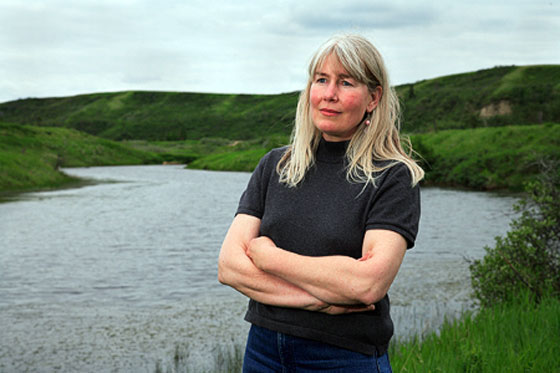
TO SPEAK IN WHITEHORSE – Jessica Ernst will discuss her experiences with fracking beginning at 7 p.m. Saturday at the CYO Hall in the basement of the Sacred Heart Cathedral. Photo courtesy JESSICA ERNST
Photo by Photo submitted
TO SPEAK IN WHITEHORSE – Jessica Ernst will discuss her experiences with fracking beginning at 7 p.m. Saturday at the CYO Hall in the basement of the Sacred Heart Cathedral. Photo courtesy JESSICA ERNST
Jessica Ernst is convinced there's nothing good about hydraulic fracturing.
Jessica Ernst is convinced there's nothing good about hydraulic fracturing.
It's bad, she insisted in an interview this week from her home in Alberta, where's she's been unable to use her water well for the last six years.
With 30 years' experience as a consultant in the oil patch, Ernst says hydraulic fracturing is bad for the environment, and it's bad for people who live near gas wells where fracking has occurred.
A recently published analysis of fracking commissioned by the European Union says somewhere between 25 and 100 per cent of the water and chemicals pumped underground at high pressure to fracture formations is not recovered, she says.
Ernst has been recognized by an organization accredited by the United Nations for her stand against one of the largest oil and gas companies in North America which she blames for contaminating her well.
In a 73-page lawsuit filed last year against the EnCana Corp. and the province of Alberta, the 54-year-old activist claims hydraulic fracturing by the company around her community of Rosebud ruined the groundwater table and her well.
At one point, says the lawsuit, excess methane gas caused by hydraulic fracturing was whistling out of her taps, creating "a serious risk of explosion.”
Her water became unusable for washing and bathing, she claims.
The oil and gas industry, says Ernst, maintains fracking is safe, and challenges anyone to bring forward evidence to prove otherwise.
Ernst says there's not much negative proof on the record because the industry settles its disputes outside the courtroom, and attaches gag orders as part of the settlement conditions.
The Yukon, she says, still has the ability to prohibit hydraulic fracturing, at least until much more is known about its implications on the health of the environment and people.
"I really do not believe scientifically it can be done safely, because you are shattering the underground formation and nobody can go down there and study it, and nobody can go down there and fix it,” she says.
Ernst says she remembers the words of her grandfather. One day, he told her there are times to stand back, watch and learn from the mistakes of others so you don't make the same mistakes yourself.
The Yukon, she says, is in the position to stand back before it makes the same errors Alberta and others have made by allowing hydraulic fracturing to occur.
She'll be in Whitehorse this weekend to talk about fracking and her experiences. The presentation will begin at 7 p.m. Saturday at the CYO Hall in the basement of the Sacred Heart Cathedral.
Northern Cross Ltd. has filed a project proposal with the Yukon Environmental and Socio-economic Assessment Board to drill two more exploration holes near Eagle Plains this winter.
The company has indicated it does not intend to use hydraulic fracturing, but can't say for sure until it begins drilling and learns more about the underground formations.
It has also indicated to the assessment board that it has been assured by the Yukon government that should Northern Cross decide sometime down the road to use fracking, a separate environmental assessment would not be required.
Three First Nations have indicated in their submissions to the assessment board that if there's even a remote chance Northern Cross will use hydraulic fracturing, the company should have to demonstrate it can be done with no negative impacts to the environment.
Northern Cross received permits in 2007 and 2008 for its first four exploration wells, though work did not start until this summer. It began drilling its first hole in August.
A Chinese company purchased the controlling interest in Northern Cross last year for $20 million.
The company indicated most of the money would be used to fulfill spending commitments made to secure the oil and gas leases.
Hydraulic fracturing involves the use of water mixed with chemicals pumped at high pressure into underground formations to fracture the formations and allow greater volumes of methane to escape.
The lawsuit filed in Alberta's highest court reads: "Prior to the arrival of CBM (coal bed methane) development in the Rosebud area, Ms. Ernst's water well ... produced large quantities of very clear, high-quality water.”
Well water tests on record prior to the arrival of drilling in the area, tests conducted as part of routine monitoring or for real estate purposes, showed the water was free of contaminants, the suit says.
It points out EnCana began drilling in the area back in 2001.
By the end of 2005, Ernst was forced to abandon her well, according to the lawsuit.
"Tap water resting in a bowl or cup would catch fire if an open flame was brought close to the water,” reads the lawsuit.
"If water was placed in a plastic pop bottle and capped for a minute or less, the gas coming off the water would explode in a flame a foot high if a lit match or lighter was placed near the mouth of the bottle.”
"... Ms. Ernst experienced eye irritations from merely being in the house,” says the lawsuit.
Ernst says her lawyers have told her to be prepared for a long haul, as there will surely be attempts to drag out the matter for as long as possible.
She's says she's already been labelled by industry and others who make a living from oil and gas as that crazy lady with nothing better to do.
For Ernst, shedding light on hydraulic fracturing and what it does to the environment has pretty much become her life's work already.
"I am putting all my time into the case,” she says. "I am working 18 hours a day, seven days a week, and I have been for the last six years.
"I am using up all my savings on the case, and I actually recognize I have given up the rest of my life for this.”
Ernst points out as she continues her fight, the practice of hydraulic fracturing and its impact is drawing more and more attention from governments in Canada, United States and around the world.
Ottawa announced last year it would be appointing a task force to examine hydraulic fracturing to determine if it was harming the environment, though the work has not yet begun in earnest.
The suggestion by industry that hydraulic fracturing has been in common use for 50 years, as Northern Cross points out in its application, is a red herring, she argues.
Never, Ernst says, has hydraulic fracturing been used with such "brute force to blast open” formations as it has been in the last decade.
By Chuck Tobin
Star Reporter
In order to encourage thoughtful and responsible discussion, website comments will not be visible until a moderator approves them. Please add comments judiciously and refrain from maligning any individual or institution. Read about our user comment and privacy policies.
Your name and email address are required before your comment is posted. Otherwise, your comment will not be posted.
Comments (10)
Up 0 Down 0
Not Jessica Ernst on Sep 30, 2012 at 8:11 am
@Frackin' eh! "The lady is right but can you stop big oil and the cry for more cheap energy?”
I think that "cry for more cheap energy” will become quieter as the toxics the companies continue to throw at us, while the government and regulators continue to let them, take their toll.
http://www.cbc.ca/news/canada/calgary/story/2012/09/27/calgary-fracking-meeting.html?cmp=rss
http://www.frackingcanada.ca/community-voice-the-campbells/
@Frank, I don't believe this is a "cause”, Ms. Ernst has publicly stated if this was just her well, she probably wouldn't bother, but the scale of the fracking and the irreversible impacts are taking on epic proportions, and they're just getting started. As none of us are immune to these impacts (except for the growing number of communities slamming the door on it), I'm grateful she and others are sharing this information, and I find it very telling and pathetic when I talk to an industry rep or the regulator, and they either decline to answer my questions or scurry away like our new found Alberta rats.
I hope people are paying attention, the companies aren't just looking to punch in a few wells here and there, and they would probably rather we didn't see the whole picture, but I think ‘spatial intensity' is a term everyone better become familiar with - or learn about the hard way.
http://www.youtube.com/watch?v=2Ml9r-0qY8s&feature=channel&list=UL
Up 0 Down 0
Frank on Sep 29, 2012 at 12:12 pm
I heard Jessica's talk.
She has a tough battle and I worry about her health.
Did she have some loss before this cause? Or, did she take up the cause because of what happened to her groudwater. I hope it goes well or her- it seems like a very difficult thing to deal with.
Up 0 Down 0
Frackin eh! on Sep 28, 2012 at 12:25 pm
The late great Peter Lougheed said that Alberta's greatest resource was it's water and not the oil and gas. He said the water should be protected. This advice is largely ignored and look at Alberta's water now.
Acid and propane gas are also used in fracking. Rarely would you have a 50% return of what you pumped down.
The lady is right but can you stop big oil and the cry for more cheap energy?
Up 0 Down 0
Not Jessica Ernst on Sep 28, 2012 at 3:12 am
@Larry Wellspring and north_of_60,
Ms. Ernst shares the science;
http://www.ernstversusencana.ca/jessica-ernst-whitehorse-yukon
Fracking contamination and science;
http://www.ernstversusencana.ca/diesel-in-water-near-fracking-confirms-epa-tests-wyoming-disputes
We are involuntarily becoming the science;
http://pennsylvaniaallianceforcleanwaterandair.wordpress.com/the-list/
Up 0 Down 0
Not Jessica Ernst on Sep 27, 2012 at 6:03 pm
north_of_60 says "Problems are rare with new wells.”
In Quebec, 19 out of 31 new wells drilled between 2006 - 2010 are already leaking. That can't be good.
"The migrated gas posed two risks: contamination of nearby aquifers, or the possibility of explosions. An explosion could only occur if the gas collected in a closed area, if there were methane concentrations of five to 15 per cent, and if there was a source of ignition, such as a spark, the document says. Last month, the ministry told the BAPE that leaks had been discovered at 19 wells. It played down the risk of the leaks, saying it was normal for natural gas to escape during drilling, and that the wells were isolated and far from residences."
http://blogs.montrealgazette.com/2011/01/18/inspectors-found-leaks-at-shale-wells-government-report-says/
Good thing the wells were "isolated and far from residences", what happens if they're not?
"The McKean County homes were located about two and half miles from each other in neighborhoods bordering Hedgehog Lane, where oil and gas drilling activities had caused methane gas infiltration into drinking water wells, leading to taste and smell impacts. Schreiner Oil, the company involved, was ordered by the PA DEP to restore the water and has been providing bottled water to the impacted neighborhood.
The explosion of the two houses in close proximity to this troubled area certainly appears to be more than coincidence, yet the phenomenon is poorly understood and there is currently no way of preventing or even predicting when such incidents may occur."
http://www.casey.senate.gov/newsroom/press/release/?id=c7091fea-fc47-42bc-90ea-d35e886e53df
Now that's a bit of a worry. So what would a leading expert on fingerprinting industry's stray gas have to say about the fracking?
"‘The shale gas boom combined with hydraulic fracking will cause wellbores to leak more often than run-of-the-mill conventional wells,' says Karlis Muehlenbachs, a geochemist at the University of Alberta. ‘The problem is going to get worse, not better.'
Muehlenbachs, a leading authority on identifying the unique carbon fingerprint or isotopes of shale and conventional gases, says regulators must do better baseline groundwater testing and rigorously check wells for leakage.
‘The biggest problem is that half or more the wells drilled leak due to improper cement jobs or industry is not following best practices,' adds Muehlenbachs.
… Muehlenbachs, who has been fingerprinting leaking gases since 1994, says that hydraulic fracking, which injects water, chemicals and sand into rock formations at high pressures, may create more leaks in wellbores over time. (As industry searches for deeper and more extreme hydrocarbons, it must blast open tight rocks with more brute force over larger land bases than conventional operations.)
‘They'll frack each well up to 20 times. Each time the pressure will shudder and bang the pipes in the wellbore. The cement is hard and the steel is soft. If you do it all the time you are going to break bonds and cause leaks. It's a real major issue.‘
According to Schlumberger, the world's largest oilfield company, there are problems galore. In 2003, the company reported that 43 per cent of 6,692 offshore wells tested in the Gulf of Mexico by U.S. regulators were found to be leaking. In fact, by the time a well gets 15 years old, there is a 50 probability it will leak significantly and therefore contaminate other zones, wells, or groundwater.
‘That's amazing. It's not Greenpeace reporting this but Schlumberger in the Oilfield Review,' says Muehlenbachs.
Although petroleum engineers now admit that companies routinely blast fluids and gas into other industry wells hundreds of metres away (B.C., Texas and North Dakota have all documented such cases), they still claim that ‘fracture communication incidents' can't happen with groundwater.
Muehlenbachs, who has documented numerous cases of groundwater contamination, calls such denials dishonest. ‘Such claims do more harm than good to industry. Don't they realize that social license matters to industry?'
Whenever methane leaks from one well into a neighboring well site, ‘industry says let's fix the leaks,' says Muehlenbachs. ‘But as soon as the leaks enter groundwater, everyone abandons the same logic and technology and says it can't happen and the denials come out. In Alberta, it's almost a religious belief that gas leaks can't contaminate groundwater.'”
http://thetyee.ca/News/2011/12/19/Fracking-Contamination/
Up 0 Down 0
Stan Rogers on Sep 27, 2012 at 10:21 am
I cannot understand how companies can hide behind propriety to not disclose what chemicals they use in fracking.
Similarly it seems equally odd that regulatory agencies have not forced disclosure for many reasons.
Up 0 Down 0
north_of_60 on Sep 26, 2012 at 1:59 pm
Yes, hydraulic fracturing can be problematic with old wells that have deteriorated casing.
Hydraulic fracturing is a common procedure when completing new wells for production. Problems are rare with new wells.
Those who fail to understand the significant differences and who seek to dump all ‘fracking' in one ‘big basket', are merely demonstrating ignorance.
At least the mindless anti-fracking frenzy keeps them entertained and out of trouble. Don't try to confuse them with science, they know how they feel, and nothing else is important.
Up 0 Down 0
Larry Wellspring on Sep 24, 2012 at 1:53 am
Obviously, this won't be a fair and balanced meeting. Jessica has no science to back what she is saying.
Up 0 Down 0
Darlene Raketti on Sep 22, 2012 at 11:36 am
WATER WARS IN FUTURE---Those big oil companies scare me. With billions of dollars at stake you can bet they'll do anything to get what they want and by any underhanded means. If we don't stop them now where will we get good water? Do we wait for the rains or what? Won't they be surprised when water is not universally safe for their grandchildren? [I am thinking generation after generation like the royal family] Perhaps they already know but just look out for themselves. By the way, its a fact that no one holds on to riches forever. It is possible that their great grand children will curse them for this folly because their own children will be in jeopardy.
Up 0 Down 0
Majella McCarron on Sep 22, 2012 at 6:49 am
Jessica, thank you for taking a stand. It takes courage to stand up to Big Business and Big Oil. Your last trip to Ireland was a great success - very educational. Hoping to see you back here soon carrying on your good work. Majella