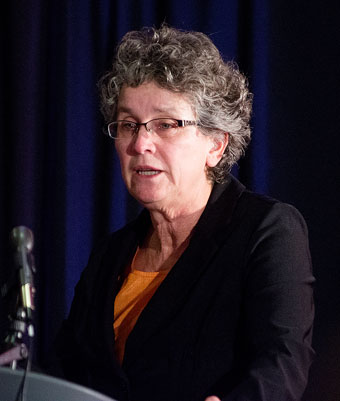
Photo by Whitehorse Star
Liz Hanson
Photo by Whitehorse Star
Liz Hanson
The Yukon legislature has urged Ottawa to recognize Fetal Alcohol Spectrum Disorder (FASD) in the Criminal Code, but backed away from incorporating the organic brain disability into territorial legislation.
The Yukon legislature has urged Ottawa to recognize Fetal Alcohol Spectrum Disorder (FASD) in the Criminal Code, but backed away from incorporating the organic brain disability into territorial legislation.
MLAs passed a motion Wednesday in support of a private member's bill — tabled in Parliament by Yukon MP Ryan Leef earlier this year — that would define FASD in the code and reform diagnostic and sentencing rules for the courts.
While nominally supportive of the proposed federal amendment, the legislature opted not to pass a section of the motion immediately relevant to Yukoners.
A majority of MLAs balked at "introducing to this House amendments to Yukon's Corrections Act in order to better meet the needs of individuals with FASD, and to accommodate FASD as a disability in Yukon's corrections system.”
That plank of the motion sought to elicit a commitment by the government to examine and change how offenders with FASD are treated in the courts and at the Whitehorse Correctional Centre.
Liz Hanson, the leader of the NDP official Opposition, expressed disappointment at the truncated motion.
"This is very begrudging support on the part of this government. I don't think that they have any commitment to support this issue,” she said in an interview today.
"We are being challenged to apply the same principles of justice and fairness to the laws and policies over which the Yukon Legislative Assembly has control, as we ask the federal government to apply laws and policies within its own jurisdiction,” she told the house Wednesday.
"We have to walk the walk.”
At the federal level, Leef's proposed Bill C-583 seeks to add to the code a definition of FASD, establish a procedure for assessing offenders and require the courts to consider the disability as a mitigating factor in sentencing.
The term FASD refers to a range of neurological impairments that can affect a person exposed to alcohol in the womb.
Hanson cited recent remarks by Rod Snow, a local lawyer and past president of the Canadian Bar Association.
"He said that if a judge decides to treat Fetal Alcohol Spectrum Disorder as a mitigating factor because she understands that the offender's disability is responsible for their behaviour, will our corrections system accommodate that person's disability when they arrive in jail, or will Corrections expect the offender to meet standards of behaviour that their disability prevents them from meeting?
"Our judges and our jailers must be guided by one consistent set of principles applied both outside and inside our jails,” Hanson said.
"It is neither ethical nor just for the law to punish individuals for failure to meet a standard of behaviour that their disability prevents them from meeting.
"Yet that is what the law and our justice system institutions do when they fail to accommodate Fetal Alcohol Spectrum Disorder.
"In this way, our society criminalizes individuals with Fetal Alcohol Spectrum Disorder because of their disability.”
The government said it was worried about difficulties assessing people with FASD in the territory, the ambiguity of the term itself and, crucially, funding.
"We are supportive in principle of Bill C-583,” Justice Minister Mike Nixon said in the legislature. "However, we have concerns with some of the provisions of the bill in its current form.
"The inclusion of a provision that would allow courts to order assessments ... is not a simple fix,” he said.
"The real fact is that most jurisdictions in the country do not have the capacity to deliver adult diagnostic services.
"The inclusion of such a provision must, of course, be accompanied by a commitment from the federal government to provide the necessary funding that would allow the provinces and territories to develop and deliver such services on a consistent and timely basis.”
Doug Graham, the minister of Health and Social Services, revealed an apparent contradiction — perhaps unwittingly — in Nixon's justification for excluding FASD-related amendments to the Corrections Act.
"When the member for Mount Lorne-Southern Lakes (NDP MLA Kevin Barr) talked about the difficulty of diagnostics for adults in the territory, it's simply not accurate.
"We've had that contract for a number of years. We've provided that service ... it has been available for a number of years.”
Nixon also touched on a Justice department study to determine the number of inmates at the Whitehorse Correctional Centre who suffer from FASD, an effort the Opposition acknowledged.
He also noted the government's five-step plan, announced in 2002, to address FASD.
The plan includes prevention, early diagnosis, family support, supportive housing and a "diagnostic team of professionals” to work in schools with students who have FASD.
Along with the NDP, Liberal MLA Sandy Silver did not vote for the NDP-tabled motion supporting Bill C-583 after the government amended it to exclude the section calling for changes to territorial legislation.
"I will absolutely not be supporting the amendment,” Silver said. "I want to give credit to our MP Ryan Leef for bucking the trend to begin with.”
Hanson told the Star the amending move was "such a petty thing,” and successful only if "you want to shoot the poor old private member in the foot.
"I just want to say that I've rarely been as disappointed as I have been this afternoon at a missed opportunity,” she said in the house Wednesday.
The NDP's Justice critic, Lois Moorcroft, pointed to the case of a woman with mental illness who reached a landmark settlement with Correctional Services Ontario "because it discriminated against her by failing to accommodate her mental health-related needs.”
The Opposition added, however, that FASD should be recognized as a lifelong disability distinguishable from mental illness, which may change with treatment.
In the Yukon, nearly 30 per cent per cent of court cases from April 1, 2010 to March 31, 2011, involved a bail breach or similar "administration of justice violation” as the most serious offence.
"As we have heard, a leading characteristic of people with Fetal Alcohol Spectrum Disorder is an inability to organize their lives, meet deadlines, keep appointments, learn from experience and understand the consequences of the failure to do any of these things,” Hanson said.
"These administration of justice breaches in effect criminalize those with Fetal Alcohol Spectrum Disorder by setting the person up for further charges — the revolving door.”
While there are few confirmed statistics on people with FASD in Canada, estimates peg the proportion of people with the disability at more than nine per 1,000 births, Hanson said.
Up to 200,000 cases of FASD remain undiagnosed, she added.
"It has been suggested that Fetal Alcohol Spectrum Disorder may be the most common birth defect in Canada, affecting ... about one per cent of the population.
Sadly, we do know that they are over-represented in the criminal justice system,” Hanson said.
The annual cost of FASD in Canada has been estimated at approximately $7.6 billion, she noted.
Hanson also acknowledged the Fetal Alcohol Syndrome Society Yukon, "who have doggedly brought about greater awareness and an appreciation of the scope of the work still to be done.”
In order to encourage thoughtful and responsible discussion, website comments will not be visible until a moderator approves them. Please add comments judiciously and refrain from maligning any individual or institution. Read about our user comment and privacy policies.
Your name and email address are required before your comment is posted. Otherwise, your comment will not be posted.
Comments (4)
Up 4 Down 6
FCO on May 5, 2014 at 4:37 am
So many will benefit from this Bill being passed in what I hope in a positive way. Too bad this had to come so late especially for those who are now stuck in the Correctional System, harmed others and taken lives. I am certainly hopeful that this assist the court in sentencing the FASD population. What about victims though, helping FASD victims, is there anything that helps/assist the victims?
Up 12 Down 5
mugsy yukon on May 3, 2014 at 4:48 am
When will the mothers of these FASD folks take responsibility for THEIR actions, she consumed the alcohol while pregnant, plain and simple, one action causes another, we know that, when will people learn that. Support the expectant mother without alcoholso there will be another way for people to get away with their bad choices, hide behind the term FASD, its wrong.
Up 9 Down 5
Josey Wales on May 2, 2014 at 10:00 pm
Awesome....yet another sect of our society that will soon have a 24/7 get no where near jail card.
Do any "birth givers" I cannot call them parents ...ever, get any child abuse charges brought forward?
Rhetorical yes, as a great heap of folks whom suffer from FASD are brought to us by the Gladue crews...which the laws that govern this place?
Clearly do not apply.
Up 16 Down 4
Concerned Yukoner on May 1, 2014 at 9:05 am
I am hoping that the general public understand that there are a large variation in degrees of FASD along with all the other disabilities. Christopher Cornell may have had a degree of FASD, but he is on the mild spectrum. Some people with FASD have huge disabilities in which they can barely speak and do not understand most every day items. Others know what they are doing, but suddenly use this as an excuse. It is absolutely wrong to blanket everyone with the same label. So many can use this as an excuse for wrong doing so they can say they are not responsible.