Hospitals' costs justified: corporation boss
The price tag for delivering health care in Watson Lake could double, and in Dawson City it could more than triple after the Yukon Hospital Corp. completes new hospitals in the far-flung communities.
By Jason Unrau on January 12, 2010
The price tag for delivering health care in Watson Lake could double, and in Dawson City it could more than triple after the Yukon Hospital Corp. completes new hospitals in the far-flung communities.
These projections are courtesy of Craig Tuton, the corporation chair, who estimated annual operating budgets at the new facilities will likely be in the $4-million to $4.5-million range.
Last year, it cost $2.2 million to run Watson Lake's cottage hospital, while Dawson's health centre's operation and maintenance bill was $1.3 million.
But Tuton justified the projects, and increased costs associated with them, as necessary to provide the level of health care "Yukoners have come to expect” and forging ahead with the $50 million worth of new hospitals will meet that demand.
As for affording the greater anticipated expense, Tuton said that's a question for the future.
"I think the question we need to ask is, ‘can we afford not to do it?'” Tuton said of the hospital projects.
"There may be a time when health care would not be sustainable, but we're not there yet ... I think we would be wrong to connect our spending with that approach.”
But his words come at a time when the government is examining its health care expenditures and ways to make them more manageable.
Following the release of a 2008 health care review, which predicted the territory's then-$201.5 million annual health budget could double by 2018 if nothing were done to rein in costs, Dave Hrycan, deputy finance minister, called that growth unsustainable.
On the heels of the 2008 health review, Premier Dennis Fentie, who also serves as Finance minister, said the exercise was "to ensure sustainability for the long term” and "to conclude our case to the federal government for the continuance or renewal of (health) access funding.”
But when federal Finance Minister Jim Flaherty arrived in Whitehorse before Christmas to meet with his provincial and territorial counterparts, the country's top moneyman was lukewarm to renewing the five-year, $30-million health access deal – set to expire in March – with the Yukon government.
Today, Fentie defended the new hospitals and their future impact on the territory's health budget.
"The health review's report demonstrates the gap we'll experience 10 years out, and the steps we're taking today will begin addressing that gap,” he told the Star early this afternoon.
"If we don't (build hospitals) in Watson Lake and Dawson City, we'll have to address (health care issues there) at Whitehorse General Hospital, or outside the Yukon with the cost of travel.”
When Fentie was elected premier in 2002, delivering health care in the territory cost the government $131 million per year. Less than a decade later, that figure has ballooned 74 per cent, with last year's health care expenditure approaching $230 million.
In addition to the new hospitals in Watson Lake and Dawson City, construction on a $17-million nurses' residence near Whitehorse General Hospital has commenced.
All projects have drawn criticism from opposition parties for being offloaded to the hospital corporation, which has gone to the Canadian Imperial Bank of Commerce to seek financing for the total $67-million construction bill.
Among the shortcomings, both the Liberals and NDP insist, is that the public will be saddled with a long-term debt so the ruling Yukon Party government can keep the expenses off its 2010 and 2011 annual budgets.
"The problem is this: the public and future generations will still have to pay whether it's on the government's books or on the Crown corporation's,” charged Steve Cardiff, the NDP house leader, during a question period during last year's fall sitting.
In July 2009, the government announced it was shifting the management of Watson Lake's cottage hospital and the new Dawson City hospital.
The opposition has also expressed concerns that the hospital corporation is keeping Yukoners in the dark about the financing deal struck with the CIBC, particularly interest rates and their accrual over time that would ultimately push the final bill well beyond $67 million.
Yesterday, Tuton appeared to make an about-face by revealing details of the arrangement between the hospital corporation and the bank.
To date, the corporation has leveraged a $17-million construction loan from the CIBC at the prime interest rate (today at 2.25 per cent) and will eventually negotiate a mortgage to carry the debt.
"We will be required to disclose the interest rates in our financial statements, but we won't know what they are until we enter into that (mortgage) negotiation,” Tuton told the Star. "Whenever we feel the rates are at the best spot, we can jump in there.”
The CIBC is also set to loan $50 million to the corporation for the hospitals in Watson Lake and Dawson City, said Tuton, and the parties have yet to sign on the dotted line. However, Tuton expects that to be similar to its financing deal to construct the new nurses' residence.
Currently, Whitehorse General Hospital's annual operating budget exceeds $35 million.
Running staff accommodations is separate from the hospital budget, said Tuton, but leasing space in the new 34-residence facility to the Health department will defray some of that expense.
"The new residence will have its own set of operational costs but we'll offset with provision of space for the department ... to cover a good portion of that,” Tuton said.
The residence is scheduled to be finished by the end of 2010, and both hospitals are expected to come on line in two years, though construction has yet to commence on either project.
According to Alan Davidson, associate professor at the University of British Columbia and an expert in government health spending and sustainability, the practice of moving large expenditures onto the backs of Crown corporations is common with more conservative governments.
"And ironically, also with the ‘new' Labour government in the United Kingdom is where this really took off,” Davidson said of the British government's struggle to modernize its National Health Service during the 1990s that saw large hospital projects moved off its books.
"The advantage to government is it does lower cost of borrowing because you don't have to borrow funds against the public accounts, so that's attractive,” Davidson explained.
"But it doesn't take a mathematical wizard to figure servicing debt over years is going to cost more in the longer term.”
The fiscally-conservative Liberal government of B.C. Premier Gordon Campbell is also moving in this direction, Davidson noted, citing the new Abbotsford Hospital and Cancer Centre, which opened in the summer of 2008, as "built as a public financeinitiative.
"And if you work to two or three year electoral cycles, it's expedient to create things with really long tails because people have short memories,” added Davidson.
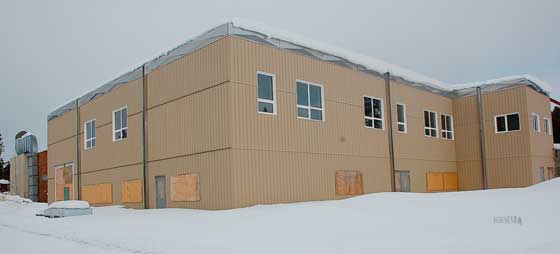
Watson Lake's hospital has already received much negative attention following a botched $4.4-million conversion job that resulted in a mould-infested, empty shell, eventually boarded up in the fall of 2008.
An architect's assessment of the building released last July determined the existing structure is capable of accommodating a new hospital, albeit with a significant amount of work.
Be the first to comment