Photo by Vince Fedoroff
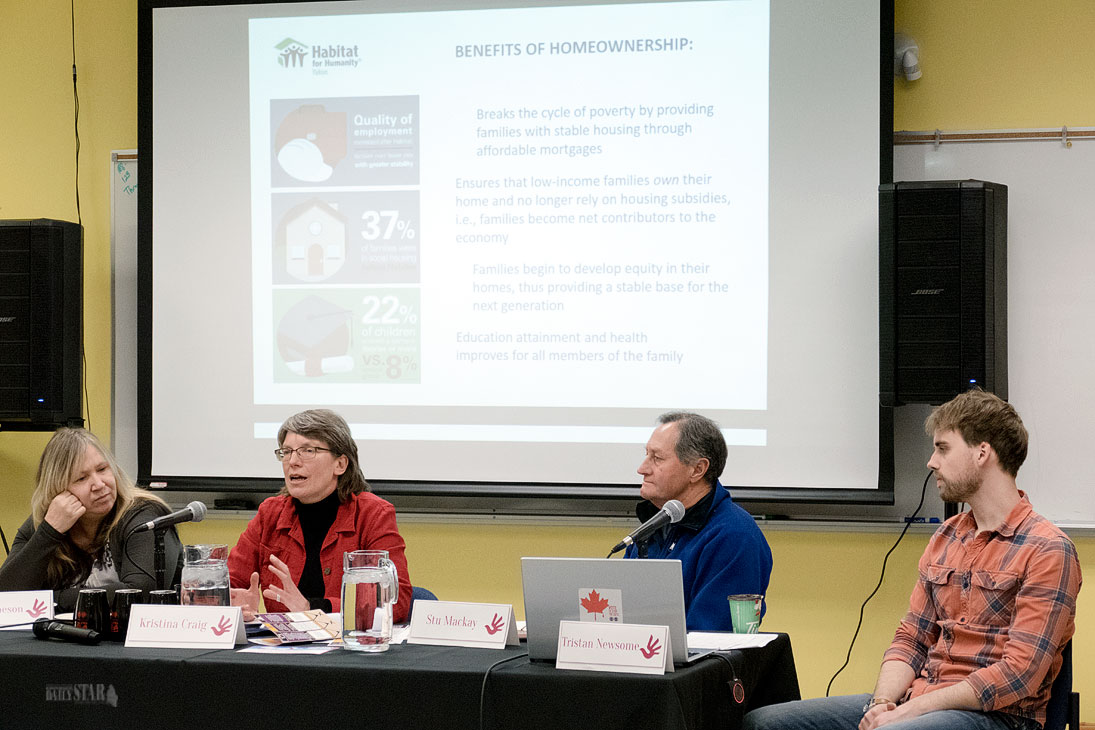
CYCLE CAN BE BROKEN – Colette Acheson, Kristina Craig, Stu Mackay and Tristan Newsome, left to right, comprised the panel at Wednesday’s discussion on poverty and incomes.
Photo by Vince Fedoroff
CYCLE CAN BE BROKEN – Colette Acheson, Kristina Craig, Stu Mackay and Tristan Newsome, left to right, comprised the panel at Wednesday’s discussion on poverty and incomes.
“So many working poor, they just don’t know how to handle money.”
“So many working poor, they just don’t know how to handle money.”
This notion, reiterated Wednesday after a panel discussion on the realities of living on a low income in Whitehorse, is not new.
But it is misguided, said Kristina Craig, co-ordinator at the Yukon Anti-Poverty Coalition.
Craig was one of four panelists at yesterday’s instalment of the fourth annual Human Rights Speaker Series, hosted by the Yukon Employees’ Union (YEU).
“We have to be very careful about assumptions around people and what they spend their money on and how they make decisions,” she said to the small crowd.
It’s important to remember, said Craig, that all humans have rights – to clothing, food, shelter, safety and security of the person – and nothing we do precludes us from those rights.
“There aren’t deserving poor and undeserving poor,” she said.
Stu Mackay, executive director of Habitat for Humanity in the Yukon, said the families who come through his organization work hard and stick to a budget, but external forces make simply getting by a daily struggle.
“The families that we have, they’re excellent money managers. They knew where every single penny was going because they’re so tight to the line every month,” he said.
“The trouble is, they couldn’t control it because they didn’t know when the rent was going to change, when the (price of) food was going to go up, when there’d be a family emergency, where the car was going to break down, all those things.”
For most people working in Whitehorse’s service sector, said Mackay, this is day-to-day life.
Colette Acheson, executive director of the Yukon Association of Community Living, a support service for people with disabilities, Tristan Newsome, executive director of the Whitehorse Food Bank, Craig and Mackay all shared knowledge gained through years of working with Yukoners going through hard times.
Their message: a significant portion of the Yukon population is in need of adequate housing, gainful employment and/or nutritious food.
With willing citizens, governments and non-profits working together however, the cycle of poverty can be broken.
Mackay spoke about Habitat for Humanity, which sells homes to working families at no profit, and with no interest, down payment or mortgages.
Instead of a down payment, the future homeowners put in 500 hours of work with the organization – “sweat equity,” he called it.
Habitat serves families in a variety of unfavorable situations, said Mackay: those who live in unsafe or costly rentals, in rent-geared-to-income housing with no path to homeownership, and those who can’t secure a conventional mortgage or bank loan.
Since the organization began in the U.S. state of Georgia in the 1970s, more than 600,000 homes have been renovated or improved internationally. More than 2,800 homes have been built in Canada since 1985.
Right now, said Mackay, Habitat is working on its 17th and 18th homes in the Yukon.
Mackay referenced a Habitat study of families from the same “social-economic origin” who live in Habitat homes, compared to families who do not.
Over time, he said, families in Habitat homes achieved better employment and stabilized their finances.
“But the big one for me,” said Mackay, “22 per cent of the children that were in Habitat homes went on to post-secondary education.” Only eight per cent of kids in the control group did the same, he said.
“Home ownership is how we break the cycle. Not necessarily immediately, but certainly for the next generation.”
Earning a “living wage” is another element in avoiding the constant stress associated with making it to the next paycheque, said Craig.
Earlier this year, the anti-poverty coalition published a calculation of the living wage in Whitehorse. Each adult in a family of four with two young children would need to earn $19.12 an hour to do more than just survive, said Craig.
By contrast, the Yukon’s minimum wage is $11.07.
The living wage accounts for income, benefits and expenses such as clothes, child care and transportation. It doesn’t include saving for the future, paying off student debts, or owning a new car, said Craig.
“It’s the basics.”
Craig noted that the new Canada child benefit – the monthly cheque sent to all eligible families with children under 18 – made a real difference to the cost of living for families in the Yukon.
“Before (the Canada child benefit) was put into our calculation, the living wage in Whitehorse would have been $20.25, with a family of four,” said Craig. “When you inserted this new benefit from the feds, it went down more than a dollar.”
This goes to show that good government policies that support low-income earners, “can be huge in ensuring that people can thrive here,” she said.
Acheson spoke about the ways in which people with intellectual disabilities, such as Fetal Alcohol Spectrum Disorder (FASD) and people on the autism spectrum, are discouraged from being active members to society.
“They’re destined to a lifetime of under-expectation in our school systems... and then in the adult world they’re sometimes destined to a lifetime on social assistance with no expectation that they’re going to be creators and contributors in a workplace,” she said.
Their quality of life could be improved, said Acheson, if the system encouraged them to work to their full capacity.
Newsome offered some startling statistics about food bank usage in Whitehorse.
Since its doors opened in 2009, the local food bank has served about 6,500 people. The average client uses the food bank four to six times a year.
“When you consider the population of Whitehorse (about 29,200)... that’s a pretty big portion of us that have used and accessed our services at some point,” said Newsome.
All told, people have accessed the food bank nearly 100,000 times over the last seven years, he said.
The food bank is an “emergency food service,” said Newsome, and it will provide three to four days’ worth of food to families of any size who are in need.
Wyke’s Independent Grocer and the Real Canadian Superstore assist the organization in offering non-perishable items, as well as frozen meat, chicken, eggs, milk, fruit, tea, sugar and flour for baking, and other essentials, such as toilet paper and garbage bags, to its clients.
Right now, a person or family can access the food bank once per month, said Newsome.
“Unfortunately, that’s all we’re able to afford, and we usually end up distributing to almost 1,500 people a month.”
The numbers go up in the summertime, said Newsome, when families have to provide lunches for kids who would otherwise have been fed in school.
Donations, which spike in December when people are in a giving mood, must be stretched to meet demand during the rest of the year, he said.
“That’s always been a struggle for us, trying to figure out how to sustain ourself into those troublesome months.”
Thanks to help from Yukoners and the federal government, however, the food bank has been able to start up a community vegetable garden next to its building on Alexander Street, said Newsome.
“The purpose of the project is community development. We would never be able to grow as much food as we need to, to distribute,” he said.
It’s Newsome’s hope that the garden will get people thinking about local produce and agriculture, and food security in the North.
YEU president Steve Geick said the goal of these noon-hour talks about human rights, which run through Friday, is to spread awareness in the lead-up to Dec. 10, which the United Nations has declared Human Rights Day.
And with the holiday season upon us, he agreed, now is a good time to think about giving back.
In order to encourage thoughtful and responsible discussion, website comments will not be visible until a moderator approves them. Please add comments judiciously and refrain from maligning any individual or institution. Read about our user comment and privacy policies.
Your name and email address are required before your comment is posted. Otherwise, your comment will not be posted.
Comments (6)
Up 4 Down 3
Yukon56 on Dec 14, 2016 at 4:41 pm
If you can't afford to live here, MOVE - welfare is lifestyle.
Up 15 Down 3
Francis Pillman on Dec 12, 2016 at 3:00 pm
More studies. It's keeps those pledging to solve the problem employed. If you don't have a government job or a house hand me down then owning a house here is a pipe dream for most. The prices of a home today remind me of a pond scam.
Up 25 Down 2
Groucho d'North on Dec 12, 2016 at 11:48 am
Yeah, and the government should do something about the price of tattoos while they're at it. It's getting harder and harder to stretch a budget each month.
Up 45 Down 4
My 2 Cents on Dec 10, 2016 at 6:00 pm
@Resident. With only a high school education from Yukon, I have managed to buy my own house in Whitehorse and by making some smart choices and working hard am living quite comfortably. The people I grew up with around the Yukon that are now having housing troubles made some choices in life such as spending $20 a day on cigarettes, and the $100 per Friday obligatory night out, guess what that's $800 per month gone right there. Also anytime their job got hard or they got tired of working they walked out because they were going to show their boss a thing or two, now guess who's hurting in the end?
I know you can make it in this territory if you'll actually work and stick with it because I did it without any higher education. You just have to make up your mind that your future lies in your own hands and start by being reliable and dependable at your job, stay away from drugs, and don't walk off the job every time something doesn't go your way. If you do that before you know it you'll have a good working name and in my experience people will be knocking on your door offering you good paying jobs. Employers in this territory are desperate for people they can rely on and promote to more responsible positions that come with higher pay, unfortunately finding those reliable people is a problem.
Up 20 Down 11
wundering on Dec 9, 2016 at 7:20 pm
"So many working poor, they just don’t know how to handle money.”
----------
The poor don't generally get a lot of practice handling money, because they don't have any.
Up 10 Down 23
resident on Dec 8, 2016 at 5:36 pm
"a significant portion of the Yukon population is in need of adequate housing, gainful employment and/or nutritious food"
I think that one would find that affordable (which could mean free/subsidized) and accessible education would address, in the long term, all the issues raised above.